A K-5 Curriculum for Students in the
Post-Carbon Era
Sarah Rios
Jaime Campos
Will education be important in the
post-carbon era?
What will need to be taught?
What skills need to be acquired?
We hope to provide one
alternative for educating students, after the fall of empire.
A special thanks to:
Guy McPherson for editing, giving advice, and
opening our eyes.
Carol Fugagli for opening her home to
us, editing, and being our parent perspective.
Hawk Fugagli for being the model
student in the post carbon era and letting us dive into
the
perspective of a child.
Doug for being the epitome of
post-carbon living education and allowing us to join his
class.
We must accept finite disappointment, but never lose infinite
hope.
-- Martin Luther King,
Jr.
TABLE OF CONTENTS: Page
Introduction 3
Bodily-Kinesthetic Intelligence 5
Interpersonal Intelligence 14
Intrapersonal Intelligence 19
Linguistic Intelligence 22
Mathematical/Logical Intelligence 64
Musical Intelligence 107
Naturalistic Intelligence 119
Spatial Intelligence 125
Glossaries 130
Linguistic 131
Mathematical/Logical 149
Musical 180
As the economy begins its downward spiral and as the
price of a gallon of gasoline continues to rollercoaster, the impending doom of
Yet, with such an inevitable ending to the story that
is the industrial era of this world, people do not or will not realize the
problems that lie ahead. Time and time again people publish books and articles
about the bubble that is about to burst. Time and time again there are signs
that the foundation of our current lives are crumbling. Our governments make
this seem like a simple scratch and try to cover it with a band-aid, but they
don’t realize that this crack is expanding and that a Grand Canyon-sized
problem is about to emerge. For those who do realize and are open to the idea
of a post-carbon future, there is hope. People around the world are building
small communities that will live off the land and do not rely on things we all
take advantage of, including flowing electricity, grocery stores, and water
coming out the tap. For this minority of people there maybe a future with a
silver lining, but it will not be a
For the future of our world there are several factors that will still be as important as they are now. Obviously the acquisition of food, water, and shelter will be necessary but so will the education of future generations. For them education will ensure a brighter tomorrow. Yet education will not be the kind that was made to simply make robots to continue the American dream. Instead it will be about educating the young to survive, to know the basic skills that will get them through tomorrow. For most people, there won’t be a need for calculus or organic chemistry, instead basic long division and simple science will suffice. Schooling will involve a movement away from technology and will include only the essentials.
Thus, what follows is a basic outline of the general topics and subtopics necessary for children in the post-carbon era. Though this is an extensive list based on current, edited scholarly standards[1] it by no means is an exhaustive list. Interpretation will be based on the knowledge of the parent or “teacher” of the child or children. Also, this is simply an outline to be followed for what is currently known as kindergarten, first, second, third, fourth, and fifth grades. Traditionally these grade levels included children that were 5-6, 6-7, 7-8, 8-9, 9-10, and 10-11 years old. Though this outline, or the technical term curriculum, only covers these ages and grade levels, it is by no means a solid boundary. Children can be taught plenty before and after. It is simply our belief that these ages hold the fundamental principles of a solid education because afterward a student will need to become a member of a hard-working society. It is our hope that before this post-carbon future happens we can include sample lessons to ease the education of the concepts covered in this curriculum. In addition, an underlying goal is to promote the spirit of inquiry. For now we wish you the best and hope that your future is bright.
Though we base our curriculum off previously established
standards, we organized this curriculum based on the ideas set forth by Howard
Gardner’s concept of multiple intelligences. Subject areas such as math,
reading, writing, music, physical education, and science had preexisting
standards that we adapted to fit the ideals of a post-carbon era. These
existing standards correlated well to
Howard Gardner’s
ideas of intelligences emerged from cognitive research
and "documents the extent to which students possess different kinds of
minds and therefore learn, remember, perform, and understand in different ways,"
according to Gardner[2]. According to this theory, "we are all
able to know the world through language, logical-mathematical analysis, spatial
representation, musical thinking, the use of the body to solve problems or to
make things, an understanding of other individuals, and an understanding of
ourselves. Where individuals differ is in the strength of these intelligences -
the so-called profile of intelligences -and in the ways in which such
intelligences are invoked and combined to carry out different tasks, solve
diverse problems, and progress in various domains."
For our purposes each learning style is mentioned in detail prior to
each section, but a short description of them follows:
·
Bodily-Kinesthetic
Intelligence deals with the physical experience
·
Interpersonal
Intelligence deals with the social experience
·
Intrapersonal
Intelligence deals with empathy and reflection of self
·
Linguistic Intelligence deals with the use of words and language
·
Mathematical/Logical
Intelligence deals with numbers and
logic
·
Musical Intelligence deals with music
·
Naturalist Intelligence which deals with an experience in the natural world
·
Spatial Intelligence which deals with the manipulation of objects in space
Bodily-Kinesthetic
Intelligence
"School is indeed a training for later life not because it teaches the 3 Rs (more or less), but because it instills the essential cultural nightmare fear of failure, envy of success, and absurdity."
- From Jules Henry's 1963 book, Culture Against Man
Howard Gardner felt that for some
there is a natural sense of what their bodies can do and how they can react in
physically demanding situations. In education, there are ways to work with
students who possess this intelligence by allowing for a manipulation of
objects or movements in class to demonstrate a piece of information. Most
commonly, physical education has aimed towards educating all students in
control of their bodies and manipulation of objects with their bodies. Not all
students have strengths in this area but a basic knowledge base is necessary
for healthy living. The following is an adaptation of standards for physical
education and we feel they still possess important skills necessary for the
post-carbon era.
KINDERGARTEN
Standard 1
Students demonstrate proficiency and the achievement of higher order
cognitive skills necessary to enhance motor skills.
Students know and are able to do the
following:
• Demonstrate
progress toward the mature form of selected manipulative, locomotor and
nonlocomotor skills.
1. demonstrate a variety of manipulative
skills (e.g., strike, throw, dribble, kick, roll, catch, trap, punt and volley)
2. demonstrate
locomotor skills (e.g., walk, run, hop, jump, skip, slide, gallop, and leap)
3. demonstrate a variety of nonlocomotor skills (e.g., bend, turn, twist, balance, stretch, push, pull, rock and sway)
•
Demonstrate mature form in walking and running.
1. same
as concept
• Identify fundamental movement patterns (e.g., skip, strike).
1. recognize movement patterns of
manipulative, locomotor, and nonlocomotor skills
• Identify a beginning movement vocabulary (e.g., personal space, high/low
levels, fast/slow speeds,
light/heavy
weights, balance, twist).
1. demonstrate an understanding of movement concepts in physical activity (space awareness, body awareness, qualities of movement, and relationships)
• Describe
appropriate concepts to performance (e.g., change direction while running).
1. perform movement
concepts in physical activity
·
space awareness: personal space,
direction, level, pathways, planes
·
body awareness: shapes, balance,
body weight transfer, flight
·
qualities of movement: time,
speed, force, flow
·
relationships: among body parts,
objects and people with people
Standard 2
Students comprehend basic physical activity principles and concepts that
enable them to make decisions, solve problems and to become self-directed
lifelong learners who are informed physical activity consumers.
Students know and are able to do the
following:
• Identify that
physical activity is necessary to build good physical fitness.
1. explain
that physical fitness is the ability to work and play with energy to spare
2. identify feelings that result from
participation in fitness activities
• Identify that there are different parts of physical
fitness.
1. explain that warm-up activity and
cool-down are essential parts of a fitness activity
• Identify
the different parts of physical fitness.
1. demonstrate aerobic, muscular
strength, muscular endurance and flexibility activities
Standard 3
Students exhibit a physically active lifestyle.
Students know and are able to do the
following:
• Engage in
moderate to vigorous physical activity.
1. participate
regularly in moderate to vigorous physical activity
2. participate
in gross motor activity of a moderate to vigorous nature
• Select and participate in activities that require some physical exertion
during personal choice times.
1. explain how some physical
exertion is good for personal well-being
2. participate
in a wide variety of activities outside of physical education class
• Identify likes and dislikes connected with participation in physical
activity.
1. explain how exercise is good for
one’s health
Standard 4
Students achieve and maintain a health-enhancing level of physical
fitness.
Students know and are able to do
the following:
• Sustain moderate
to vigorous physical activity for short periods of time.
1. same
as concept
• Identify the physiological signs (e.g., fast heart rate, increased breathing)
of moderate physical activity.
1. recognize that moderate physical
activity increases heart rate and breathing rate
Standard 5
Students develop self-initiated behaviors that promote effective
personal and social interactions in physical activity settings.
Students know and are able to do
the following:
• Apply, with
teacher reinforcement, classrooms rules and procedures and safe practices.
1. follow identified
rules and procedures
2. work in a group setting without
interfering with others
3. handle and care for equipment safely
and responsibly
• Share space and
equipment with others.
1. take turns using a
piece of equipment
2. participate
in physical activity, respecting others’ personal space
Standard 6
Students demonstrate understanding and respect for differences among
people in physical activity settings.
Students know and are able to do
the following:
• Interact
positively with students in class regardless of personal differences (e.g.,
race, gender, disability).
1. participate
with peers without regard to personal differences (e.g., race, gender, ability)
• Demonstrate
cooperation with others in group tasks.
1. demonstrate
willingness to participate in all group activities
2. explain
how sharing with others can lead to positive feelings (e.g., acceptance,
belonging to the group)
Standard 7
Students develop behavioral skills (self-management skills) essential
to maintaining a physically active lifestyle.
Students know and are able to do
the following:
• Engage in
physical activities
1. explain
that activity is good for one’s health
2. identify feelings
that result from participation in physical activities
3. participate in a variety of activities that require varying degrees of physical exertion
(e.g.,
large group games, aerobic activities, fine motor)
• Try new movement
activities and skills.
1.
participate in a wide variety
of physical activities
FIRST
TO THIRD GRADE
Standard
1
Students demonstrate proficiency and the achievement of higher order
cognitive skills necessary to enhance motor skills.
Students know and are able to do the
following:
NOTE: All levels are built upon previous levels.
• Demonstrate mature form in all locomotor patterns
and selected manipulative and nonlocomotor skills.
1. perform
all eight locomotor skills with mature form (walk, run, hop, jump, skip, slide,
gallop and leap)
2. perform
movement skills to a rhythm
• Adapt a skill area (e.g., dribbling, passing,
dance sequence) to the demands of a game-like situation.
1. demonstrate
the ability to adapt movement skills to changing environmental conditions and
expectations (e.g., partner needs for force production, tossing a ball to a
moving partner, rising and sinking while twisting, using different rhythms)
2. combine
a variety of physical activities (e.g., various travel patterns in relation to
music,
locomotor and nonlocomotor combinations
• Demonstrate
beginning skills of a few specialized movement forms.
1. dribble and pass a variety of objects to self and around stationary objects (hands, feet
and equipment)
2. throw and kick
using mature form
3. strike a ball
repeatedly with hand or object
4. toss and catch a ball alone or with a
partner
• Combine movement skills in
applied settings.
1. demonstrate control in traveling activities, weight bearing and balance activities on a
variety
of body parts
2. demonstrate skills of chasing, fleeing,
dodging to avoid others
• Apply critical elements to
improve personal performance in fundamental and selected specialized
movement
skills.
1. demonstrate
critical elements of a fundamental skill (e.g., throwing, kicking, striking)
2. use concepts of space, effort, and
relationships that vary the quality of movement
• Use critical elements of
fundamental and specialized movement skills to provide feedback to
others.
1. use feedback to
improve personal performance
2. recognize the critical elements of a
fundamental movement or skill performed by a fellow student and provide
feedback to that student
•
Apply concepts that impact the quality of increasingly complex movement
performance (e.g., maintaining a wide base of support in a balance activity).
1. understand that appropriate practice
improves performance (e.g., a ball must be passed in front of a moving player;
the lower the center of gravity, the more stable an object)
Standard
2
Students comprehend basic physical activity principles and concepts
that enable them to make decisions, solve problems and to become self-directed
lifelong learners who are informed physical activity consumers.
Students know and are able to do the
following:
NOTE: All levels are built upon previous levels.
•
Identify several activities related to each component of health-related
physical fitness.
1. identify the components of
health-related physical fitness (e.g.,
cardiorespiratory endurance, muscular strength, muscular endurance,
flexibility, body composition)
2. identify and demonstrate several activities related to each
component of physical fitness
•
Explain that muscles produce movement and begin to identify muscles.
1. name
and locate large muscle groups
2. demonstrate
activities that utilize specific muscle groups
• Demonstrate how to perform physical fitness tests.
1. demonstrate correct form when
performing physical fitness activities
Standard
3
Students exhibit a physically active lifestyle.
Students know and are able to do the
following:
NOTE: All levels are built upon previous levels.
• Select and participate regularly in
physical activities for the purpose of improving skill and health.
1. participate
regularly in physical activity for the purpose of improving skill performance
2. participate
regularly in physical activity for the purpose of developing a healthy
lifestyle
• Identify the benefits derived from regular physical activity.
1. describe
health benefits that result from regular and appropriate participation in
physical activity
2. identify
benefits of at least one activity they regularly participate in
• Identify several moderate to vigorous physical activities that provide
personal pleasure.
1. same
as concept
Standard 4
Students achieve and maintain a health-enhancing level of physical
fitness.
Students know and are able to do the
following:
NOTE: All levels are built upon previous levels.
•
Accomplish the following
1. identify
the components of health-related physical fitness (i.e., cardiorespiratory
endurance, muscular strength, muscular endurance, flexibility, body
composition)
2. identify
and demonstrate several activities related to each component of physical
fitness
• Participate regularly in physical activity for the purpose
of improving physical fitness (goal setting).
1.
engage in appropriate physical activity that results in
the improvement of health-related
physical fitness
Standard 5
Students develop self-initiated behaviors that promote effective
personal and social interactions in physical activity settings.
Students know and are able to do the
following:
NOTE: All levels are built upon previous levels.
•
Follow, with few reminders, activity-specific rules, procedures and etiquette.
1. respond
positively to an occasional reminder about a rule/infraction
2. use
expected behaviors in physical activity settings
• Utilize
safety principles in activity situations.
1. stop activity
immediately at the signal to do so
2. demonstrate and use
equipment safely and responsibly
3. use
the rules of physical education on the playground
• Work cooperatively and productively with a partner or small group.
1. use respect during
all physical activity
2. work
cooperatively with another to complete an assigned task
• Work independently and on-task for short periods of time.
1. demonstrate
specific teacher-directed skills until a signal is given to end task
2. demonstrate
the ability to share equipment with other students before repeating a turn
• Interact with peers while participating in group activities.
1. treat others with
respect during physical activity
2. resolve conflicts in socially
acceptable ways
Standard 6
Students demonstrate understanding and respect for differences among
people in physical activity settings.
Students know and are able to do the
following:
NOTE: All levels are built upon previous levels.
• Participate in multicultural physical activities.
1. identify one’s own
cultural/ethnic roots
2. apply variations in activities and
games enjoyed in classmates’ homes and
Neighborhood
• Explain the attributes that individuals
with differences can bring to group activities.
1. display
consideration of others’ abilities in physical activity settings
• Describe differences and similarities among the
activities of a variety of national, cultural and ethnic backgrounds.
1.
share with peers an activity, dance or game in which
he/she has participated with family
or friends
Standard 7
Students develop behavioral skills (self-management skills) essential
to maintaining a physically active lifestyle.
Students know and are able to do the
following:
NOTE: All levels are built upon previous levels.
• Practice activities to increase skill
and fitness competence (goal setting).
1. select activities
that are personally challenging and rewarding
2. explain how
repeated practice will lead to skill and fitness success
3. explain how gained competence provides increased enjoyment in movement and fitness
Activities
FOURTH
TO FIFTH GRADE
Standard 1
Students demonstrate proficiency and the achievement of higher order
cognitive skills necessary to enhance motor skills.
Students know and are able to do the
following:
NOTE: All levels are built upon
previous levels.
•
Demonstrate competence in a variety of movement forms.
1. throw, catch, strike
and kick using mature form in a variety of physical activity settings
2. dribble
and pass a variety of objects to a stationary target/receiver (e.g., hands,
feet, equipment)
3. balance with control
on a variety of objects
4. transfer weight from feet to hand at
fast and slow speeds, using large extensions (e.g., mule kick, handstand,
cartwheel)
5. travel, changing speeds and directions,
in response to a variety of rhythms
• Apply
more advanced movement and game strategies.
1. use basic offensive and defensive strategies in small
group games
•
Identify the critical elements of more advanced movement skills.
1. identify the critical elements of
a basic movement made by a fellow student and provide feedback to that student
•
Identify the characteristics of highly skilled performance in a few movement
forms.
1. identify the characteristics of a highly skilled performer
in a few movement forms
• Apply
more advanced discipline-specific knowledge (e.g., conditioning and fitness in
a selected sport).
1. demonstrate specialized movement skills
Standard 2
Students comprehend basic physical activity principles and concepts
that enable them to make decisions, solve problems and to become self-directed
lifelong learners who are informed physical activity consumers.
Students know and are able to do the
following:
NOTE: All levels are built upon
previous levels.
• Describe the
relationship between a healthy lifestyle and feeling good.
1. give examples of the
benefits derived from regular physical activity
2. identify
several moderate to vigorous physical activities that provide personal pleasure
• Apply basic principles of
training to improve physical fitness.
1. engage in appropriate activity that
results in the development of muscular strength and endurance
2. apply
the concepts that impact the quality of physical fitness
• Describe physiological
indicators of exercise during and after physical activity.
1. demonstrate ability to calculate heart rate
2. monitor intensity of exercise (e.g.,
heart rate, respiration, body temperature)
Standard 3
Students exhibit a physically active lifestyle.
Students know and are able to do the
following:
NOTE: All levels are built upon
previous levels.
•
Participate regularly in health-enhancing physical activities to accomplish
personal health goals.
1. participate
regularly in a physical activity that develops a healthy lifestyle
2. describe health benefits that result
from regular and appropriate participation in
physical activity
•
Participate in a variety of physical activities of personal interest.
1. identify
at least one enjoyable activity he/she participates in daily (formal or
informal)
2. identify opportunities for more formal participation in physical activities in the
community
3. design games, gymnastics and dance
sequences based on personal
interests
Standard 4
Students achieve and maintain a health-enhancing level of physical
fitness.
Students know and are able to do the
following:
NOTE: All levels are built upon
previous levels.
•
Accomplish the following:
1. engage
in appropriate activities that result in the development of muscular strength
and endurance, flexibility, appropriate body composition, and aerobic endurance
•
Apply basic principles of training to improve or maintain health-related
physical fitness.
1. participate
in moderate to vigorous physical activities at least four days per week
2. accumulate
30-60 minutes of moderate activity per day at least four days per week
3. maintain
continuous aerobic activity for a specified time and activity (e.g., 10 minutes
or more)
4. demonstrate how to balance food intake
with physical activity
Standard 5
Students develop self-initiated behaviors that promote effective
personal and social interactions in physical activity settings.
Students know and are able to do the
following:
NOTE: All levels are built upon
previous levels.
• Explain the influence of peer pressure
in physical activity settings.
1. explain
the difference between acts of courage and reckless acts
2. demonstrate
responsibility when teaching or learning an activity with a partner or small
group
• Identify potential consequences
when confronted with a behavior choice.
1. act
in a safe manner during physical activity
• Cooperate with a group to achieve group
goals in competitive as well as cooperative settings.
1. work
independently and on task for partner, small or large group activities
2. participate
in establishing rules and
procedures that are safe and effective for specific
activities
• Identify the social benefits of
participation in physical activity.
1. explain
the difference between compliance and noncompliance of game rules and
demonstrate compliance
2. identify
one’s own performance problems without blaming others
Standard 6
Students demonstrate understanding and respect for differences among
people in physical activity settings.
Students know and are able to do the
following:
NOTE: All levels are built upon
previous levels.
• Explain the role of sports,
games and dance in modern culture.
1. explain
the validity of games and activities reflecting one’s own and others’ heritage
• Identify behaviors that are supportive
and inclusive in physical activity settings.
1. demonstrate
fairness in games and activities
2. demonstrate
acceptance of the skills and abilities of others through verbal and
nonverbal
behavior
• Participate
in physical activities with others regardless of diversity and ability.
1. identify
the attributes that individual differences can bring to group activities
Standard 7
Students develop behavioral skills (self-management skills) essential
to maintaining a physically active lifestyle.
Students know and are able to do the
following:
NOTE: All levels are built upon
previous levels.
• Establish personal physical activity
goals.
1. explain
how appropriate practice improves performance
2. use
information from internal (self-evaluation) and external sources to set
physical
activity goals to improve
performances
• Explore a variety of new
physical activities for personal interest.
1.
identify opportunities for
participation in physical activity in the school
• Participate in new and challenging
activities.
1. participate
in a variety of physical activities, both in and out of school, based upon
individual interests and capabilities
Interpersonal
Intelligence
"We want one
class to have a liberal education. We want another class, a very much larger
class of necessity, to forgo the privilege of a liberal education and fit
themselves to perform specific difficult
manual tasks."
- President Woodrow
Wilson, in a speech to businessmen
Howard Gardner included the idea of an interpersonal intelligence
into his theories in order to include those students who have the knack for
understanding others and interacting with them. It was his thought that there
are people who are skilled at assessing emotions, desires, intentions, and
motivations of others that around them. Often a person with strong
interpersonal skills is able to communicate verbally effectively, analyze
situations from different perspectives, create relationships with others that
are positive, and be able to resolve conflicts among a group of people.
In a post carbon era, these skills would be essential in
maintaining a level of empathy to others in order to promote a good life in
difficult times. In addition, team work and the skills associated to a good
team will be main factors in ensuring proper function of a community. What
follows are categories we feel will be important in educating children in
regards to the interpersonal intelligence.
Team Work: These skills will attempt to teach
students to work together with others as one unit towards a goal.
Empathy: The ability to feel compassion to those around them and, as an
extension, to realize and connect the emotions others are feeling to a
situation in that person’s life.
Building Relationships: The ability to recognize the
importance of having others in ones lives and working towards building and
maintaining these relationships.
KINDERGARTEN
Team Work:
1.
Knows what a team is
2.
Understands that the basic set up of a team is several people
working together
3.
Is able to identify the leader of a team
Empathy:
1.
Identify healthy ways to handle feelings.
2.
Is able to identify the basic emotions others may have (for
example, “mom is happy”).
Building Relationships:
1.
Recognize adults in familiar environments.
2.
Cooperate in games with familiar adults.
3.
Seek attention of familiar adults.
4.
Recognize members of immediate family.
5.
Communicate with members of immediate family.
6. Name members of
immediate family
7. Show awareness of family
roles (for example, parents, siblings, extended family).
FIRST GRADE
Team Work:
1.
Can take on the role of leader and follower
2.
Can set goals or incorporate ideas when making a goal for the
group
3.
Is able to identify progress in a group project or goal
Empathy:
1.
Once a family members feeling is identified can recognize what results
in the opposite feeling (for example, if mom is sad and hugs make her happy,
give her a hug).
2.
Is able to be sensitive to others feelings
Building Relationships:
1.
Use cooperative play responses with peers.
2. Play alone contentedly, but like to be near
adults.
3. Initiate own play activities.
4.
Differentiate among types of relationships (for example, friends,
family, classmates, community
members).
SECOND GRADE
Team Work:
1.
Identify various ways to resolve conflict using positive behavior.
2.
Knows how to voice a disapproval with a leaders idea in such a way
that will not result in conflict.
Empathy:
1.
Interact appropriately with peers and other children (for example,
helps others, shows concern, is friendly, shares with others).
Building Relationships:
1.
Initiate and continue interaction play or activities with peers.
2.
Wait for interaction with adults or peers.
3.
Wait for turn to play with adult present.
4.
Wait with peers without adult present.
5.
Interact appropriately with various familiar adults (for example,
tells the adult about a new discovery, responds appropriately to greeting from another
adult).
THIRD GRADE
Team Work:
1.
Initiate positive actions to resolve conflict (for example,
identifies the conflict, deals with feelings).
2.
Use words and brief discussions to resolve conflicts (for example,
gives friends choices, uses words to express feelings).
Empathy:
1. Use appropriate
behaviors and words to deal with anger (for example, stops and thinks, leaves
the immediate location, gets assistance).
Building Relationships:
1.
Enter into appropriate activities with unfamiliar peers or adults.
2.
Identify the skills needed to be a responsible friend and family
member (for example, doing chores and helping others).
3.
Demonstrate various ways of communicating care and consideration
of others (for example, sharing and saying “please” and “thank you”).
4.
Conduct self during interactions in ways that are appropriate for
the relationship (for example, does not hug strangers, listens attentively to a
instructor).
5.
Use actions of others as social cues (for example, waits to start
eating until all have been served, lets others go first when waiting in line).
FOURTH GRADE
Team Work:
1.
Interact acceptably with others within the course of social,
occupational, and community living.
2.
Use discussion and compromise to resolve conflicts (for example,
pros and cons of plan to
resolve problem, cause of conflict, and
different points of view).
Empathy:
1.
Knows when it is appropriate to be solemn (for example, during a
death or funeral).
Building Relationships:
1.
Initiate interactions with family, friends, peers, and adults (for
example, says “Hello,” introduces self, asks another’s name, explains hobbies
and interests).
2.
Use appropriate techniques to invite someone to join a group (for
example, asks if person wants to play).
3.
Identify the importance of demonstrating consideration of others
in physical activity settings.
4.
Use appropriate language to conduct social interactions including
greetings, apologies, and introductions.
FIFTH GRADE
Team Work:
1.
Use appropriate interpersonal communication skills when working in
a group (for example, checks for understanding, expresses opinions, takes
turns, accepts criticisms, gives feedback).
2.
Seek help and use suggestions when unable to resolve conflicts
(for example, when afraid, when angry, when peer won’t cooperate, when adult
help is needed).
Empathy:
1.
Identify what makes a
positive relationship with another person (for example, being friendly, making
each other laugh, complimenting each other).
2.
Identify what makes a harmful relationship with another person
(for example, physically hurting the other, not sharing with others, arguing
with each other).
Building Relationships:
1.
Use behaviors that represent active listening (for example, looks
at person while speaking, responds to questions, is attentive while another is
speaking).
2.
Use appropriate nonverbal communications to relay messages to
others (for example, body language, winking, waving).
3.
Respond appropriately to humor (for example, laughs at jokes,
tells jokes, avoids humor that hurts others).
Intrapersonal
Intelligence
"Ninety-nine
[students] out of a hundred are automata, careful to walk in prescribed paths,
careful to follow the prescribed custom. This is not an accident but the result
of substantial education, which, scientifically defined, is the subsumption of
the individual.... The great purpose of school can be
realized better in dark, airless, ugly places .... It is to master the physical
self, to transcend the beauty of nature. School should develop the power to
withdraw from the natural world."
- William Torrey
Harrison, commissioner of education in the
his 1906 book The Philosophy of Education):
Howard Gardner defined the Intrapersonal Intelligence as “the capacity
to understand oneself, to appreciate one's feelings, fears and
motivations”.
There are no established curriculums for this intelligence, and here
we describe a basic outline of the essentials to help your student develop
healthy methods of dealing with personal problems and learning to do
self-evaluation and introspection.
Methods like yoga can be also used to teach introspection and a
physical way of focusing the mind and the body.
Looking for someone in your community who can teach yoga to you and your
students would be an excellent activity for your child to learn how to focus
their mind and body.
Meditation: Here students will learn to take time from their day to
sit in a quiet peaceful place that is most comfortable to the child and sit in
silence and learn to reflect on their thoughts and feelings. In doing so,
students will be able to understand what is truly important in their lives and
look past the situations that make them upset or sad.
Journal Writing: Here students will develop their writing skills
and discover means of expressing themselves and documenting their feelings.
These entries may begin as pictures and later progress to written entries. This
encourages students to write down their thoughts in order to provoke
self-reflection and institute a place where they can confide their feelings
without risk of punishment.
Observation: Here students
will learn to observe different situations and draw conclusions about their
place in the family, community and world.
KINDERGARTEN AND FIRST GRADE
Meditation:
1.
Introduce learning how to sit
still while listening to calming music or even sitting in silence for a
prescribed length of time. Making this exercise a weekly occurrence.
2.
Having the student chose a calm
and comforting place to have the weekly meditation sessions (can be outdoors or
indoors).
3.
Allowing the child to identify
their favorite place
4. Encouraging the child to go to their favorite place when they are sad, angry, or want time to themselves
Journal Writing:
1.
Have student create his or her
own journal out of items they find around them (for example, rocks, sticks,
etc).
2. Have them draw or write in their journal to express their feelings about what makes them happy, sad, irritated, hopeful, etc.
Observation:
1.
Ask your student to define who
they think they are in terms of their family and community. These can be
discussed verbally with an adult.
2.
Students can express their
answers and observations through drawings, songs, dance or whatever form is appropriate.
SECOND TO THIRD GRADE
Meditation:
1. Continue to encourage meditation and begin to increase it to 2-3 times
a week.
Journal Writing:
1. Students should begin to use a combination of drawings and sentences to
express their feeling.
2. Students should be encouraged to begin writing short narratives or
stories to describe their daily lives.
Observation:
1. Continue to have the students think about their place in the community
2. Have them describe what they feel are their roles and responsibilities within
their families and communities
FOURTH TO FIFTH GRADE
Meditation:
1. Continue to encourage meditation and begin to increase it to 3-4 times
a week.
2. If the student becomes accustomed to the meditation the student can be
encouraged to incorporate it as part of their daily routine
Journal Writing:
1. Students should be writing journal entries on a daily basis
2. Students should continue to write short narratives or stories to
describe their daily lives.
Observation:
1. Continue to have the students think about their place in the community
2. Have them describe what they feel are their roles and responsibilities within
their families and communities
Linguistic Intelligence
"In our dreams ... people yield themselves with perfect docility to our molding hands. The present educational conventions [intellectual and character development] fade from our minds, and unhampered by tradition we work our own good will upon a grateful and responsive folk. We shall not try to make these people or any of their children into philosophers or men of learning or men of science. We have not to raise up from among them authors, educators, poets or men of letters. We shall not search for embryo great artists, painters, musicians, nor lawyers, doctors, preachers, politicians, statesmen, of whom we have ample supply. The task we set before ourselves is very simple ... we will organize children ... and teach them to do in a perfect way the things their fathers and mothers are doing in an imperfect way."
- Rockefeller
Education Board, a major advocate of compulsory public education, in a 1906
statement:
The linguistic intelligence is among Howard
Gardners original six intelligences and incompasses spoken and written
language, the ability to learn languages and the ability to use language to
accomplish a goal. The ability to
communicate, read, and write will still be important skills to have during a
post carbon era.. The curriculum for the Linguistic Intelligence is divided into three different
sections: Writing,
* See glossery for bolded terms
KINDERGARTEN
Writing Process
Research has established the major steps of
the writing process. These steps are identified in the five concepts, each
supported with specific performance objectives. While all steps are needed and
used by effective writers as they compose text, different skills may be
emphasized in individual assignments. These steps may be used recursively as a
piece moves toward completion. Throughout the process, students should reflect
on their own writing skills, set goals, and evaluate their own progress.
Writing Elements
This section focuses on the elements of effective writing. Good writing
instruction incorporates multiple performance objectives into an integrated
experience of learning for the student. The order of the concepts and
performance objectives is not intended to indicate a progression or hierarchy
for writing instruction. Instructional activities may focus on just one concept
or many.
Writing
Applications
Writing skills particular to the applications listed here may be taught
across the curriculum, although some applications may lend themselves more
readily to specific content areas. It is imperative that students write in all
content areas in order to increase their communication skills, and ultimately
to improve their understanding of content area concepts. When appropriate,
other content standards are referenced to show interdisciplinary connections.
Writing Process:
Prewriting
• Prewriting includes using strategies to generate, plan, and organize
ideas for specific purposes.
1. Generate ideas through class discussion.
2. Draw
a picture about ideas generated through class discussion.
Drafting
• Drafting incorporates prewriting activities
to create a first draft containing necessary elements for a specific purpose.
1. Communicate
by drawing, telling, or writing for a purpose.
2. Create
a group draft, scripted by the teacher.
Revising
• Revising includes evaluating and refining the rough draft for clarity
and effectiveness. (Ask: Does this draft say what you want it to say?)
1. Reread
original draft scripted by teacher or individual.
2. Add
additional details with prompting.
Editing
• Editing includes proofreading and correcting
the draft for conventions.
1. Review
the draft for errors in conventions, with prompting.
Publishing
• Publishing involves formatting and
presenting a final product for the intended audience.
1.
Share a finished piece of
writing.
Writing Elements:
Ideas and Content
• Writing is clear
and focused, holding the reader’s attention throughout. Main ideas stand out
and are developed by strong support and rich details. Purpose is accomplished.
1. Use
pictures that convey meaning.
2. Use pictures with imitative text (writing that mimics another piece), letters, or
recognizable
words to convey meaning.
3. Use
labels, captions, or picture descriptors to expand meaning.
Organization
• Organization addresses the structure
of the writing and integrates the central meaning and patterns that hold the
piece together.
1. Show a clear sense of coordination between text and pictures
(e.g., a reader can readily see that they go together).
2. Consistently
write left to right and top to bottom.
3. Space
appropriately between words with some degree of accuracy.
Voice
• Voice will vary according to the
type of writing, but should be appropriately formal or casual, distant or
personal, depending on the audience and purpose.
1. Create pictures or text with distinctive
personal style and originality.
Word
Choice
• Word choice reflects the writer’s
use of specific words and phrases to convey the intended message and employs a
variety of words that are functional and appropriate to the audience and
purpose.
1. Select labels, captions, or descriptors to enhance pictures.
2. Use words, labels,
or short phrases that clearly go with picture text.
Sentence
Fluency
• Fluency addresses the rhythm and
flow of language. Sentences are strong and varied in structure and length.
1. Attempt
simple sentences (some may be fragments).
Conventions
• Conventions addresses the mechanics
of writing, including capitalization, punctuation, spelling, grammar and usage,
and paragraph breaks.
1. Write
the 26 letters of the alphabet in:
a. lower case
b. upper case
2. Distinguish
between upper and lower case letters.
3. Use capital letters to begin “important” words, although may be inconsistent or
experimental.
4. Use
spaces between words.
5. Write
left to right and top to bottom.
6. Use
punctuation in writing, although may be inconsistent or experimental.
7. Use
knowledge of letter sound relationship to spell simple words with some
consonants and few vowels (e.g., I lik t d nts. – I like to draw knights.)
8. Use
resources (word wall) to spell correctly.
9. Write
own name on personal work.
Writing
Applications:
Expressive
• Expressive writing includes personal
narratives, stories, poetry, songs, and dramatic pieces. Writing may be
based on real or imagined events.
1. Create narratives
by drawing and dictating.
2. Participate in writing simple poetry, rhymes, songs, or
chants.
Expository
• Expository writing
includes non-fiction writing that describes, explains, informs, or summarizes
ideas and content. The writing supports a thesis based on research,
observation, and/or experience.
1. Participate
in creating expository texts (e.g., labels, lists, observations, journals,
summaries) through drawing or writing.
Functional
• Functional writing provides specific
directions or information related to real-world tasks. This includes letters,
memos, schedules, directories, signs, manuals, forms, recipes, and technical
pieces for specific content areas.
1. Participate
in writing a variety of functional text (e.g., classroom rules, letters,
experiments, recipes, notes/messages, labels, directions,
posters, graphs/tables).
2. Participate
in writing communications, with teacher as scribe, including:
a.
friendly
letters
b.
thank-you notes
Literary
Response
• Literary response is the writer’s
reaction to a literary selection. The response includes the writer’s
interpretation, analysis, opinion, and/or feelings about the piece of
literature and selected elements within it.
1. Participate
in a group discussion, based on a literature selection, that identifies the:
a.
character(s)
b. setting
c.
sequence of events
2. Participate in a group discussion in response to a given piece
of literature that connects:
a. text to self (personal connection)
b. text to world (social connection)
c. text to text (compare within multiple texts)
Research
• Research writing is a process in
which the writer identifies a topic or question to be answered. The writer
locates and evaluates information about the topic or question, and then
organizes, summarizes, and synthesizes the information into a finished product.
1. Participate
in creating a simple class report where the teacher is the scribe.
FIRST GRADE
Writing Process:
Prewriting
•
Prewriting includes using strategies to generate, plan, and organize ideas for
specific purposes.
1. Generate
ideas through prewriting activities (e.g., brainstorming, webbing, drawing, writer’s notebook, group
discussion).
2. Draw
a picture or storyboard about ideas generated.
3. Organize
ideas using simple webs, maps, or lists.
4. Discuss
the purpose for a writing piece.
5. Discuss
who the intended audience of a writing piece will be.
Drafting
• Drafting incorporates prewriting activities
to create a first draft containing necessary elements for a specific purpose.
1.
Write a draft (e.g., story,
caption, letter, observations, message).
Revising
• Revising includes evaluating and refining the rough draft for clarity
and effectiveness. (Ask: Does this draft say what you want it to say?)
1.
Reread original draft for
clarity.
2. Add additional details with prompting.
Editing
• Editing includes proofreading and correcting
the draft for conventions.
1. Review the draft for errors in conventions,
with prompting.
Publishing
• Publishing involves formatting and
presenting a final product for the intended audience.
1.
Rewrite and illustrate
selected pieces of writing for sharing with intended audience.
2.
Write legibly.
Writing Elements:
Ideas and Content
• Writing is clear
and focused, holding the reader’s attention throughout. Main ideas stand out
and are developed by strong support and rich details. Purpose is accomplished.
1. Write
stand-alone text that expresses
a clear message.
2. Incorporate
details in pictures and text.
Organization
• Organization addresses the structure
of the writing and integrates the central meaning and patterns that hold the
piece together
1. Demonstrate
sequencing or patterning in written text or storyboards.
2. Show a sense of beginning (e.g., This is a story of…, One day…,
My favorite food…).
3. Write
multiple sentences in an order that supports a main idea or story.
Voice
• Voice will vary according to the
type of writing, but should be appropriately formal or casual, distant or
personal, depending on the audience and purpose.
1. Create pictures and
text that is expressive, individualistic, engaging, and lively.
Word Choice
• Word choice reflects the writer’s
use of specific words and phrases to convey the intended message and employs a
variety of words that are functional and appropriate to the audience and
purpose.
1. Select
words that convey a clear, general meaning.
2. Use
a variety of words, even if not spelled correctly, to convey the intended
message.
3. Use expressive or descriptive phrases and short sentences, beyond one- or two-word
labels.
Sentence
Fluency
• Fluency addresses the rhythm and
flow of language. Sentences are strong and varied in structure and length.
1. Write
simple sentences.
Conventions
• Conventions addresses the mechanics
of writing, including capitalization, punctuation, spelling, grammar and usage,
and paragraph breaks.
1. Incorporate conventions into own text, including:
a.
spacing between words
b.
spacing between lines
c.
consistent left-right and up-down orientation
d.
placement of title
2. Use capital letters correctly for:
a.
the pronoun I
b.
the beginning of a sentence
c.
names
3. Punctuate
endings of sentences using:
a.
periods
b.
question marks
c.
exclamation points
4.
Spell high-frequency
words (These are the most common words in English, ranked in frequency
order. correctly.)
5.
Use common spelling patterns
(i.e., onset and rimes, word families, and simple CVC
words (Consonant Vowel Consonant)) to spell
words correctly.
6. Use
basic phonetic spelling of unfamiliar words to create readable text.
7. Use resources (e.g., word wall,
dictionaries) to spell correctly.
8. Use
subject /verb agreement in simple sentences.
9. Use
the following parts of speech correctly in simple sentences:
a.
nouns
b.
action verbs
10. Write own name on personal work.
Writing
Applications:
Expressive
• Expressive writing includes personal
narratives, stories, poetry, songs, and dramatic pieces. Writing
may be based on real or imagined events.
1. Write
a narrative that includes:
a.
a main idea based on real or imagined events
b.
character(s)
c.
a sequence of events
2. Participate in writing simple poetry, rhymes,
songs, or chants.
Expository
• Expository writing
includes non-fiction writing that describes, explains, informs, or summarizes
ideas and content. The writing supports a thesis based on research,
observation, and/or experience.
1.
Create expository texts
(e.g., labels, lists, observations, journals) through drawing and/or writing.
2. Participate in creating simple summaries from informational texts, graphs, tables, or maps.
Functional
• Functional writing provides specific
directions or information related to real-world tasks. This includes letters,
memos, schedules, directories, signs, manuals, forms, recipes, and technical
pieces for specific content areas.
1. Write a variety of functional text (e.g., classroom rules,
letters, experiments, recipes,
notes/messages,
labels, directions, posters, graphs/tables).
2. Participate in writing communications, with
teacher as scribe, including
a.
friendly letters
b.
thank-you notes
Literary
Response
• Literary response is the writer’s
reaction to a literary selection. The response includes the writer’s
interpretation, analysis, opinion, and/or feelings about the piece of
literature and selected elements within it.
1. Write
a response to a literature selection that identifies the:
a. character(s)
b.
setting
c. sequence of events
d. main idea
2. Participate
in a group response to a given piece of literature that connects:
a.
text to self (personal connection)
b.
text to world (social connection)
c.
text to text (compare within multiple texts)
Research
• Research writing is a process in
which the writer identifies a topic or question to be answered. The writer
locates and evaluates information about the topic or question, and then
organizes, summarizes, and synthesizes the information into a finished product.
1.
Write a simple report with a
title and three facts, using informational sources.
SECOND GRADE
Writing Process
Prewriting
•
Prewriting includes using strategies to generate, plan, and organize ideas for
specific purposes.
1. Generate
ideas through prewriting activities (e.g., brainstorming, webbing, drawing,
writer’s notebook, group discussion).
2. Determine the purpose (e.g., to
entertain, to inform, to communicate) of a writing piece.
3. Determine the intended audience of a
writing piece.
4. Maintain a record (e.g., list, picture,
journal, folder, notebook) of writing ideas.
Drafting
• Drafting incorporates prewriting activities
to create a first draft containing necessary elements for a specific purpose.
1. Write
a draft with supporting details.
2. Organize
details into a logical sequence.
Revising
• Revising includes evaluating and refining the rough draft for clarity
and effectiveness. (Ask: Does this draft say what
you want it to say?)
1. Reread
original draft for clarity.
2. Add
additional relevant details for audience understanding.
3. Evaluate the draft for use of one or more
writing elements, with the assistance of teacher, peer, checklist, or rubric.
Editing
• Editing includes proofreading and correcting
the draft for conventions.
1. Review
the draft for errors in conventions.
2. Use
simple resources (e.g., word
walls, primary dictionaries) to
correct conventions.
Publishing
• Publishing involves formatting and
presenting a final product for the intended audience.
1. Rewrite and illustrate selected pieces of
writing for sharing with intended audience.
2. Write legibly.
Writing Elements
Ideas and Content
• Writing is clear
and focused, holding the reader’s attention throughout. Main ideas stand out
and are developed by strong support and rich details. Purpose is accomplished.
1. Write stand-alone text that expresses
a clear message.
2. Incorporate
relevant details that give the text interest.
Organization
• Organization addresses the structure
of the writing and integrates the central meaning and patterns that hold the
piece together.
1. Organize
content in a selected format (e.g., friendly letter, narrative,
expository text).
2. Use
beginning and concluding statements (other than simply “The End”) in text.
3. Use signal words (e.g., first, second, third; 1, 2, 3) to indicate the order of events or
ideas.
4. Use transitional words and phrases (e.g., next, then,
so, but, while, after that, because) to connect ideas.
5. Write multiple sentences that support a topic.
Voice
• Voice will vary according to the
type of writing, but should be appropriately formal or casual, distant or
personal,
depending on the audience and purpose.
1. Show awareness of
the audience through word choice and style.
2. Write text that is
expressive, individualistic, engaging, and lively.
Word
Choice
• Word choice reflects the writer’s
use of specific words and phrases to convey the intended message and employs a variety
of words that are functional and appropriate to the audience and purpose.
1. Select words that convey the intended meaning and create a picture in the reader’s
mind.
2. Use a variety of
words, even if not spelled correctly, to convey the intended message.
3. Use expressive or
descriptive phrases and short sentences, beyond one- or two-word
labels.
Sentence
Fluency
• Fluency addresses the rhythm and
flow of language. Sentences are strong and varied in structure and length.
1. Write
simple sentences.
2. Write sentences that flow together and sound natural when read
aloud.
3. Use a variety of sentence beginnings and lengths
Conventions
• Conventions addresses the mechanics
of writing, including capitalization, punctuation, spelling, grammar and usage,
and paragraph breaks.
1. Use capital letters for:
a. the pronoun I
b. the beginning of a sentence
c.
proper nouns (i.e.,
names, days, months)
2. Punctuate endings of sentences using:
a. periods
b. question marks
c.
exclamation points
3. Use
commas to punctuate:
a.
items in a series
b.
greetings and closings of letters
c.
dates
4. Use
a colon to punctuate time.
5. Use
apostrophes to correctly punctuate contractions.
6. Spell high frequency words correctly.
7. Use common spelling patterns/ generalizations, including:
a. word families
b.
simple CVC words
c. regular plurals
d.
simple prefixes
e.
simple suffixes
8. Use
phonetic spelling and syllabication to create readable text.
9. Use resources (e.g., environmental print,
word walls, dictionaries) to spell correctly.
10. Use
the following parts of speech correctly in simple sentences:
a. nouns
b. action verbs
c.
personal pronouns
d.
adjectives
11. Use
subject/verb agreement in simple sentences.
12. Write
own name on personal work.
Writing
Applications
Expressive
• Expressive writing includes personal
narratives, stories, poetry, songs, and dramatic pieces. Writing may be
based on real or imagined events.
1. Write a narrative that includes:
a. a main idea based on real or imagined events
b. character(s)
c.
a sequence of events
2. Write
simple poetry, rhymes, or chants.
Expository
• Expository writing
includes non-fiction writing that describes, explains, informs, or summarizes
ideas and content. The writing supports a thesis based on research,
observation, and/or experience.
1.
Write expository texts
(e.g., labels, lists, observations, journals).
2.
Participate in creating simple summaries from informational texts,
graphs, tables, or maps.
Functional
• Functional writing provides specific
directions or information related to real-world tasks. This includes letters,
memos, schedules, directories, signs, manuals, forms, recipes, and technical
pieces for specific content areas.
1. Write a variety of
functional text (e.g., classroom rules, letters, experiments, recipes,
notes/messages, labels, directions, posters, graphs/tables).
2. Write
communications, including:
a. friendly letters
b.
thank-you notes
Literary
Response
• Literary response is the writer’s
reaction to a literary selection. The response includes the writer’s
interpretation, analysis, opinion, and/or feelings about the piece of
literature and selected elements within it.
1. Write a response to a literature selection
identifies the:
a. character(s)
b.
setting
c. sequence of events
d.
main idea
e. problem/solution
2. Write a response to a literature selection that connects:
a.
text to self (personal connection)
b.
text to world (social connection)
c.
text to text (compare within multiple texts)
Research
• Research writing is a process in
which the writer identifies a topic or question to be answered. The writer
locates and evaluates information about the topic or question, and then
organizes, summarizes, and synthesizes the information into a finished product.
1. Locate and use informational sources to write a simple report
that includes:
a. a title
b.
a main idea
c.
supporting details
THIRD GRADE
Writing Process
Prewriting
•
Prewriting includes using strategies to generate, plan, and organize ideas for
specific purposes.
1. Generate ideas through a variety of
activities (e.g., brainstorming, graphic organizer, drawing, writer’s notebook, group
discussion, printed material).
2. Determine the purpose (e.g., to entertain,
to inform, to communicate, to persuade) of a
writing piece.
3. Determine the intended audience of a writing
piece.
4. Use
organizational strategies (e.g., graphic organizer, KWL chart, log) to plan writing.
5. Maintain a record (e.g., list, pictures,
journal, folder, notebook) of writing ideas.
6. Use time-management strategies, when appropriate, to produce a writing
product within a set time period.
Drafting
• Drafting incorporates prewriting activities
to create a first draft containing necessary elements for a specific purpose.
1. Use
a prewriting plan to develop a draft
with main idea(s) and supporting details.
2. Organize
writing into a logical sequence that is clear to the audience.
Revising
• Revising includes evaluating and refining the rough draft for clarity
and effectiveness. (Ask: Does this draft say what you want it to say?)
1. Evaluate the draft for use of ideas and
content, organization, voice, word choice, and sentence fluency.
2. Add details to the draft to more
effectively accomplish the purpose.
3. Rearrange words, sentences, and
paragraphs to clarify the meaning of the draft.
4. Use a combination of sentence structures
(i.e., simple, compound) to improve sentence fluency in the draft.
5. Modify word choice appropriate to the
application in order to enhance the writing.
6. Apply appropriate tools or strategies
(e.g., peer review, checklists, rubrics) to refine the
draft.
7. Use resources and reference materials to
select more precise vocabulary.
Editing
• Editing includes proofreading and correcting
the draft for conventions.
1. Identify punctuation, spelling, and
grammar and usage errors in the draft..Use resources (e.g., dictionary, word
lists, spelling/grammar checkers) to correct conventions.
2. Apply
proofreading marks to indicate errors in conventions, although
may be
inconsistent or experimental.
3. Apply
appropriate tools or strategies (e.g., peer review, checklists, rubrics) to edit the
draft.
Publishing
• Publishing involves formatting and
presenting a final product for the intended audience.
1. Prepare writing in a format (e.g., oral
presentation, manuscript, multimedia) appropriate to audience and purpose.
2. Share
the writing with the intended audience.
3. Use
margins and spacing to enhance the final product.
4. Write legibly.
Writing Elements
Ideas and Content
• Writing is clear
and focused, holding the reader’s attention throughout. Main ideas stand out
and are developed by strong support and rich details. Purpose is accomplished.
1. Express
ideas that are clear and directly related to the topic.
2. Provide
content and selected details that are well-suited to audience and purpose.
3. Use
relevant details to provide adequate support for the ideas.
Organization
• Organization addresses the structure
of the writing and integrates the central meaning and patterns that hold the
piece together.
1. Organize content in a selected format.
(e.g., friendly
letter, narrative, expository text).
2. Create
a beginning that captures the reader’s interest.
3. Place
details appropriately to support the main idea.
4. Use transitional
words and phrases (e.g., next, then, so, but, while, after that,
because)
to connect ideas.
5. Create
an ending that provides a sense of resolution
or closure.
6. Construct
a paragraph that groups sentences around a topic.
Voice
• Voice will vary according to the
type of writing, but should be appropriately formal or casual, distant or
personal, depending on the audience and purpose.
1. Show awareness of the audience through word
choice and style.
2. Convey a sense of originality, sincerity, liveliness, or humor appropriate to topic and
type of writing.
Word
Choice
• Word choice reflects the writer’s
use of specific words and phrases to convey the intended message and employs a
variety of words that are functional and appropriate to the audience and
purpose.
1. Use a variety of specific and accurate words that effectively convey the intended
message.
2. Use descriptive words and phrases that energize the writing.
3. Apply vocabulary and/or terminology appropriate to the type of
writing.
4. Use literal and figurative language in a variety
of ways (e.g., imitating, creating new words, rhyming), although may be
inconsistent or experimental.
Sentence Fluency
• Fluency addresses the rhythm and
flow of language. Sentences are strong and varied in structure and length.
1. Write simple and compound sentences.
2. Write sentences that
flow together and sound natural when read aloud.
3. Vary sentence beginnings, lengths, and patterns to enhance the
flow of the writing.
Conventions
• Conventions addresses the mechanics
of writing, including capitalization, punctuation, spelling, grammar and usage,
and paragraph breaks.
1. Use capital letters for:
a.
proper
nouns (i.e., names, days, months)
b.
titles
c.
names of places
d.
abbreviations
e.
literary titles (i.e., book, story, poem)
2. Punctuate endings of
sentences using:
a. periods
b. question marks
c.
exclamation points
3. Use commas to
punctuate:
a. items in a series
b. greetings and closings of letters
c.
dates
4. Use quotation marks to punctuate dialogue, although may be inconsistent or
experimental.
5. Use a colon to
punctuate time.
6. Use apostrophes to punctuate:
a.
contractions
b.
singular possessive
7. Spell high-frequency
words correctly.
8. Use common spelling patterns/generalizations to spell words
correctly, including:
a. word families
b. regular plurals
c. r-controlled
d. diphthong
e. consonant digraphs
f. CVC words
g. CCVC words
h. CVCC words
i. affixes
9. Spell simple homonyms correctly in
context.
10. Use resources (e.g., dictionaries, word walls) to spell
correctly.
11. Use
the following parts of speech correctly in simple sentences:
a.
nouns
a. action verbs
b.
personal pronouns
c.
adjectives
12. Use subject/verb agreement in simple sentences.
Writing
Applications
Expressive
• Expressive writing includes personal
narratives, stories, poetry, songs, and dramatic pieces. Writing may be
based on real or imagined events.
1. Write a narrative based on imagined or real events, observations, or memories that
includes:
a.
characters
b. setting
c. plot
d.
sensory details
e.
clear language
f.
logical sequence of events
2. Write
in a variety of expressive forms (e.g., poetry, skit) that may employ:
a. figurative language
b. rhythm
c. dialogue
d. characterization
e.
a plot
f.
appropriate format
Expository
• Expository writing
includes non-fiction writing that describes, explains, informs, or summarizes
ideas and content. The writing supports a thesis based on research,
observation, and/or experience.
1. Record
information (e.g., observations, notes, lists, charts, map labels and legends)
related to the topic.
2. Write
an expository paragraph that contains:
a.
a topic sentence
b.
supporting details
c.
relevant information
3.
Write in a variety of
expository forms (e.g., summary, newspaper article, reflective paper, log,
journal).
Functional
• Functional writing provides specific
directions or information related to real-world tasks. This includes letters,
memos, schedules, directories, signs, manuals, forms, recipes, and technical
pieces for specific content areas.
1. Write communications, including:
a. thank-you notes
b.
friendly
letters
c. formal letters
d.
messages
e.
invitations
2. Address
an envelope for correspondence that includes:
a.
an appropriate return address
b.
an appropriate recipient address
Persuasive
• Persuasive writing is used for the
purpose of influencing the reader. The author presents an issue and expresses
an opinion in order to convince an audience to agree with the opinion or to
take a particular action.
1. Write persuasive text (e.g., advertisement, paragraph) that attempts to influence the reader.
Literary
Response
• Literary response is the writer’s
reaction to a literary selection. The response includes the writer’s
interpretation, analysis, opinion, and/or feelings about the piece of
literature and selected elements within it.
1. Write
a reflection to a literature selection (e.g., journal entry, book review).
2. Write
a book report or review that may identify the:
a. main idea
b.
character(s)
c.
setting
d.
sequence of events
e.
problem/solution
3. Write a response to a literature selection
that connects:
a. text to self (personal connection)
b.
text to world (social
connection)
c.
text to text (compare within
multiple texts)
Research
• Research writing is a process in
which the writer identifies a topic or question to be answered. The writer
locates and evaluates information about the topic or question, and then
organizes, summarizes, and synthesizes the information into a finished product.
1. Paraphrase
information from at least one source (e.g., Internet, reference materials).
2. Organize
notes in a meaningful sequence.
3. Write
an informational report that includes main ideas and relevant details.
FOURTH GRADE
Writing Process
Prewriting
• Prewriting includes using
strategies to generate, plan, and organize ideas for specific purposes.
1. Generate
ideas through a variety of activities (e.g., brainstorming, graphic
organizer, drawing, writer’s notebook, group discussion, printed material).
2. Determine
the purpose (e.g., to entertain, to inform, to communicate, to persuade) of an
intended writing piece.
3. Determine
the intended audience of a writing piece.
4. Use
organizational strategies (e.g., graphic organizer, KWL chart, log) to plan
writing.
5. Maintain
a record (e.g., list, pictures, journal, folder, notebook) of writing ideas.
6. Use
time-management strategies, when appropriate, to produce a writing
product within a set time period.
Drafting
• Drafting incorporates prewriting activities
to create a first draft containing necessary elements for a specific purpose.
1. Use a prewriting plan to develop a
draft with main idea(s) and supporting details.
2. Organize writing into a logical sequence
that is clear to the audience.
Revising
• Revising includes evaluating and refining
the rough draft for clarity and effectiveness. (Ask: Does this draft say what
you want it to say?
1. Evaluate
the draft for use of ideas and content, organization, voice, word choice, and
sentence fluency.
2. Add
details to the draft to more effectively accomplish the purpose.
3. Rearrange
words, sentences, and paragraphs to clarify the meaning of the draft.
4. Use
a combination of sentence structures (i.e., simple, compound) to improve sentence
fluency in the draft.
5. Modify
word choice appropriate to the application in order to enhance the writing.
6. Apply
appropriate tools or strategies (e.g., peer review, checklists, rubrics) to refine the
draft.
7. Use
resources and reference materials to select more precise vocabulary.
Editing
• Editing includes proofreading and correcting
the draft for conventions.
1. Identify punctuation, spelling, and grammar
and usage errors in the draft.
2. Use resources (e.g., dictionary, word lists,
spelling/grammar checkers) to correct
conventions.
3. Apply
proofreading marks to indicate errors in conventions.
4. Apply appropriate tools or strategies (e.g.,
peer review, checklists, rubrics) to edit the
draft.
Publishing
• Publishing involves formatting and
presenting a final product for the intended audience.
1.
Prepare writing in a format (e.g., oral
presentation, manuscript, multimedia)
appropriate to
audience and purpose.
2. Share the writing with the intended audience.
3. Use margins and spacing to enhance the final
product.
4. Write legibly.
Writing Elements
Ideas and
Content
• Writing is clear
and focused, holding the reader’s attention throughout. Main ideas stand out
and are developed by strong support and rich details. Purpose is accomplished.
1. Express ideas that are clear and directly
related to the topic.
2. Provide content and selected details that
are well-suited to audience and purpose.
3. Use relevant details to provide adequate
support for the ideas.
Organization
• Organization addresses the structure
of the writing and integrates the central meaning and patterns that hold the
piece together.
1. Use a structure that fits the type of writing (e.g., letter format, narrative, lines of
poetry).
2. Create a beginning that captures the
reader’s interest.
3. Place details
appropriately to support the main idea.
4. Use a variety of transitional words that creates smooth
connections between ideas.
5. Create an ending that
provides a sense of resolution or closure.
6. Construct a paragraph
that groups sentences around a topic.
Voice
• Voice will vary according to the
type of writing, but should be appropriately formal or casual, distant or
personal, depending on the audience and purpose.
1. Show awareness of the audience through word
choice and style.
2. Convey a sense of originality, sincerity,
liveliness, or humor appropriate to topic and type of writing.
Word
Choice
• Word choice reflects the writer’s
use of specific words and phrases to convey the intended message and employs a
variety of words that are functional and appropriate to the audience and
purpose.
1. Use a variety of
specific and accurate words that effectively convey the intended message.
2. Use descriptive words
and phrases that energize the writing.
3. Apply vocabulary
and/or terminology appropriate to the type of writing.
4. Use literal
and figurative language in a variety of ways (e.g., imitating, creating
new words, rhyming), although may be inconsistent or experimental.
Sentence
Fluency
• Fluency addresses the rhythm and
flow of language. Sentences are strong and varied in structure and length.
1. Write simple
and compound sentences.
2. Write sentences that
flow together and sound natural when read aloud.
3. Vary sentence
beginnings, lengths, and patterns to enhance the flow of the writing.
4. Use effective and
natural dialogue when appropriate.
Conventions
• Conventions addresses the mechanics
of writing, including capitalization, punctuation, spelling, grammar and usage,
and paragraph breaks.
1. Use capital letters
for:
a.
proper
nouns (i.e., names, days,
months)
b. titles
c. names of places
d. abbreviations
e.
literary titles (i.e., book,
story, poem)
2. Punctuate endings of sentences using:
a. periods
b. question marks
c.
exclamation points
3. Use commas to
punctuate:
a. items in a series
b. greetings and closings of letters
c.
dates
d.
introductory words
4. Use quotation marks
to punctuate:
a. dialogue (although may be inconsistent or
experimental)
b. titles
5. Use a colon to
punctuate time.
6. Use apostrophes to
punctuate:
a. contractions
b. singular possessive
7. Spell high-frequency
words correctly.
8. Use common spelling patterns/generalizations to spell words
correctly, including:
a.
r-controlled
b.
diphthong
c. vowel digraphs
d.
CVC
words
e.
CCVC
words
f.
CVCC
words
g. silent e
h. irregular plurals
i.
affixes
9. Spell simple homonyms correctly in context.
10. Use resources (e.g., dictionaries, word walls) to spell
correctly.
11. Use paragraph breaks to indicate an organizational structure.
12. Use the following parts of speech correctly in simple sentences:
a. nouns
b. action verbs
c. personal pronouns
d.
adjectives
e.
conjunctions
13. Use subject/verb agreement in simple and
compound sentences.
Writing
Applications
Expressive
• Expressive writing includes personal
narratives, stories, poetry, songs, and dramatic pieces. Writing may be
based on real or imagined events.
1.
Write a narrative based on imagined or real events,
observations, or memories that
includes:
a. characters
b.
a setting
c.
a plot
d. sensory details
e. clear language
f.
logical
sequence of events
2. Write in a variety of expressive forms
(e.g., poetry, skit) that may employ:
a.
figurative
language
b.
rhythm
c.
dialogue
d.
characterization
e. a plot
f.
appropriate
format
Expository
• Expository writing
includes non-fiction writing that describes, explains, informs, or summarizes
ideas and content. The writing supports a thesis based on research,
observation, and/or experience.
1.
Record information (e.g., observations, notes, lists, charts, map
labels and legends) related to the topic.
2.
Write an expository paragraph that contains:
a. a topic sentence
b. supporting details
c.
relevant information
3.
Write in a variety of expository forms (e.g., essay, summary, newspaper
article, reflective paper, log, journal).
Functional
• Functional writing provides specific
directions or information related to real-world tasks. This includes letters,
memos, schedules, directories, signs, manuals, forms, recipes, and technical
pieces for specific content areas.
1. Write a variety of
functional text (e.g., directions, recipes, procedures, rubrics, labels,
graphs/tables).
2. Write communications, including:
a. thank-you notes
b.
friendly
letters
c.
formal
letters
d. messages
e. invitations
3. Address an envelope for correspondence that
includes:
a. an appropriate return address
b.
an appropriate recipient address
Persuasive
• Persuasive writing is used for the
purpose of influencing the reader. The author presents an issue and expresses
an opinion in order to convince an audience to agree with the opinion or to
take a particular action.
1. Write persuasive text (e.g., advertisement, paragraph) that
attempts to influence the reader.
Literary
Response
• Literary response is the writer’s
reaction to a literary selection. The response includes the writer’s
interpretation, analysis, opinion, and/or feelings about the piece of
literature and selected elements within it.
1. Write a reflection to a literature selection
(e.g., journal entry, book review).
2. Write
a book report or review that identifies the:
a. main idea
b.
character(s)
c. setting
d.
sequence of events
e. conflict/solution
3. Write a response that demonstrates an understanding of a
literary selection, and depending on the
selection, includes:
d.
evidence from the text
e.
personal experience
f.
comparison to other text/media
Research
• Research writing is a process in
which the writer identifies a topic or question to be answered. The writer
locates and evaluates information about the topic or question, and then
organizes, summarizes, and synthesizes the information into a finished product.
1. Paraphrase
information from a variety of sources (e.g. reference materials).
2. Organize notes in a meaningful sequence.
3. Write an informational report that includes
main ideas and relevant details.
FIFTH GRADE
Writing Process
Prewriting
•
Prewriting includes using strategies to generate, plan, and organize ideas for
specific purposes.
1. Generate
ideas through a variety of activities (e.g., brainstorming, graphic
organizer, drawing, writer’s notebook, group discussion, printed material).
2. Determine
the purpose (e.g., to entertain, to inform, to communicate, to persuade) of an
intended writing piece.
3. Determine
the intended audience of a writing piece.
4. Use
organizational strategies (e.g., graphic organizer, KWL chart, log) to plan
writing.
5. Maintain
a record (e.g., list, pictures, journal, folder, notebook) of writing ideas.
6. Use
time-management strategies, when appropriate, to produce a writing
product within a set time period.
Drafting
• Drafting incorporates prewriting activities
to create a first draft containing necessary elements for a specific purpose.
1. Use a prewriting plan to develop a
draft with main idea(s) and supporting details.
2. Organize writing into a logical sequence
that is clear to the audience.
Revising
• Revising includes evaluating and refining the rough draft for clarity
and effectiveness. (Ask: Does this draft say what you want it to say?)
1. Evaluate
the draft for use of ideas and content, organization, voice, word choice, and
sentence fluency.
2. Add
details to the draft to more effectively accomplish the purpose.
3. Rearrange
words, sentences, and paragraphs to clarify the meaning of the draft.
4. Use
a combination of sentence structures (i.e., simple, compound) to improve
sentence fluency in the draft.
5. Modify
word choice appropriate to the application in order to enhance the writing.
6. Apply
appropriate tools or strategies (e.g., peer review, checklists, rubrics) to refine the
draft.
7. Use
resources and reference materials to select more precise vocabulary.
Editing
• Editing includes proofreading and correcting
the draft for conventions.
1. Identify punctuation, spelling, and grammar
and usage errors in the draft.
2. Use resources (e.g., dictionary, word lists,
spelling/grammar checkers) to correct
conventions.
3. Apply proofreading marks to indicate
errors in conventions.
4. Apply appropriate tools or strategies (e.g.,
peer review, checklists, rubrics) to edit the
draft.
Publishing
• Publishing involves formatting and
presenting a final product for the intended audience.
1.
Prepare writing in a format (e.g., oral
presentation, manuscript, multimedia)
appropriate to
audience and purpose.
2. Share the writing with the intended
audience.
3. Use margins and spacing to enhance the final
product.
4. Write legibly.
Writing Elements
Ideas and Content
• Writing is clear
and focused, holding the reader’s attention throughout. Main ideas stand out
and are developed by strong support and rich details. Purpose is accomplished.
1. Express ideas that are clear and directly
related to the topic.
2. Provide content and selected details that
are well-suited to audience and purpose.
3. Use relevant details to provide adequate
support for the ideas.
Organization
• Organization addresses the structure
of the writing and integrates the central meaning and patterns that hold the
piece together.
1.
Use a structure that fits the type of writing (e.g., letter format, narrative,
lines of
poetry).
2. Create a beginning that captures the
reader’s interest.
3. Place details appropriately to support the
main idea.
4. Use
a variety of words or phrases that creates smooth and effective transitions.
5. Create an ending that provides a sense of resolution
or closure.
6. Construct a paragraph that groups sentences
around a topic.
Voice
• Voice will vary according to the
type of writing, but should be appropriately formal or casual, distant or
personal, depending on the audience and purpose.
1. Show awareness of the audience through word
choice and style.
2. Convey a sense of originality, sincerity,
liveliness, or humor appropriate to topic and
type of writing.
3. Use language
appropriate for topic and purpose.
Word
Choice
• Word choice reflects the writer’s
use of specific words and phrases to convey the intended message and employs a
variety of words that are functional and appropriate to the audience and
purpose.
1. Use a variety of
specific and accurate words that effectively convey the intended message.
2. Use descriptive words
and phrases that energize the writing.
3. Apply vocabulary
and/or terminology appropriate to the type of writing.
4. Use literal and figurative language where
appropriate to purpose.
Sentence
Fluency
• Fluency addresses the rhythm and
flow of language. Sentences are strong and varied in structure and length.
1. Write simple and
compound sentences.
2. Write sentences that
flow together and sound natural when read aloud.
3. Vary sentence
beginnings, lengths, and patterns to enhance the flow of the writing.
4. Use effective and
natural dialogue when appropriate.
Conventions
• Conventions addresses the mechanics
of writing, including capitalization, punctuation, spelling, grammar and usage,
and paragraph breaks.
1. Use capital letters
correctly for:
a.
proper
nouns
• place names
• holidays
• languages
• historical events
• organizations
b. literary titles (i.e.,
book, story, poem, play, song)
c. titles
d. abbreviations
e.
words used as names
(i.e., Mother, Uncle Jim)
2. Punctuate endings of
sentences using:
a. periods
b. question marks
c.
exclamation points
3. Use commas to
punctuate:
a. items in a series
b. greetings and closings of letters
c.
dates
d.
introductory words
e. dialogue
f.
direct address
4. Use quotation marks
to punctuate:
a. simple dialogue
b. titles
5. Use colons to
punctuate:
a. time
b. business letter salutations
6. Use apostrophes to
punctuate:
a. contractions
b. singular possessive
7. Spell high-frequency
words correctly.
8. Use common spelling patterns/generalizations
to spell words correctly, including:
a.
irregular plurals
b.
silent
e
c. i before e
d. words ending in -y
e.
doubling final consonant
9. Spell homonyms correctly in context.
10. Use resources (e.g., dictionaries, word
walls) to spell correctly.
11. Use paragraph breaks to indicate an
organizational structure.
12. Use
the following parts of speech correctly in simple sentences:
a. nouns
b. action verbs
c. personal pronouns
d.
conjunctions
e.
adverbs
13. Use subject/verb agreement in simple and compound sentences.
Writing
Applications
Expressive
• Expressive writing includes personal
narratives, stories, poetry, songs, and dramatic pieces. Writing may be
based on real or imagined events.
1.
Write a narrative based on imagined or real events,
observations, or memories that
includes:
a. characters
b.
a setting
c.
a plot
d. sensory details
e. clear language
f.
logical
sequence of events
2. Write in a variety of expressive forms
(e.g., poetry, skit) that may employ:
a.
figurative
language
b.
rhythm
c.
dialogue
d.
characterization
e. a plot
f.
appropriate
format
Expository
• Expository writing
includes non-fiction writing that describes, explains, informs, or summarizes
ideas and content. The writing supports a thesis based on research,
observation, and/or experience.
1.
Record information (e.g., observations, notes, lists, charts, map
labels and legends) related to the topic.
2.
Write an expository paragraph that contains:
d. a topic sentence
e. supporting details
f.
relevant information
3.
Write in a variety of expository forms (e.g., essay, summary, newspaper
article, reflective paper, log, journal).
Functional
• Functional writing provides specific
directions or information related to real-world tasks. This includes letters,
memos, schedules, directories, signs, manuals, forms, recipes, and technical
pieces for specific content areas.
1. Write a variety of
functional text (e.g., directions, recipes, procedures, rubrics, labels,
graphs/tables).
2. Write communications, including:
thank-you notes
friendly letters
formal letters
messages
invitations
3. Address an envelope for correspondence that
includes:
an appropriate return address
an appropriate recipient address
Persuasive
• Persuasive writing is used for the
purpose of influencing the reader. The author presents an issue and expresses
an opinion in order to convince an audience to agree with the opinion or to
take a particular action.
1.
Write persuasive text (e.g., advertisement, paragraphs) that attempts
to influence the reader.
Literary
Response
• Literary response is the writer’s
reaction to a literary selection. The response includes the writer’s
interpretation, analysis, opinion, and/or feelings about the piece of
literature and selected elements within it.
1. Write a reflection to a literature selection
(e.g., journal entry, book review).
2. Write a book report or review that
identifies the:
main idea
character(s)
setting
sequence of events
conflict/solution
3. Write a response that
demonstrates an understanding of a literary selection, and depending on the
selection, includes:
a. evidence from the text
b. personal experience
c. comparison to other text/media
Research
• Research writing is a process in
which the writer identifies a topic or question to be answered. The writer
locates and evaluates information about the topic or question, and then
organizes, summarizes, and synthesizes the information into a finished product.
1. Paraphrase information from a variety of
sources (e.g., Internet, reference materials).
2. Organize notes in a meaningful sequence.
3. Write an
informational report that includes main ideas and relevant details.
Reading Process consists of the five critical components of reading, which are
Phonemic Awareness, Phonics, Fluency, Vocabulary and Comprehension of connected
text. These elements support each other and are woven together to build a solid
foundation of linguistic understanding for the reader.
1. Print Concepts: These skills establish an awareness of the organization of our written language as students learn to access print in the early stages of reading development. Specific skills include demonstrating correct directional behavior, from opening a book to following the text, recognizing distinguishing features of a sentence, such as end punctuation and alphabetizing a list of words.
2. Phonemic Awareness: Phonemic Awareness is the knowledge of the individual speech sounds in spoken words and the ability to manipulate those sounds. Instructional time spent isolating the sounds in spoken language, and then putting them back together into a complete word, enables students to work from the familiar (sounds) to the unknown (letters).
3. Phonics: Phonics is the understanding of the symbol-sound relationship in written language. Students learn that there are predictable connections between the sounds or phonemes that are spoken, and the letters or graphemes that are written. This knowledge is important as students begin to decode unfamiliar words in text.
4. Vocabulary: Readers who develop a rich and varied repertoire of word meanings have a greater capacity for understanding the text they read. Reading vocabulary refers specifically to words readers recognize or use in print. Students learn vocabulary by direct instruction, and also indirectly through experiences in listening to read alouds and in reading on their own.
5. Fluency: Fluency is the ability to read a text with automaticity, accuracy, and expression to support comprehension. Fluency is a critical bridge between decoding and comprehension. Once a reader is able to access the printed words with confidence, he or she can better concentrate on reading for understanding.
6. Comprehension Strategies: Understanding the meaning embedded in text is
the fundamental reason for reading. Good readers establish a purpose for reading
and actively monitor their comprehension to accomplish their goal. They adjust
the speed of their reading to accommodate challenging text, resolve
comprehension problems while they’re reading, and check for understanding when
they are finished. Good readers consciously use comprehension strategies to
make sense of what they have read.
Comprehending Literary Text
Comprehending Literary Text identifies the comprehension strategies that
are specific in the study of a variety of literature.
1. Elements of Literature: elements in this concept address higher level thinking skills. This concept addresses the structure and elements of text such as plot, characters and theme, but also analyze, interpret, conclude and draw inferences. In this strand, students are expected to identify, analyze and interpret a variety of genres, relating them to their own experience and knowledge.
2.
Historical and Cultural
Aspects of Literature: This concept
recognizes that comprehension of literary text is enhanced by an informed
awareness of global issues and cultures. Literature that crosses cultural and
national boundaries offers an excellent experience for students to broaden
their horizons and understanding. Learning about the historical impact of an
issue or incident allows today’s students to make connections to the past and
understand the present.
Comprehending
Informational Text
Comprehending Informational Text delineates specific and unique skills that are
required to understand the wide array of informational text that is a part of
our day to day experiences.
1. Expository Text: Expository text, such as encyclopedias, articles, textbooks and reference sources, provides organized information and explanations. Students need to be able to use, interpret, and analyze expository text to locate information for school or personal use.
2. Functional Text: Functional
text, such as maps, schedules, forms and workplace manuals conveys information.
Students need to be able to use, interpret, and analyze functional text in
order to perform everyday practical tasks.
KINDERGARTEN
Reading Process
Print Concepts:
• Demonstrate understanding of print concepts.
1.
Recognize that print represents spoken language and conveys meaning
(e.g., his/her
own name, Exit
and Danger signs).
2. Hold
a book right side up and turn pages in the correct direction.
3. Start at the top left of the printed
page, track words from left to right, using return sweep, and move from the top
to the bottom of the page.
4. Identify
different parts of a book (e.g., front cover, back cover, title page) and the
information they provide.
5.
Distinguish between printed
letters and words.
6.
Recognize that spoken words
are represented in written language by specific sequences
of letters.
7. Recognize the concept of words by
segmenting spoken sentences into individual words.
8.
Demonstrate the one-to-one
correlation between a spoken word and a printed word.
Phonemic Awareness
• Identify and manipulate the sounds of speech.
1.
Distinguish spoken rhyming words from non-rhyming words (e.g., run, sun
versus run,
man).
2.
Orally produce rhyming words in response to spoken words (e.g., What
rhymes with
hat?).
3. Orally
produce groups of words that begin with the same initial sound (alliteration).
4. Blend
two or three spoken syllables to say words.
5. Blend
spoken simple onsets and rimes to form real words (e.g., onset /c/ and
rime /at/
makes
cat).
6. Blend spoken phonemes to form a single
syllable word (e.g., /m/…/a/…/n/…makes
man).
7.
Identify the initial and
final sounds (not the letter) of a spoken word.
8.
Segment one-syllable words
into its phonemes, using manipulatives to mark each
phoneme (e.g., dog makes
/d/…/o/…/g/ while the student moves a block or tile for each
phoneme).
Phonics
• Decode words, using knowledge of phonics,
syllabication, and word parts.
1. Identify
letters of the alphabet (upper and lower case).
2. Recognize
that a new word is created when a specific letter is changed, added, or
removed.
3.
Say letter sounds represented
by the single-lettered consonants and vowels.
Vocabulary
•
Acquire and use new vocabulary in
relevant contexts.
1.
Determine what words mean
from how they are used in a sentence, heard or read.
2. Sort
familiar words into basic categories (e.g., colors, shapes, foods).
Comprehension Strategies
• Employ strategies to comprehend text.
1.
Make predictions based on
title, cover, illustrations, and text.
2.
Derive meaning from books that are highly predictable, use repetitive
syntax, and have
linguistic redundancy.
Comprehending Literary Text
Elements of Literature
Identify, analyze, and apply
knowledge of the structures and elements of literature.
1. Participate (e.g., react, speculate, join
in, read along) when predictably patterned selections of fiction and poetry are
read aloud.
2. Identify
elements of a story, including characters, setting, and key events.
3. Retell or re-enact a story, placing the
events in the correct sequence.
4. Determine whether a literary selection, that is heard, is
realistic or fantasy.
Comprehending
Informational Text
Expository Text
Identify, analyze, and apply knowledge of
the purpose, structures, and elements of expository
text.
1. Identify
the purpose for reading expository text.
2. Restate facts from
listening to expository text.
3. Respond appropriately to questions based on facts in expository
text, heard or read.
Functional Text
Identify, analyze, and apply knowledge of the
purpose, structures, clarity, and relevancy of functional text.
1. Sequentially follow a two or three-step set of directions (e.g., recipes, center directions,
classroom procedures, science
experiments) using picture clues.
2. Identify signs, symbols, labels, and captions in the
environment.
FIRST GRADE
Reading
Process
Print
Concepts
Demonstrate
understanding of print concepts.
1. Alphabetize
a series of words to the first letter.
2. Distinguish between uppercase and lowercase letters.
3. Recognize
the distinguishing features of a sentence (e.g., capitalization, ending
punctuation).
4. Identify
the title, author, and table of contents of a book.
Phonemic Awareness
Identify and manipulate the sounds of speech.
1. Generate
a series of rhyming words, including consonant blends.
2.
Orally segment a
multi-syllable word into its syllables.
3.
Recognize the new spoken word
when a specified phoneme is added, changed or removed (e.g., change cow to
how, pan to an).
4.
Distinguish between initial,
medial, and final sounds in single-syllable words.
5.
Distinguish between long and
short vowel sounds in orally stated single-syllable words (bit/bite).
6.
Generate sounds from letters
and letter patterns, including consonant blends and long- and short-vowel
patterns (phonograms), to combine those sounds into recognizable words.
7. Blend spoken phonemes with more than three
sounds into one-syllable words, including consonant blends and digraphs (e.g., /f/i/n/d/
= find; /fl/a/t/ = flat).
8.
Segment spoken phonemes
contained in one-syllable words of two to five phoneme
sounds into individual phoneme sounds (e.g.,
splat = /s/p/l/a/t/ using manipulatives to
mark each phoneme).
Phonics
Decode words, using knowledge of phonics, syllabication, and word parts.
1.
Decode
regularly spelled two-syllable words fluently by applying the most common
letter-sound correspondences, including the sounds represented by:
• single letters (consonants and vowels)
• consonant blends (e.g., bl, st, tr)
• consonant digraphs (e.g., th, sh, ck)
• vowel digraphs and diphthongs (e.g., ea, ie,
ee)
2.
Use knowledge of inflectional
endings (e.g., -s, -ed, -ing) to identify base words.
3. Use
knowledge of base words to identify compound words.
4.
Read words with common
spelling patterns (e.g., -ite, -ill, -ate).
5.
Recognize high frequency
words and irregular sight words.
6.
Read common contractions
fluently (e.g., I’m, I’ll, can’t).
7.
Use knowledge of word order
(syntax) and context to confirm decoding.
Vocabulary
Acquire and use new vocabulary in relevant
contexts.
1. Recognize base words and their
inflections (e.g., look, looks,
looked, looking).
2. Classify
common words into conceptual categories (e.g., animals, foods, toys).
3.
Identify the words that
comprise contractions (e.g., can’t=can not, it’s=it is, aren’t=are
not).
4. Recognize that two words
can make a compound word (e.g., sailboat, football,
popcorn).
Fluency
•
Read fluently.
1. Consistently
read grade level text with at least 90 percent accuracy.
2.
Read aloud with fluency in a
manner that sounds like natural speech.
Comprehension Strategies
Employ strategies to comprehend text.
1. Predict
what might happen next in a reading selection.
2.
Relate information and events
in a reading selection to life experiences and life
experiences to the text.
Comprehending Literary Text
Elements of Literature
Identify, analyze, and apply knowledge of the
structures and elements of literature.
1. Identify
the plot of a literary selection, heard or read.
2. Describe characters (e.g., traits, roles, similarities) within a literary selection, heard or
read.
3. Sequence
a series of events in a literary selection, heard or read.
4. Determine
whether a literary selection, heard or read, is realistic or fantasy.
5. Participate (e.g., clapping, chanting, choral reading) in the reading of poetry by
responding to the
rhyme and rhythm.
Historical and Cultural Aspects of Literature
Recognize and apply knowledge of the
historical and cultural aspects of American, British, and world literature.
1. Compare events, characters and conflicts in literary selections from a variety of cultures
to their experiences.
Comprehending
Informational Text
Expository Text
Identify,
analyze, and apply knowledge of the purpose, structures, and elements of
expository text.
1. Identify
the topic of expository text, heard or read.
2. Answer questions (e.g., who, what, where, when, why, how) about expository text,
heard or read.
3. Identify organizational features (e.g., title, table of contents, heading, bold print) of
expository text.
Functional Text
Identify, analyze, and apply knowledge of the
purpose, structures, clarity, and relevancy of functional text.
1. Follow a set of written multi-step
directions with picture cues to assist.
2. Determine
whether a specific task is completed, by checking to make sure all the steps
were followed in the right order, with picture cues to assist.
3. State the meaning of specific signs (e.g., traffic, safety,
warning signs).
SECOND GRADE
Reading
Process
Print Concepts
1. Alphabetize
a series of words to the second letter.
2.
Recognize the distinguishing features of a sentence (e.g., capitalization of the first word,
internal
punctuation, ending punctuation, quotation marks).
Phonemic Awareness
1. Orally
segment a multi-syllable word into its syllables.
2. Blend
isolated phonemes to form two-syllable words, using r-controlled vowel sounds,
digraphs, and diphthongs (e.g.,
/t/…/i/…/g/…/er/ makes tiger).
3.
Segment spoken phonemes in two-syllable words, using manipulatives to
mark each phoneme (e.g., tiger makes /t/…/i/…/g/…/er/ while student moves one
block for each phoneme).
Phonics
1.
Read multi-syllabic words
fluently, using letter-sound knowledge.
2. Apply knowledge of basic syllabication rules when decoding two- or three-syllable
written words (e.g.,
su/per, sup/per, fam/i/ly).
3. Recognize regular plurals (e.g.,
hat/hats, watch/watches) and irregular plurals (e.g., fly/flies, wife/wives) in
context.
4.
Use knowledge of spelling patterns
such as diphthongs, and special vowel spellings
when reading.
5. Read
common abbreviations (e.g., Oct., Mr., Ave.) fluently.
6.
Recognize high frequency words and irregular sight words.
7. Read
common contractions fluently (e.g., haven’t, it’s, aren’t).
8.
Use knowledge of vowel
digraphs and r-controlled letter-sound associations to read
words.
9. Use knowledge of word order (syntax) and context to confirm decoding.
Vocabulary
1. Identify
simple prefixes (e.g., un-, re-) to determine the meaning of words.
2. Use knowledge of simple prefixes (e.g.,
un-, re-) to determine the meaning of words.
3.
Identify simple suffixes (e.g.,
-ful, -ly) to determine the meaning of words.
4. Use knowledge of simple suffixes (e.g.,
-ful, -ly) to determine the meaning of words.
5. Recognize
words represented by common abbreviations (e.g., Mr., Ave., Oct.).
6. Identify the words that comprise contractions (e.g., can’t = can not, it’s = it is,
aren’t =
are not).
7. Determine the meaning of
compound words, using knowledge of individual words (e.g.,
lunchtime, daydream, everyday).
Fluency
1. Consistently read grade level text with at
least 90 percent accuracy.
2. Read
aloud with fluency in a manner that sounds like natural speech, demonstrating
automaticity.
3.
Use punctuation, including commas, periods, and question marks to guide
reading
for
fluency.
Comprehension Strategies
1. Predict
what might happen next in a reading selection.
2. Compare a prediction about an action or
event to what actually occurred within a text.
3. Ask
relevant questions in order to comprehend text.
4. Relate information and events in a reading
selection to life experiences and life
experiences to the text.
Comprehending Literary Text
Elements of Literature
1.
Describe literary elements of text including
characters, plot (specific events, problem
and solution), and setting.
2. Describe
characters (e.g., traits, roles, similarities) within a literary selection.
3.
Sequence a series of events
in a literary selection.
4. Identify
cause and effect of specific events in a literary selection.
5. Identify words that the author selects in a literary selection to create a graphic visual
experience.
6. Identify words that
the author selects to create a rich auditory experience (e.g., alliteration,
onomatopoeia, assonance, consonance) in a literary selection.
7. Identify
differences between fiction and nonfiction.
Historical
and Cultural Aspects of Literature
1. Compare events, characters and
conflicts in literary selections from a variety of cultures to their
experiences.
Comprehending
Informational Text
Expository Text
1. Identify
the main idea in expository text.
2. Locate
facts in response to questions about expository text.
3.
Locate specific information
by using organizational features (e.g., title, table of contents, headings, captions,
bold print, glossary, indices) in expository text.
4. Identify a variety of sources (e.g., trade books, encyclopedias, magazines, electronic
sources, textbooks) that may be used to answer specific questions and/or gather
information
5. Locate specific information from graphic features (e.g.,
charts, maps, diagrams, illustrations, tables, timelines) of expository text.
Functional
Text
1.
Follow a set of written
multi-step directions.
2. Determine whether a specific task is completed, by checking to
make sure all the steps were followed in the right order.
3. State the meaning of specific signs, graphics, and symbols (e.g., computer icons, map
features, simple
charts and graphs).
THIRD GRADE
Reading Process
Print
Concepts
1. Alphabetize
a series of words to the third letter.
2. Recognize
the distinguishing features of a paragraph (e.g., indentation of first word,
topic sentence, supporting sentences,
concluding sentences).
Phonics
1. Read
multi-syllabic words fluently, using letter-sound knowledge.
2.
Apply knowledge of basic syllabication rules when decoding four- or
five-syllable written
words (e.g., in/for/ma/tion, mul/ti/pli/ca/tion, pep/per/o/ni).
3. Apply knowledge of the following common
spelling patterns to read words:
• that drop the final e and add endings such
as: –ing, -ed, or –able (e.g., use/using/used/usable)
• with final consonants that need to be doubled
when adding an ending (e.g., hop/hopping)
• that require changing the final y to i (e.g.,
baby/babies)
• that end in –tion, -sion (e.g., election,
vision)
• with complex word families (e.g., -ight, -ought)
• that include common prefixes, suffixes and
root words
4. Read common abbreviations (e.g., Wed., Sept.) fluently.
5. Recognize high frequency words and irregular
sight words.
6. Use knowledge of word order (syntax) and
context to confirm decoding.
Vocabulary
1. Use
knowledge of prefixes (e.g., un-, re-, in-, dis-) to determine the meaning of
words.
2. Use
knowledge of suffixes (e.g., -ful, -ly, -less) to determine the meaning of
words.
3. Recognize words represented by common
abbreviations (e.g., Mr., Ave.,Oct.)
4. Identify the words that comprise a
contraction (e.g., can’t=can not,
it’s=it is, aren’t=are
not).
5. Determine the meaning of compound words,
using knowledge of individual words
(e.g., lunchtime,
daydream, everyday).
6. Determine
the meaning of common synonyms, antonyms, and homonyms.
7. Determine the meanings and other features of words (e.g.,
pronunciation, syllabication, synonyms, parts of speech) using the dictionary
and thesaurus
Fluency
1. Consistently read grade level text with at
least 90 percent accuracy.
2. Read
aloud from familiar prose and poetry with fluency and appropriate rhythm,
pacing, intonation, and vocal patterns.
Comprehension Strategies
1. Predict
events and actions, based upon prior knowledge and text features.
2. Compare a prediction about an action or event
to what actually occurred within a text.
3. Ask relevant questions in order to
comprehend text.
4. Answer clarifying questions in order to comprehend text.
5. Extract information from graphic
organizers (e.g., webs, Venn diagrams, flow charts) to comprehend text.
6. Connect information and events in text to
related text and sources.
Comprehending Literary Text
Elements of Literature
1. Compare (and contrast) literary elements across stories, including plots, settings, and
characters.
2. Describe
characters (e.g., traits, roles, similarities) within a literary
selection.
3.
Sequence a series of events
in a literary selection.
4. Make
relevant connections (e.g., relationships, cause/effect, comparisons) between
earlier events and later events in text.
5. Identify the speaker or narrator in a literary selection.
6. Identify
rhyme, rhythm, repetition, and sensory images in poetry.
7. Distinguish
between/among fiction, nonfiction, poetry, plays, and narratives, using
knowledge of their
structural elements.
Historical
and Cultural Aspects of Literature
1. Compare
events, characters and conflicts in literary selections from a variety of
cultures to their experiences.
Comprehending
Informational Text
Expository Text
1. Identify the main idea and supporting details in expository
text.
2. Locate
facts in response to questions about expository text.
3. Locate specific information by using
organizational features (e.g., title, table of contents, headings, captions,
bold print, key words, glossary, indices, italics) in expository text.
4. Use a variety of sources (e.g., trade
books, encyclopedias, magazines, atlases, almanacs, electronic sources,
textbooks) to answer specific questions, and/or gather information.
5. Interpret
information from graphic features (e.g., charts, maps, diagrams, illustrations,
tables, timelines) of
expository text.
Functional Text
1.
Follow a set of written
multi-step directions.
2.
Provide multi-step directions.
3. Evaluate written directions for sequence and completeness.
4. Interpret information in functional documents (e.g., maps, schedules, pamphlets) for a
specific purpose.
Persuasive Text
1. Distinguish fact from opinion in persuasive text (e.g.,
advertisements, product labels, written communications).
2. Identify persuasive vocabulary (e.g., emotional words) used to influence readers'
perspective
FOURTH GRADE
Reading Process
Vocabulary
1. Use
knowledge of root words and affixes to determine the meaning of unknown words.
2. Use
context to determine the relevant meaning of a word.
3. Determine
the difference between figurative language and literal language.
4. Identify
figurative language, including similes, personification, and idioms.
5. Determine the meanings, pronunciations,
syllabication, synonyms, antonyms, and parts of speech of words by using a
variety of reference aids, including dictionaries, thesauri, and glossaries (and
CD-ROM and Internet when available).
6. Identify
antonyms, synonyms, and homonyms for given words within text.
Fluency
1.
Read from familiar prose and poetry with fluency and appropriate rhythm,
pacing,
intonation, and expression relevant to the text.
Comprehension Strategies
1. Predict text content using prior
knowledge and text features (e.g., illustrations, titles, topic sentences,
key words).
2. Confirm predictions about text for
accuracy.
3. Generate
clarifying questions in order to comprehend text.
4. Use
graphic organizers in order to clarify the meaning of the text.
5. Connect
information and events in a text to experience and to related text and sources.
6. Use reading strategies (e.g., drawing
conclusions, determining cause and effect, making inferences, sequencing) to
comprehend text.
Comprehending Literary Text
Elements of Literature
1. Identify the main problem or conflict of a plot.
2. Identify the resolution of a problem or conflict in a
plot.
3. Identify the moral of literary selection (e.g., fables,
folktales, fairytales, legends).
4. Distinguish
between major characters and minor characters.
5. Describe a character’s traits using textual evidence (e.g., dialogue, actions, narrations,
illustrations).
6. Identify
the speaker or narrator in a literary selection.
7. Identify all aspects of the setting (e.g., time of day or year, historical period, place,
situation).
8. Compare
(and contrast) the characters, events, and setting in a literary selection.
9. Identify characteristics and structural elements (e.g., imagery, rhyme, verse, rhythm,
meter) of poetry.
10. Identify
common forms of literature (e.g., poetry, novel, short story, biography,
autobiography,
drama) based upon their
characteristics.
Historical
and Cultural Aspects of Literature
1. Describe the historical and cultural aspects found in
cross–cultural works of literature.
Comprehending
Informational Text
Expository
Text
1. Identify the main idea and supporting details in
expository text
2. Distinguish
fact from opinion in expository text.
3. Determine author's main purpose (e.g., to inform, to describe, to explain) for writing the
expository text.
4. Locate specific information by using organizational features (e.g., table of contents,
headings, captions, bold print,
glossaries, indices, italics, key words, topic sentences, concluding sentences)
of expository text.
5. Identify appropriate print and electronic reference sources
(e.g., encyclopedia, atlas, almanac, dictionary, thesaurus, periodical,
textbooks, CD-ROM, website) needed for a specific purpose.
6. Interpret
information from graphic features (e.g., charts, maps, diagrams, illustrations,
tables, timelines) in expository text.
7. Distinguish
cause from effect.
8. Draw
valid conclusions based on information gathered from expository text.
Functional Text
1. Locate specific information from functional text (e.g.,
letters, memos, directories, menus, schedules, pamphlets, search engines,
signs, manuals, instructions, recipes, labels, forms).
2. Interpret details from functional text for a specific purpose
(e.g., to follow directions, to solve problems, to perform procedures, to
answer questions).
Persuasive Text
1.
Determine the author’s
position regarding a particular idea, subject, concept, or object.
2. Identify persuasive vocabulary
(e.g., loaded/emotional words, exaggeration) used to
influence readers' opinions.
FIFTH GRADE
Reading Process
Vocabulary
Acquire
and use new vocabulary in relevant contexts.
1. Use
knowledge of root words and affixes to determine the meaning of unknown words.
2. Use
context to determine the intended meaning of a word with multiple meanings
(e.g., hatch, arm, boot).
3. Determine
the difference between figurative language and literal language.
4.
Determine the meaning of
figurative language, including similes, personification, and
idioms.
5. Determine the meanings, pronunciations,
syllabication, synonyms, antonyms, and parts of speech of words, by using a
variety of reference aids, including dictionaries, thesauri,
6.
Identify antonyms, synonyms,
and homographs for given words within text.
Fluency
1. Read from familiar prose and poetry with
fluency and appropriate rhythm, pacing, intonation, and expression relevant to
the text.
Comprehension Strategies
Employ strategies to comprehend text.
1. Predict
text content using prior knowledge and text features (e.g., illustrations,
titles,
topic key words).
2. Confirm predictions about text for
accuracy.
3. Generate
clarifying questions in order to comprehend text.
4. Use
graphic organizers in order to clarify the meaning of the text.
5.
Connect information and
events in a text to experience and to related text and sources.
6. Use
reading strategies (e.g., drawing conclusions, determining cause and effect,
making inferences, sequencing) to comprehend text.
Comprehending Literary Text
Elements of Literature
Identify, analyze, and apply
knowledge of the structures and elements of literature.
1. Identify the components of a plot (e.g., main events, conflict, rising action, climax, falling
action, resolution).
2. Identify the theme (moral, lesson, meaning, message, view or comment on life) of a
literary selection.
3. Distinguish between
major characters and minor characters.
4. Analyze how a character’s traits influence that character’s
actions.
5. Identify the narrative point of view (e.g., first person, third person, omniscient) in a
literary selection.
6. Determine of all the aspects of the
setting (e.g., time of day or year, historical period, place, situation) in a
literary selection.
7. Identify
the intended effect of the techniques (e.g., appeal of characters,
believability of characters and plot, use of figurative language) that the
author uses to influence readers’ feelings and attitudes.
8. Identify types of
poetry (e.g., free verse, haiku, cinquain, limericks).
9. Identify
various genres of fiction (e.g., mysteries, science fiction, historical
fiction, adventures, fantasies, fables, myths) based upon their characteristics.
Historical
and Cultural Aspects of Literature
1. Describe the historical and cultural aspects
found in cross–cultural works of literature.
Comprehending
Informational Text
Expository
Text
Identify, analyze,
and apply knowledge of the purpose, structures, and elements of expository
text.
1. Identify the
main idea and supporting details in expository text.
2. Distinguish fact from opinion in expository text, using
supporting evidence from text.
3. Determine author's main purpose (e.g., to inform, to describe, to explain) for writing the
expository text.
4. Locate
specific information by using organizational features (e.g., table of contents,
headings, captions, bold print, glossaries, indices, italics, key words, topic
sentences, concluding sentences) of expository text.
5. Locate
appropriate print and electronic reference sources (e.g., encyclopedia, atlas,
almanac, dictionary, thesaurus, periodical, textbooks.
6. Interpret
information from graphic features (e.g., charts, maps, diagrams, illustrations,
tables, timelines) in expository text.
7.
Identify cause and effect
relationships (stated and implied).
8. Draw valid conclusions based on information
gathered from expository text.
Functional
Text
Identify, analyze, and apply knowledge of the
purpose, structures, clarity, and relevancy of functional text.
1. Locate
specific information from functional text (e.g., letters, memos, directories,
menus, schedules, pamphlets, search engines, signs, manuals, instructions,
recipes, labels, forms).
2. Interpret details from functional text for a specific purpose
(e.g., to follow directions, to solve problems, to perform procedures, to
answer questions).
Persuasive Text
Explain basic elements of argument
in text and their relationship to the author’s purpose and use of persuasive
strategies.
1. Determine an author’s position regarding a
particular idea, subject, concept, or object, using supporting evidence from the text.
2. Identify the intended effect of persuasive
vocabulary (e.g., loaded/emotional words, exaggeration, euphemisms) that the author uses to influence readers' opinions.
3. Identify
the intended effect of persuasive strategies (e.g., peer pressure, bandwagon,
repetition) that the author uses to influence readers' perspectives.
LISTENING
KINDERGARTEN
Listening and Speaking
Students
effectively listen and speak in situations that serve different purposes and
involve a variety of audiences.
Students know and are able to do the following:
• Tell or retell a personal experience
or creative story in a logical sequence.
• Follow simple directions.
• Share ideas, information, opinions
and questions.
• Listen and respond to stories, poems
and nonfiction.
• Participate in group discussions.
FIRST TO THIRD GRADE
Listening and Speaking
Students effectively listen and speak in situations that serve different
purposes and involve a variety of audiences.
Students know and are able to do the following:
• Use effective vocabulary and logical
organization to relate or summarize ideas, events and other information.
• Give and follow multiple-step
directions.
• Prepare and deliver information by
generating topics; identifying the audience; and organizing ideas, facts or
opinions for a variety of speaking purposes such as giving directions, relating
personal experiences, telling a story or presenting a report.
FOURTH TO FIFTH GRADE
Listening and
Speaking
Students
effectively listen and speak in situations that serve different purposes and
involve a variety of audiences.
Students know and are able to do the following:
• Prepare and deliver an
organized speech and effectively convey the message through verbal and
nonverbal communications with a specific audience.
• Prepare and deliver
an oral report in a content area and effectively convey the information through
verbal and nonverbal communications with a specific audience.
• Interpret and
respond to questions and evaluate responses both as interviewer and
interviewee.
• Predict, clarify, analyze and critique a
speaker’s information and point of view.
Mathematical/ Logical
Intelligence
"We believe that education is one of the principal causes of
discontent of late years manifesting itself among the laboring classes."
- The 1888 Report of the Senate Committee on Education includes this
line, on page 1,382
Number and Operations
Number sense is the
understanding of numbers and how they relate to each other and how they are
used in specific context or real-world application. It includes an awareness of
the different ways in which numbers are used, such as counting, measuring,
labeling, and locating. It includes an awareness of the different types of
numbers such as, whole numbers, integers, fractions, and decimals and the
relationships between them and when each is most useful. Number sense includes
an understanding of the size of numbers, so that students should be able to
recognize that the volume of their room is closer to 1,000 than 10,000 cubic
feet. Students develop a sense of what numbers are, i.e., to use numbers and
number relationships to acquire basic facts, to solve a wide variety of
real-world problems, and to estimate to determine the reasonableness of
results.
Data
Analysis, Probability, and Discrete Mathematics
Students use data
collection, data analysis, statistics, probability, systematic listing and
counting, and the study of graphs. This prepares students for the study of
discrete functions as well as to make valid inferences, decisions, and
arguments. Discrete mathematics is a branch of mathematics that is
widely used in business and industry. Combinatorics is the mathematics of
systematic counting.
Patterns, Algebra, and
Functions
Patterns occur everywhere in nature. Algebraic methods are used to explore,
model and describe patterns, relationships, and functions involving numbers,
shapes, and graphs within a variety of real-world problem solving situations.
Geometry and Measurement
Geometry is a natural place for the development of
students' reasoning, higher thinking, and justification skills culminating in
work with proofs. Geometric modeling and spatial reasoning offer ways to
interpret and describe physical environments and can be important tools in
problem solving. Students use geometric methods, properties and relationships,
transformations, and coordinate geometry as a means to recognize, draw,
describe, connect, analyze, and measure shapes and representations in the
physical world. Measurement is the assignment of a numerical value to an
attribute of an object, such as the length of a pencil.
Structure
and Logic
This section
emphasizes the core processes of problem solving.. Students use algorithms,
algorithmic thinking, and logical reasoning (both inductive and deductive) as
they make conjectures and test the validity of arguments and proofs. Concept
two develops the core processes as students evaluate situations, select problem
solving strategies, draw logical conclusions, develop and describe solutions,
and recognize their applications.
KINDERGARTEN
Numbers
and Operations
1: Number
Sense
1.
Express whole numbers 0 to
20.
-Knowing how to write
them out with letters and numbers.
2. Count
forward to 20 and backward from 10 with or without objects using different
starting points.
3.
Identify numbers which are
one more or less than a given number to 20.
4. Compare
and order whole numbers through 20.
5. Recognize and compare the ordinal position (1st,
2nd, 3rd, 4th…) of at least five objects.
2: Numerical Operations
• Understand and apply numerical
operations and their relationship to one another. Students build a foundation for
learning how to add and subtract by putting together and taking apart numbers
through ten. They apply strategies to solve contextual and numerical problems.
1. Solve contextual
problems by developing, applying, and recording strategies with addition and
subtraction to 10 using objects, pictures, and symbols.
2. Develop and use
multiple strategies to determine
• sums to 10 and
• differences with subtractions to 10.
3. Create word problems based on addition to 10 and differences with sutraction to 10
3:
Estimation
• Use estimation.
1. Identify quantities to 20 as more or less
than 5 or as more or less than 10.
Data
Analysis, Probability, and Discrete Mathematics
1: Data Analysis (Statistics)
• Understand and apply data
collection, organization, and representation to analyze and sort data.
Students collect data to create
object graphs and pictographs and apply number concepts to describe and
interpret the graphs.
1. Construct
simple displays of data using objects or pictures.
2. Ask
and answer questions by counting, comparing quantities, and interpreting simple
displays of data.
2: Systematic Listing and Counting
• Understand and demonstrate the systematic listing and counting
of possible outcomes. Students sort objects and describe how they sorted them.
1. Sort, classify, count, and represent up to 20 objects.
Patterns, Algebra, and
Functions
1: Patterns
• Identify patterns and apply pattern recognition to reason
mathematically while integrating content from other areas. Students study simple repeating
and growing patterns in preparation for increasingly sophisticated patterns
that can be represented with algebraic expressions in later grades.
1. Recognize, describe, extend, create, and record simple
repeating patterns.
2.
Recognize, describe, extend, and
record simple patterns with growing complexity.
2: Algebraic Representations
• Represent and analyze mathematical situations and
structures using algebraic representations.
Students learn what it means to add and
subtract by joining and separating sets of objects. This lays
the foundation for algebraic thinking.
1. Record equivalent
forms of whole numbers to 10 by constructing models and using numbers.
2. Compare expressions using spoken words and the symbol =.
Geometry and Measurement
1:
Geometric Properties
• Analyze the attributes and
properties of 2- and 3-dimensional figures and develop mathematical arguments
about their relationships. Students develop basic ideas related to geometry as they
name, draw, describe, and compare simple two- and three-dimensional figures and
find these shapes around them.
1. Identify, analyze,
and describe circles, triangles, and rectangles (including squares) in different
orientations and environments.
2. Build, draw, compare, describe,
and sort 2-dimensional figures (including irregular figures) using attributes.
2: Measurement
• Understand and
apply appropriate units of measure, measurement techniques, and formulas to
determine measurements. Students informally develop early measurement concepts.
This is an important precursor to measurement in later grades when students
measure objects with tools.
1.
Compare and order objects
according to observable and measurable attributes.
2. Use
the attribute of length to describe and compare objects using non-standard
units.
(For example, how many paperclips long is
the shoe.)
Structure
and Logic
1: Logic, Reasoning, Problem Solving, and Proof
• Evaluate situations, select
problem-solving strategies, draw logical conclusions, develop and describe
solutions, and recognize their applications. Students begin to build the
understanding that doing mathematics involves solving problems and discussing
how they solved them. Students also begin to develop their mathematical
communication skills as they participate in mathematical discussions involving
questions like “How did you get that?” and “Why is that true?”
1. Identify the question(s) asked and any other questions that need to be answered in order to find a solution.
2. Identify the given
information that can be used to find a solution.
3. Select from a variety of problem-solving strategies and use one or more strategies to
arrive at a solution.
4. Represent a problem situation using any combination of words,
numbers, pictures, physical objects, or symbols.
5. Explain and clarify
mathematical thinking.
6. Determine whether a solution is reasonable.
FIRST GRADE
Number and Operations
1: Number
Sense
1. Express whole numbers 0 to 100, in groups of tens and ones using and connecting multiple representations.
2. Count forward to 100 and backward from 100 by 1s and 10s using different starting points, and count forward to 100 by 2s and 5s.
3. Identify numbers which are 10 more or less than a given number to 90.
4. Compare and order whole numbers through 100 by applying the concepts of place value.
5. Recognize and
compare ordinal numbers, first through tenth.
2: Numerical Operations
• Understand and apply numerical
operations and their relationship to one another. Students build a foundation for
learning how to add and subtract by putting together and taking apart numbers
through ten. They apply strategies to solve contextual and numerical problems.
1. Solve contextual problems using multiple representations for addition and subtraction
facts.
2. Demonstrate addition and subtraction of numbers that total less than 100 by using various representations that connect to place value concepts.
3. Develop and use multiple strategies for addition facts to 10+10 and their related subtraction facts.
4. Create word problems based on addition and subtraction facts.
5. Apply properties to
solve addition/subtraction problems to
• identity property of
addition/subtraction and
• commutative property
of addition.
* Commutative
Property of Addition
The property of addition that allows two or more addends to
be added in any order without changing the sum; a + b = b
+ a
3:
Estimation
• Use estimation strategies reasonably and fluently.
Students use five, ten, and twenty as benchmark numbers to develop their sense
of quantity as well as to compare numbers.
1. Use estimation to determine if sums are more or less than 5, more or less than 10, or
more or less than 20.
Data
Analysis, Probability, and Discrete Mathematics
1: Data Analysis (Statistics)
• Understand and apply data
collection, organization, and representation to analyze and sort data. Students
are introduced to basic ideas of data analysis by collecting and visually
representing data. These ideas reinforce their understanding of whole numbers
and addition and subtraction as students ask and answer questions about the
data. As they move through the grades, students continue to apply what they
learn about data, making mathematics relevant and connecting numbers to applied
situations.
1.
Collect, record, organize, and
display data using tally charts or pictographs.
2.
Ask and answer questions by
interpreting simple displays of data, including tally charts
or pictographs.
2: Systematic Listing and Counting
• Understand and demonstrate the
systematic listing and counting of possible outcomes. Students sort objects using a Venn diagram
and describe how they sorted them.
1. Use Venn diagrams to sort, classify, and count objects and
justify the sorting rule.
Patterns,
Algebra, and Functions
1: Patterns
• Identify patterns and apply
pattern recognition to reason mathematically while integrating content from other
areas. Students will continue to develop their understanding of
repeating and growing patterns. Repeating patterns will be more sophisticated
than in kindergarten. Students will notice that growing patterns involve
addition and subtraction, and they will work with other types of patterns as
they learn to make generalizations about what they observe.
1. Recognize,
describe, extend, create, and record repeating patterns.
2. Recognize, describe, extend,
create, and record growing patterns.
2:
Algebraic Representations
• Represent and analyze mathematical
situations and structures using algebraic representations. Students work with
and create number sentences in contextual situations as they construct
equivalent forms of whole numbers and explore equations in their many forms.
1. Record
equivalent forms of whole numbers to 100 by constructing models and using
numbers.
2. Compare expressions using spoken
words and the symbols = and ≠.
3. Represent a word problem
requiring addition or subtraction facts using an equation.
Geometry and Measurement.
1: Geometric
Properties
• Analyze the attributes and
properties of 2- and 3-dimensional figures and develop mathematical arguments
about their relationships. Students expand their knowledge of
two-dimensional geometric figures by sorting, comparing, and contrasting them
according to their characteristics. They learn important mathematical
vocabulary used to name the figures. Students work with composite shapes made
out of basic two-dimensional figures as they continue to develop their spatial
sense of shapes, objects, and the world around them.
1.
Identify and draw 2-dimensional
geometric figures based on given attributes regardless
of size or orientation.
2.
Compare and sort basic
2-dimensional figures (including irregular figures) using
attributes and explain the reasoning
for the sorting.
2:
Measurement
• Understand and apply appropriate
units of measure, measurement techniques, and formulas to determine
measurements. Students begin to
understand what it means to measure, and they develop their measuring skills
using everyday objects. As they practice using measurement tools to measure
objects, they reinforce their sense of number and continue to develop their
sense of space and shapes.
1. Compare and order objects
according to length, capacity, and weight.
2. Measure and compare the length of
objects using the benchmark of one inch.
3. Sequence
the days of the week and the months of the year.
Structure
and Logic
1: Logic,
Reasoning, Problem Solving, and Proof
• Evaluate situations, select
problem-solving strategies, draw logical conclusions, develop and describe
solutions, and recognize their applications. Students further develop the
concept that doing mathematics involves solving problems and discussing what
they did to solve them. Students continue to develop their mathematical
communication skills as they participate in mathematical discussions involving
questions like “How did you get that?”; “Why did you do that?”; and “How do you
know that?” Students begin to build their mathematical vocabulary as they use
correct mathematical language appropriate to grade 1.
1.
Identify the question(s) asked and
any other questions that need to be answered in
order to find a solution.
2. Identify
the given information that can be used to find a solution.
3. Select from a variety of
problem-solving strategies and use one or more strategies to arrive at a
solution.
4. Represent a problem situation using any
combination of words, numbers, pictures, physical objects, or symbols.
5. Explain
and clarify mathematical thinking.
6. Determine whether a solution is reasonable.
SECOND GRADE
Number and Operations
1: Number
Sense
• Understand and apply numbers, ways
of representing numbers, and the relationships among numbers and different
number systems. Students refine their understanding of the base ten number
system and use place value concepts of ones, tens, and hundreds to understand
number relationships. They become fluent in writing and renaming numbers in a
variety of ways. This fluency, combined with the understanding of place value,
is a strong foundation for learning how to add and subtract two-digit numbers.
1. Express whole numbers 0 to 1000, in groups of hundreds, tens and ones using and
connecting multiple representations.
2. Count forward to 1000 and backward from 1000 by 1s, 10s, and 100s using different
starting points.
3.
Identify numbers which are
100 more or less than a given number to 900.
4. Compare and order whole numbers
through 1000 by applying the concept of place
value.
5. Count money to $1.00.
6. Sort whole numbers
through 1000 into odd and even, and justify the sort.
2: Numerical Operations
• Understand and apply numerical
operations and their relationship to one another. Students continue to focus on what it means to add and subtract as
they become fluent with single-digit addition and subtraction facts and develop
addition and subtraction procedures for two-digit numbers. Students make sense
of these procedures by building on what they know about place value, number
relationships, and putting together or taking apart sets of objects. They begin
to develop an understanding of multiplication.
1.
Solve contextual problems
using multiple representations involving
•
addition and subtraction with one- and/or two-digit numbers,
•
multiplication for 1s, 2s, 5s, and 10s, and
•
adding and subtracting money to $1.00.
2. Demonstrate the ability to add and subtract whole numbers (to at least two digits) and
decimals (in the context of money)
• with up to three
addends
• and to $1.00.
3. Demonstrate fluency of addition and
subtraction facts.
4. Apply and interpret the concept of
addition and subtraction as inverse operations to solve problems.
5. Create and solve word problems based on addition and subtraction of two-digit numbers.
6.
Demonstrate the concept of
multiplication for 1s, 2s, 5s, and 10s.
7. Describe the effect of operations (addition
and subtraction) on the size of whole numbers.
8. Apply
properties to solve addition/subtraction problems
• identity property of
addition/subtraction,
• commutative property of addition,
and
•
associative property of addition.
3:
Estimation
• Use estimation strategies reasonably and fluently. Students
use the benchmark numbers 20, 50, and 100 to estimate sums without rounding.
1. Use estimation to determine if sums of
two 2-digit numbers are more or less than 20, more or less than 50, or more or
less than 100.
Data
Analysis, Probability, and Discrete Mathematics
1: Data Analysis (Statistics)
• Understand and apply data
collection, organization, and representation to analyze and sort data. Students
create displays of data and ask and answer questions about data as they apply
their growing understanding related to numbers and the operations of addition,
subtraction, and multiplication.
1. Collect, record, organize, and display data using pictographs, frequency tables, or single bar
graphs.
2. Formulate and answer questions by interpreting displays of data,
including pictographs, frequency tables, or single bar graphs.
2: Systematic Listing and Counting
• Understand and demonstrate the
systematic listing and counting of possible outcomes. Students apply their
number sense skills to solve contextual problems involving systematic listing
and counting.
1. List
all possibilities in counting situations.
2. Solve a variety of problems based on
the addition principle of counting.
Patterns,
Algebra, and Functions
1: Patterns
• Identify patterns and apply
pattern recognition to reason mathematically while integrating content from
each of the other strands. Students work with patterns to extend
their thinking about numbers, operations, and geometry and use reasoning to
describe the patterns and their rules.
1. Recognize, describe, extend, create, and
find missing terms in a numerical or symbolic pattern.
2. Explain the rule for a given numerical
or symbolic pattern and verify that the rule works.
2: Functions and
Relationships
•
Describe and model functions and their relationships. Students extend their
understanding of patterns as they explore the relationships between sets of
numbers using objects, pictures, and function tables.
1. Describe a rule that represents a given
relationship between two quantities using words or pictures.
3:
Algebraic Representations
• Represent and analyze mathematical
situations and structures using algebraic representations. Students make strong
connections between algebraic representations and number sense. These
connections lay the foundation for future work with larger numbers and algebra.
1. Record equivalent forms of whole numbers
to 1000 by constructing models and using numbers.
2. Compare
expressions using spoken words and the symbols =, ≠, <, and >.
3. Represent a word problem requiring
addition or subtraction through 100 using an equation.
4. Identify the value of an unknown number
in an equation involving an addition or subtraction fact.
Geometry and Measurement
1: Geometric Properties
• Analyze the attributes and
properties of 2- and 3-dimensional figures and develop mathematical arguments
about their relationships. Students extend their spatial
understanding of geometry developed in kindergarten and Grade 1 by solving
problems involving two-dimensional figures.
1.
Describe and compare the attributes of polygons up to six sides using the
terms side, vertex, point, and length.
2: Transformation of Shapes
•
Apply spatial reasoning to create transformations and use symmetry to analyze
mathematical situations. Students explain the rationale for symmetry of
two-dimensional figures.
1. Identify, with
justification, whether a 2-dimensional figure has lines of symmetry.
3:
Measurement
• Understand and apply appropriate
units of measure, measurement techniques, and formulas to determine
measurements. Students understand the process of measuring length and progress
from measuring length with nonstandard units to using standard units. They use
tools such as rulers, tape measures, or meter sticks. Students are well
acquainted with two-digit numbers by this point and are able to tell time on
different types of clocks.
1.
Tell time to the nearest minute
using analog and digital clocks.
2. Apply measurement skills to measure the attributes of an object (length, capacity,
weight).
3. Read temperatures on a thermometer using
Fahrenheit and Celsius.
4. Demonstrate
unit conversions
• 1 foot = 12 inches,
• 1 quart = 4
cups,
• 1 pound = 16
ounces,
• 1 hour = 60
minutes,
• 1 day = 24 hours,
• 1 week = 7 days,
and
• 1 year = 12 months.
Structure
and Logic
1: Logic,
Reasoning, Problem Solving, and Proof
• Evaluate situations, select
problem-solving strategies, draw logical conclusions, develop and describe
solutions, and recognize their applications. Students have opportunities to
“do” mathematics by solving problems and talking about what they did to solve
those problems. Students communicate their mathematical thinking and make
increasingly more convincing mathematical arguments.
1. Identify the question(s) asked and any
other questions that need to be answered in order to find a solution.
2. Identify
the given information that can be used to find a solution.
3. Select from a variety of
problem-solving strategies and use one or more strategies to arrive at a
solution.
4. Represent
a problem situation using any combination of words, numbers, pictures, physical
objects, or symbols.
5. Explain and clarify mathematical thinking.
6. Determine whether a solution is reasonable.
THIRD GRADE
Number
and Operations
1: Number Sense
• Understand and apply numbers, ways
of representing numbers, and the relationships among numbers and different
number systems. Students build on their previous work with numbers and deepen
their understanding of place value in various contexts. They extend their
understanding of the base ten number system to larger numbers and apply this
understanding by representing numbers in various equivalent forms. Students
develop an understanding of the meanings and uses of fractions. They solve
problems that involve comparing and ordering fractions and learn to represent
fractions in different ways.
1. Express whole numbers through six digits using and connecting multiple representations.
2. Compare and order whole numbers through six digits by applying the concept of place value.
3. Count and represent money using coins and bills to $100.00.
4. Sort
whole numbers into sets and justify the sort.
5. Express benchmark fractions as fair
sharing, parts of a whole, or parts of a set.
6. Compare
and order benchmark fractions.
2: Numerical Operations
• Understand and apply numerical
operations and their relationship to one another. Students build on their previous work with numbers to understand
the meanings of multiplication and division. Students apply basic
multiplication facts and efficient procedures. They explore the relationship
between multiplication and division as they learn related multiplication and
division facts.
1. Add
and subtract whole numbers to four digits.
2. Create and solve word problems
based on addition, subtraction, multiplication, and
division.
3. Demonstrate the concept of
multiplication and division using multiple models.
4. Demonstrate fluency of
multiplication and division facts through 10.
5. Apply and interpret the concept
of multiplication and division as inverse operations to
solve problems.
6. Describe
the effect of operations (multiplication and division) on the size of whole
numbers.
7. Apply
commutative, identity, and zero properties to multiplication and apply the i
dentity property to division.
3: Estimation
• Use estimation strategies reasonably and fluently while
integrating content from each of the other strands. Students build upon their previous experience with estimation of numbers
and quantities. They use multiple strategies to make estimations. Students
compare the reasonableness of their estimate to the actual computation.
Multiple and continuous estimation experiences lead to greater understanding of
number sense.
1. Make estimates appropriate to a given
situation or computation with whole numbers.
Data
Analysis, Probability, and Discrete Mathematics
1: Data Analysis (Statistics)
• Understand and apply data
collection, organization, and representation to analyze and sort data. Students
construct and analyze frequency tables, single bar graphs, and single line
graphs in addition to pictographs and tally charts from previous grades and use
them to solve problems. Students’ understanding of number and operations are
reinforced as they interpret information from the displays of data.
1. Collect, record, organize, and display
data using frequency tables, single bar graphs, or single line graphs.
2. Formulate and answer questions by
interpreting and analyzing displays of data, including frequency tables, single
bar graphs, or single line graphs.
2: Systematic Listing and Counting
• Understand and demonstrate the
systematic listing and counting of possible outcomes. Students use lists and
charts to systematically organize information and determine the outcomes of a
given situation.
1. Represent all possibilities for a
variety of counting problems using arrays, charts, and systematic lists; draw
conclusions from these representations.
2. Solve a variety of problems based on
the multiplication principle of counting.
Patterns,
Algebra, and Functions
1: Patterns
• Identify patterns and apply pattern recognition to reason
mathematically while integrating content from each of the other strands.
Students understand that logical patterns exist and are a regular occurrence in
mathematics. Students recognize, extend, and generalize numerical sequences
with both words and symbols.
1. Recognize,
describe, extend, create, and find missing terms in a numerical sequence.
2. Explain the rule for a given
numerical sequence and verify that the rule works.
2:
Functions and Relationships
• Describe and model functions and
their relationships. Students build
on the ideas of functions from second grade. Students focus on the relationship
between two quantities and how different representations are related.
1. Recognize and describe a relationship
between two quantities, given by a chart, table or graph, in which the
quantities change proportionally, using words, pictures, or expressions.
2. Translate between the different
representations of whole number relationships, including symbolic, numerical,
verbal, or pictorial.
3:
Algebraic Representations
• Represent and analyze mathematical
situations and structures using algebraic representations. Students use a
variety of representations to illustrate mathematical situations and
relationships. These representations help students conceptualize ideas and
solve problems.
1. Record equivalent forms of whole numbers
to six digits by constructing models and using numbers.
2. Use a symbol to represent
an unknown quantity in a given context.
3. Create and solve simple one-step
equations that can be solved using addition and multiplication facts.
Geometry and Measurement
1:
Geometric Properties
• Analyze the attributes and
properties of 2- and 3-dimensional figures and develop mathematical arguments
about their relationships. Students describe, analyze, compare,
and classify two-and three-dimensional shapes.
1. Describe sequences of 2-dimensional
figures created by increasing the number of sides, changing size, or changing
orientation.
2. Recognize similar figures.
3. Identify and
describe 3-dimensional figures including their relationship to real world
objects: sphere, cube, cone, cylinder, pyramids, and rectangular prisms.
4. Describe and compare
attributes of two- and three-dimensional figures.
2: Transformation of Shapes
• Apply spatial reasoning to create
transformations and use symmetry to analyze mathematical situations. Students
begin to apply their understanding of spatial reasoning and recognize how the
positions of 2-dimensional figures change in terms of translations,
reflections, and rotations.
1.
Identify a translation, reflection, or rotation and model its effect on a
2-dimensional figure.
2. Identify, with justification, all lines of
symmetry in a 2-dimensional figure.
3:
Measurement
• Understand and apply appropriate
units of measure, measurement techniques, and formulas to determine
measurements. Students form an understanding of perimeter and area. They select
appropriate units, strategies, and tools to solve problems involving perimeter
and area. In upper grades, they will calculate area and perimeters of more
complex figures.
1. Determine elapsed time
• across
months using a calendar
• by hours
and half hours using a clock.
2. Apply measurement skills to measure length, weight, and capacity
using US Customary units.
3. Convert
units of length, weight, and capacity
• inches
or feet to yards,
• ounces to
pounds, and
• cups to
pints, pints to quarts, quarts to gallons.
4. Determine the area of a rectangular
figure using an array model.
5. Measure and calculate perimeter of
2-dimensional figures.
Structure
and Logic
1: Logic,
Reasoning, Problem Solving, and Proof
• Evaluate situations, select
problem-solving strategies, draw logical conclusions, develop and describe
solutions, and recognize their applications. Students describe, explain, and
justify their solution processes which may include numbers, words (including
mathematical language), pictures, physical objects, or equations. Students use
all of these representations as needed. For a particular solution, students
should be able to explain or show their work using at least one representation
and verify that their answer is reasonable.
1. Analyze
a problem situation to determine the question(s) to be answered.
2. Identify relevant, missing, and
extraneous information related to the solution to a problem.
3. Select and use one or more strategies
to efficiently solve the problem and justify the selection.
4. Determine whether a problem to be
solved is similar to previously solved problems, and identify possible
strategies for solving the problem.
5. Represent a problem situation using any
combination of words, numbers, pictures, physical objects, or symbols.
6. Summarize mathematical information,
explain reasoning, and draw conclusions.
7. Analyze and evaluate whether a solution
is reasonable, is mathematically correct, and answers the question.
8. Make and test conjectures based on
data (or information) collected from explorations and experiments
FOURTH GRADE
Number Sense and Operations
1: Number
Sense
1.
Read whole numbers in
contextual situations.
2. Identify
whole numbers in or out of order.
3. Write
whole numbers in or out of order.
4. State
place values for whole numbers (e.g., In the number 203,495 what is the value
of the 2?).
5. Construct
models to represent place value concepts for the one’s, ten’s, hundred’s, and
thousand’s places.
6. Apply
expanded notation to model place value (e.g., 203,495 = 200,000 + 3,000 + 400 +
90 + 5).
7. Compare
two whole numbers.
8. Order
three or more whole numbers.
9. Make
models that represent mixed numbers.
10. Identify symbols, words, or
models that represent mixed numbers.
11. Use
mixed numbers in contextual situations.
12. Compare two unit fractions (e.g., ½ to 1/5) or proper or mixed numbers with like
denominators.
13. Order three or more unit
fractions or proper or improper fractions with like
denominators.
14. Use
decimals in contextual situations.
15. Compare
two decimals.
16. Order three or more decimals.
17. Determine the equivalency among decimals, fractions, and percents (e.g., 49/100 = 0.49 = 49%).
18. Identify all whole-number factors and
pairs of factors for a given whole number through 144.
19. Determine multiples of a
given whole number with products through 144.
2:
Numerical Operations
• Understand and apply
numerical operations and their relationship to one another.
1. Add whole numbers.
2.
Subtract whole numbers.
3. Select the grade-level appropriate
operation to solve word problems.
4. Solve word problems using
grade-level appropriate operations and numbers.
5. Multiply multi-digit numbers by
two-digit numbers.
6. Divide with one-digit divisors.
7. State
multiplication and division facts through 12s.
8. Demonstrate the associative property of
multiplication.
9. Apply grade-level appropriate properties to
assist in computation.
10. Apply the symbol: · and ( ) for multiplication, and <,
> .
11. Use grade-level appropriate mathematical
terminology.
12. Add or subtract fractions with like
denominators, no regrouping.
13. Simplify numerical expressions using the
order of operations with grade-appropriate operations on number sets.
3: Estimation
• Use estimation strategies reasonably
and fluently.
1. Solve
grade-level appropriate problems using estimation.
2. Use estimation to verify the reasonableness of a calculation (e.g., is 3284 x 343 = 1200 reasonable?).
3. Estimate length and weight using both
4. Estimate and measure for distance.
Data Analysis, Probability, and Discrete
Mathematics
1: Data Analysis (Statistics)
• Understand and apply data collection, organization, and representation to
analyze and sort data. This is considered to be the analysis and interpretation of numerical data in
terms of samples and populations.
1. Formulate questions to
collect data in contextual situations.
2. Construct
a single-bar graph, line graph or two-set Venn
diagram with appropriate labels and title from organized data.
3. Interpret graphical representations and data displays including single-bar graphs, circle
graphs, two-set
Venn diagrams, and line
graphs that display continuous data.
4. Answer questions based on graphical representations and data displays including single-
bar graphs, circle
graphs, two-set Venn diagrams, and line graphs that display continuous data.
5. Identify the mode(s) of given data.
6. Formulate predictions from a given set of
data.
7. Solve contextual problems using graphs, charts, and tables.
2:Probability
• Understand and apply the basic
concepts of probability. This is the field of mathematics that deals with the likelihood that an
event will occur expressed as the ratio of the number of favorable outcomes in
the set of outcomes divided by the total number of possible outcomes.
1. Name the possible
outcomes for a probability experiment.
2. Describe the probability of events as being more likely, less likely, equally likely, unlikely,
certain, impossible,
fair or unfair.
3. Predict the outcome of a grade-level
appropriate probability experiment.
4. Record the data from performing a
grade-level appropriate probability experiment.
5. Compare the outcome of an experiment to
predictions made prior to performing the experiment.
6. Make predictions from the results of
student-generated experiments using objects (e.g., coins, spinners and number
cubes).
7. Compare
the results of two repetitions of the same grade-level appropriate probability
experiment.
3: Discrete Mathematics – Systematic
Listing and Counting
• Understand and demonstrate the systematic listing and counting of possible
outcomes. This field of mathematics is generally referred to as Combinatorics.
1. Find all possible combinations when 1
item is selected from each of two sets containing up to three objects (e.g.,
how many outfits can be made with 3 pants and 2 t-shirts?).
Patterns,
Algebra and Functions
1: Patterns
• Identify patterns and apply pattern recognition to reason mathematically.
Students begin with simple repetitive patterns of many iterations. This is the
beginning of recursive thinking. Later, students can study sequences that can
best be defined and computed using recursion.
1. Communicate
a grade-level appropriate iterative pattern, using symbols or numbers.
2. Extend
a grade-level appropriate iterative pattern.
3. Create
grade-level appropriate iterative patterns.
2:Algebraic
Representations
• Represent and analyze mathematical situations and structures using algebraic
representations. Algebraic representation is about abstract structures and
about using the principles of those structures in solving problems expressed
with symbols.
1. Evaluate expressions involving the four
basic operations by substituting given whole numbers for the variable.
2. Use variables in contextual situations.
3. Solve one-step equations with one
variable represented by a letter or symbol using multiplication of whole
numbers (e.g., 12 = n x 4 ).
3:
Analysis of Change
• Analyze change in a variable over
time and in various contexts such as, qualitative change, quantitative change,
and the idea that slope represents the constant rate of change in linear
functions, and functions that have non-constant rates of change.
1. Identify
the change in a variable over time (e.g., an object gets taller, colder,
heavier, etc.).
2. Make simple predictions based on a
variable (e.g., increase homework time as you progress through the grades).
Geometry and Measurement
1: Geometric Properties
• Analyze the attributes and
properties of two- and three-dimensional shapes and develop mathematical
arguments about their relationships (in conjunction with
1. Identify
the properties of two-dimensional figures using appropriate terminology.
2. Identify
models or illustrations of prisms, pyramids, cones, cylinders and spheres.
3. Draw points, lines, line segments (open
or closed endpoints), rays or angles.
4. Classify
angles (e.g., right, acute, obtuse, straight).
5. Classify
triangles as right, acute, or obtuse.
6. Identify
congruent geometric shapes.
7. Identify
similar shapes.
8. Draw
a two-dimensional shape that has line symmetry.
2: Transformation of Shapes
• Apply
spatial reasoning to create transformations and use symmetry to analyze
mathematical situations.
1. Demonstrate
translation using geometric figures.
2. Identify a tessellation.
3:
Coordinate Geometry
• Specify and describe spatial relationships using coordinate geometry
and other representational systems.
1. Name
the coordinates of a point plotted in the first quadrant.
4: Measurement - Units of Measure - Geometric
Objects
• Understand and apply appropriate units of measure, measurement
techniques, and formulas to determine measurements.
1. Identify the appropriate measure of accuracy for the area of an object (e.g., sq. ft. or sq.
miles).
2. Compute elapsed time using a clock (e.g., hours and minutes since or until…) or a
calendar
(e.g., days, weeks, years since or until…).
3. Select
an appropriate tool to use in a particular measurement situation.
4. Approximate
measurements to the appropriate degree of accuracy.
5. Compare units of measure to determine more or less relationships including:
• length - yards
and miles, meters and kilometers
• weight - pounds
and tons, grams and kilograms
6. State equivalent relationships (e.g., 3
teaspoons = 1 Tablespoon, 16 cups = 1 gallon,
2000 pounds = 1 ton).
7. Compare
the weight of two objects using both
8. Determine
perimeter of simple polygons (e.g., square, rectangle, triangle).
9. Determine
area of squares and rectangles.
10. Differentiate
between perimeter and area of quadrilaterals.
Structure and Logic
1: Algorithms and Algorithmic Thinking
• Use reasoning to solve mathematical
problems in contextual situations. Determine step-by-step series of instructions
to explain mathematical processes.
1. Discriminate necessary information from
unnecessary information in a given grade-level appropriate word problem.
2. Develop an algorithm to calculate perimeter of simple
polygons.
2:Logic,
Reasoning, Arguments, and Mathematical Proof
• Evaluate situations, select problem
solving strategies, draw logical conclusions, develop and describe solutions,
and recognize and describe their applications. Develop mathematical arguments
based on induction and deduction, and distinguish between valid and invalid
arguments.
1. Draw a conclusion from a Venn diagram.
2. Identify simple valid arguments using if…then
statements based on graphic organizers (e.g., 2-set Venn diagrams and
pictures).
FIFTH GRADE
Number Sense and Operations
1: Number Sense
• Understand and apply numbers, ways of representing numbers, the
relationships among numbers and different number systems.
1. Make models that represent improper fractions.
2. Identify symbols, words, or models that
represent improper fractions.
3. Use improper fractions in contextual situations.
4. Compare two proper fractions or improper
fractions with like denominators.
5. Order
three or more unit fractions, proper or improper fractions with like
denominators or mixed number with like denominators.
6. Compare
two whole numbers, fractions, and decimals (e.g., 1/2 to 0.6).
7. Order whole numbers,
fractions, and decimals.
8. Determine the equivalency between and
among fractions, decimals, and percents in contextual situations.
9. Identify all whole number factors and
pairs of factors for a number.
10. Recognize that 1 is
neither a prime nor a composite number.
11. Sort
whole numbers (through 50) into sets containing only prime numbers or only
composite numbers.
2: Numerical Operations
• Understand and apply
numerical operations and their relationship to one another.
1. Select
the grade-level appropriate operation to solve word problems.
2.
Solve word problems using
grade-level appropriate operations and numbers.
3. Multiply whole numbers.
4. Divide with whole numbers.
5. Demonstrate the distributive
property of multiplication over addition.
6. Demonstrate the addition and
multiplication properties of equality.
7. Apply
grade-level appropriate properties to assist in computation.
8. Apply the symbol “[ ]” to represent grouping.
9. Use
grade-level appropriate mathematical terminology.
10.
Simplify fractions to lowest terms.
11. Add
or subtract proper fractions and mixed numbers with like denominators with regrouping.
12. Add
or subtract decimals.
13. Multiply decimals.
14. Divide decimals.
15. Simplify
numerical expressions using the order of operations with grade-appropriate
operations on number sets.
3:Estimation
• Use estimation strategies reasonably
and fluently.
1. Solve grade-level appropriate problems
using estimation.
2. Use estimation to verify the reasonableness
of a calculation (e.g., Is 4.1 x 2.7 about 12?).
3.
Round to estimate
quantities.
4. Estimate
and measure for area and perimeter.
5.
Compare estimated
measurements between
yard is about a meter).
Data
Analysis, Probability, and Discrete Mathematics
1:Data Analysis (Statistics)
• Understand and apply data collection, organization, and representation to
analyze and sort data. This is considered to be the analysis and interpretation of numerical data in
terms of samples and populations.
1. Formulate questions to collect data in contextual situations.
2. Construct
a double-bar graph, line plot, frequency table or three-set Venn diagram with
appropriate labels and title from organized data.
3. Interpret
graphical representations and data displays including bar graphs (including
double-bar), circle graphs, frequency tables, three-set Venn diagrams, and line
graphs that display continuous data.
4. Answer questions based on graphical
representations and data displays including bar graphs (including double-bar),
circle graphs, frequency tables, three-set Venn diagrams, and line graphs that
display continuous data.
5. Identify the mode(s) and
mean (average) of given data.
6. Formulate reasonable predictions from a
given set of data.
7.
Compare two sets of data
related to the same investigation.
8. Solve
contextual problems using graphs, charts, and tables.
2: Probability
• Understand and apply the basic
concepts of probability. This is the field of mathematics that deals with the likelihood that an
event will occur expressed as the ratio of the number of favorable outcomes in
the set of outcomes divided by the total number of possible outcomes.
1. Name
the possible outcomes for a probability experiment.
2. Describe
the probability of events as being:
• certain
(represented by “1”)
• impossible
(represented by “0”)
• neither
certain nor impossible (represented by a fraction less than 1).
3. Predict
the outcome of a grade-level appropriate probability experiment.
4. Record
the data from performing a grade-level appropriate probability experiment.
5. Compare the outcome of an experiment to
predictions made prior to performing the experiment.
6. Make predictions from the results of
student-generated experiments using objects (e.g., coins, spinners and number
cubes).
7. Compare the results of two repetitions of the same grade-level appropriate probability
experiment.
3: Discrete Mathematics – Systematic
Listing and Counting
• Understand and demonstrate the
systematic listing and counting of possible outcomes. This field of mathematics
is generally referred to as Combinatorics.
1. Find all possible combinations when 1 item
is selected from each of 2 sets of different items, using a systematic approach
(e.g., shirts: t-shirt, tank top, sweatshirt; pants: shorts, jeans).
Patterns, Algebra and Functions
1:
Patterns
• Identify patterns and apply pattern
recognition to reason mathematically. Students begin with simple repetitive patterns
of many iterations. This is the beginning of recursive thinking. Later,
students can study sequences that can best be defined and computed using
recursion.
1. Communicate a grade-level appropriate
iterative pattern, using symbols or numbers.
2. Extend a grade-level
appropriate iterative pattern.
3. Solve grade-level appropriate iterative
pattern problems.
2: Algebraic Representations
• Represent and analyze mathematical situations and structures using algebraic
representations. Algebraic representation is about abstract structures and
about using the principles of those structures in solving problems expressed
with symbols.
1. Evaluate expressions involving the four basic operations by substituting given decimals
for the variable.
2. Use variables in
contextual situations.
3. Solve
one-step equations with one variable represented by a letter or symbol (e.g.,
15 = 45 ÷ n).
3: Analysis
of Change
• Analyze change in a variable over
time and in various contexts such as, qualitative change, quantitative change,
and the idea that slope represents the constant rate of change in linear
functions, and functions that have non-constant rates of change.
1. Describe patterns of change:
• constant rate
(speed of movement of the hands on a clock)
• increasing or
decreasing rate (rate of plant growth)
Geometry and Measurement
1: Geometric Properties
• Analyze the attributes and
properties of two- and three-dimensional shapes and develop mathematical
arguments about their relationships (in conjunction with
1.
Recognize regular polygons.
2. Draw two-dimensional figures by applying
significant properties of each (e.g., draw a quadrilateral with
two sets of parallel
sides and four right angles).
3. Sketch
prisms, pyramids, cones, and cylinders.
4. Identify
the properties of two- and three-dimensional geometric figures using
appropriate terminology and vocabulary.
5. Draw
points, lines line segments, rays, and angles with appropriate labels.
6. Recognize that all pairs of vertical
angles are congruent.
7. Classify triangles as scalene, isosceles,
or equilateral.
8. Recognize
that a circle is a 360º rotation about a point.
9. Identify
the diameter, radius and circumference of a circle.
10. Understand that the sum
of the angles of a triangle is 180o.
11. Draw
two congruent geometric figures.
12. Draw two similar geometric
figures.
13. Identify the lines of symmetry
in a two-dimensional shape.
1: Transformation of Shapes
• Apply spatial reasoning to create
transformations and use symmetry to analyze mathematical situations.
1. Demonstrate reflections using
geometric figures.
2. Describe
the transformations that created a tessellation.
2: Measurement -
Units of Measure - Geometric Objects
• Understand and apply appropriate units of measure, measurement
techniques, and formulas to determine measurements.
1. State an appropriate measure of accuracy for a contextual
situation (e.g., “What unit of measurement
would you use to measure
the top of your desk?”).
2. Draw
two-dimensional figures to specifications using the appropriate tools (e.g.,
draw a circle with a 2 inch radius).
3. Determine relationships including volume
(e.g., pints and quarts, milliliters and liters).
4. Convert measurement units to equivalent
units within a given system (
5. Solve problems involving perimeter of
convex polygons.
6. Determine the area of figures composed
of two or more rectangles on a grid.
7. Solve
problems involving area of simple polygons.
8. Describe the change in perimeter or area when one attribute (length, width) of a
rectangle is altered.
Structure
and Logic
1: Algorithms
and Algorithmic Thinking
• Use reasoning to solve mathematical
problems in contextual situations. Determine step-by-step series of
instructions to explain mathematical processes.
1. Discriminate necessary information from
unnecessary information in a given grade-level appropriate word problem.
2. Design
simple algorithms using whole numbers.
3.
Develop an algorithm or formula to
calculate areas of simple polygons.
2: Logic,
Reasoning, Arguments, and Mathematical Proof
• Evaluate situations, select problem solving strategies, draw logical
conclusions, develop and describe solutions, and recognize and describe their
applications. Develop mathematical arguments based on induction and deduction,
and distinguish between valid and invalid arguments.
1. Construct if…then statements.
2. Identify simple valid arguments using if
… then statements based on graphic organizers (e.g., 3-set Venn diagrams
and pictures).
Science is part of the Mathematical/Logical intelligence according to Howard Gardner. What follows is the science curriculum for students in the grade levels K-5.
Inquiry Process
Inquiry Process establishes the basis for
students’ learning in science. Students use scientific processes: questioning,
planning and conducting investigations, using appropriate tools and techniques
to gather data, thinking critically and logically about relationships between
evidence and explanations, and communicating results.
History and Nature of Science
Scientific investigation grows from the contributions of many people.
History and Nature of Science emphasizes the importance of the inclusion of
historical perspectives and the advances that each new development brings to
technology and human knowledge. This strand focuses on the human aspects of
science and the role that scientists play in the development of various
cultures.
Science
in Personal and Social Perspectives
Science in Personal and Social Perspectives emphasizes developing the
ability to design a solution to a problem, to understand the relationship
between science and technology, and the ways people are involved in both. Students understand the impact of science and
technology on human activity and the environment. This strand affords students the opportunity
to understand their place in the world – as living creatures, consumers,
decision makers, problem solvers, managers, and planners.
Life
Science
Life Science expands students’ biological understanding of life by
focusing on the characteristics of living things, the diversity of life, and
how organisms and populations change over time in terms of biological
adaptation and genetics. This
understanding includes the relationship of structures to their functions and
life cycles, interrelationships of matter and energy in living organisms, and
the interactions of living organisms with their environment.
Physical
Science
Physical Science affords students the opportunity to increase their
understanding of the characteristics of objects and materials they encounter
daily. Students gain an understanding of the nature of matter and energy,
including their forms, the changes they undergo, and their interactions. By
studying objects and the forces that act upon them, students develop an
understanding of the fundamental laws of motion, knowledge of the various ways
energy is stored in a system, and the processes by which energy is transferred
between systems and surroundings.
Earth
and Space Science
Earth and Space Science provides the foundation for students to develop
an understanding of the Earth, its history, composition, and formative
processes, and an understanding of the solar system and the universe. Students
study the regularities of the interrelated systems of the natural world. In
doing so, they develop understandings of the basic laws, theories, and models
that explain the world (NSES, 1995). By studying the Earth from both a
historical and current time frame, students can make informed decisions about
issues affecting the planet on which they live.
KINDERGARTEN
Inquiry Process
1:
Observations, Questions, and Hypotheses
•
Observe, ask questions, and make predictions.
1. Observe common objects using
multiple senses.
2. Ask
questions based on experiences with objects, organisms, and events in the
environment.
3. Predict
results of an investigation based on life, physical, and Earth and space
sciences
(e.g., the
five senses, changes in weather).
2: Scientific Testing (Investigating and
Modeling)
• Participate in planning and conducting
investigations, and recording data.
1. Demonstrate safe behavior and appropriate
procedures (e.g., use of instruments, materials, organisms) in all science inquiry.
2. Participate in guided investigations
in life, physical, and Earth and space sciences.
3. Perform simple measurements using
non-standard units of measure to collect data.
3: Analysis and Conclusions
• Organize and analyze data; compare to
predictions.
1. Organize (e.g., compare, classify, and
sequence) objects, organisms, and events according to various characteristics.
2. Compare objects according to their
measurable characteristics (e.g., longer/shorter, lighter/heavier).
4: Communication
• Communicate results of investigations.
1. Communicate observations
with pictographs, pictures, models, and/or words.
2. Communicate
with other groups to describe the results of an investigation.
History and Nature of Science
1: History of Science as a Human Endeavor
•
Identify individual and cultural contributions to scientific knowledge.
1. Give
examples of how diverse people (e.g., children, parents, cooks, healthcare
workers, gardeners) use science in daily life.
2. Identify how diverse people and/or cultures, past and present, have made important
contributions
to scientific innovations
Science
in Personal and Social Perspectives
1: Science and Technology in Society
• Understand the
impact of technology.
1. Describe
how simple tools (e.g., scissors, pencils, paper clips, hammers) can make tasks
easier.
Life
Science
1. Characteristics of Organisms
• Understand that basic structures in plants and animals serve a
function.
1. Distinguish between living things and
nonliving things.
2.
Name the following human body
parts:
|
• head • shoulders • arms • elbows • wrists • hands • fingers |
• legs • hips • knees • ankles • feet • heels • toes |
3. Identify the five senses and their related
body parts:
•
sight – eyes
•
hearing – ears
•
smell – nose
•
taste – tongue
• touch – skin
2: Life
Cycles
• Understand the life cycles of plants and animals.
1. Describe
that most plants and animals will grow to physically resemble their parents.
3:
Organisms and Environments
• Understand the relationships among various organisms and their
environment.
1. Identify some plants and animals that exist in the local
environment.
2. Identify
that plants and animals need the following to grow and survive:
• food
• water
• air
• space
3. Describe changes observed in a small system (e.g., ant farm,
plant terrarium, aquarium).
Physical
Science
1: Properties of Objects and Materials
• Classify objects and materials by their observable properties.
1.
Identify the following
observable properties of objects using the senses:
•
shape
•
texture
•
size
•
color
2. Compare
objects by the following observable properties:
•
size
•
color
• type of material
2:
Position and Motion of Objects
• Understand spatial relationships and the way objects move.
1. Describe spatial relationships (i.e., above, below, next to, left, right, middle, center) of objects.
3: Energy
and Magnetism
• Investigate different forms of energy.
1. Investigate
how applied forces (push and pull) can make things move.
2. Investigate how forces can make things move without another thing touching them
(e.g., magnets,
static electricity).
3. Sort
materials according to whether they are or are not attracted by a magnet.
4. Identify
familiar everyday uses of magnets (e.g., in toys, cabinet locks, decoration).
Earth
and Space Science
1: Properties of Earth Materials
• Identify the basic properties of Earth materials.
1. Identify
rocks, soil, and water as basic Earth materials.
2. Compare physical properties (e.g., color, texture, capacity to retain water) of basic Earth
materials.
3. Classify
a variety of objects as being natural or man-made.
4. Identify ways some natural or man-made materials can be reused or recycled (e.g., efficient use of paper,
2: Changes in the
Earth and Sky
• Understand characteristics of weather conditions and climate.
1. Identify the following aspects of weather:
• temperature
• wind
• precipitation
• storms
2. Describe observable changes in weather.
3. Give examples of how the weather affects people’s daily
activities.
FIRST
GRADE
Inquiry Process
1:
Observations, Questions, and Hypotheses
•
Observe, ask questions, and make predictions.
1. Compare common objects using
multiple senses.
2. Ask
questions based on experiences with objects, organisms, and events in the
environment.
3.
Predict results of an
investigation based on life, physical, and Earth and space sciences
(e.g.,
animal life cycles, physical properties, Earth materials).
2: Scientific Testing (Investigating and
Modeling)
• Participate in planning and conducting
investigations, and recording data.
1. Demonstrate
safe behavior and appropriate procedures (e.g., use of instruments, materials,
organisms) in all science inquiry.
2. Participate
in guided investigations in life, physical, and Earth and space sciences.
3. Use
simple tools such as rulers, thermometers, magnifiers, and balances to collect
data
(
4. Record data from guided investigations
in an organized and appropriate format (e.g., lab
book, log, notebook, chart paper).
3: Analysis and Conclusions
• Organize and analyze data; compare to
predictions.
1.
Organize (e.g., compare, classify, and sequence) objects, organisms, and
events
according to various characteristics.
2. Compare the results of the investigation
to predictions made prior to the investigation.
4: Communication
• Communicate results of investigations.
1. Communicate
the results of an investigation using pictures, graphs, models, and/or words.
2. Communicate with other groups to describe
the results of an investigation.
History and Nature of Science
1: History of Science as a Human
Endeavor
•
Identify individual and cultural contributions to scientific knowledge.
1. Give
examples of how diverse people (e.g., children, parents, weather reporters,
cooks, healthcare workers, gardeners) use science in daily life.
2. Identify how diverse people and/or cultures,
past and present, have made important contributions to scientific innovations
3:
Science in Personal and Social Perspectives
1: Science and Technology in Society
• Understand the
impact of technology.
1. Identify
various technologies (e.g., radios) that people use.
2. Describe how suitable tools (e.g., magnifiers, thermometers) help make better
observations and measurements.
Life
Science
1: Characteristics of Organisms
• Understand that basic structures in plants and animals serve a
function.
1. Identify the following characteristics of
living things:
• growth and
development
• reproduction
• response to
stimulus
2.
Compare the following observable features of living things:
•
movement – legs, wings
• protection – skin, feathers, tree bark
• respiration – lungs, gills
• support – plant stems, tree trunks
3. Identify observable similarities and
differences (e.g., number of legs, body coverings, size) between/among
different groups of animals.
2: Life
Cycles
• Understand the life cycles of plants and animals.
1. Identify
stages of human life (e.g., infancy, adolescence, adulthood).
2. Identify
similarities and differences between animals and their parents.
3:
Organisms and Environments
• Understand the relationships among various organisms and their
environment.
1. Identify some plants and animals that exist in the local
environment.
2. Compare
the habitats (e.g., desert, forest, prairie, water, underground) in which
plants and animals live.
3. Describe how plants and animals within a habitat are dependent
on each other.
Physical
Science
1: Properties of Objects and Materials
• Classify objects and materials by their observable properties.
1. Classify
objects by the following observable properties:
•
shape
•
texture
•
size
•
color
• weight
2. Classify materials as solids or liquids.
2:
Position and Motion of Objects
• Understand spatial relationships and the way objects move.
1. Demonstrate
the various ways that objects can move (e.g., straight line, zigzag,
back-and-forth, round-and-round, fast, slow).
Earth
and Space Science
1: Properties of Earth Materials
• Identify the basic properties of Earth materials.
1. Describe
the following basic Earth materials:
• rocks
• soil
• water
2. Compare
the following physical properties of basic Earth materials:
• color
• texture
• capacity to retain water
2. Identify common uses (e.g., construction, decoration) of basic Earth materials (i.e.,
rocks, water, soil).
4. Identify
the following as being natural resources:
• air
• water
• soil
• trees
• wildlife
5. Identify ways to conserve natural resources (e.g., reduce, reuse, recycle, find
alternatives).
2:
Objects in the Sky
• Identify objects in the sky.
1. Identify evidence that the Sun is the natural source of heat and light on the Earth (e.g.,
warm surfaces, shadows, shade).
2. Compare celestial objects (e.g., Sun, Moon, stars) and transient objects in the sky (e.g.,
clouds, birds, airplanes).
3. Describe observable changes that occur in the sky, (e.g., clouds forming and moving, the
position of the Moon).
3:
Changes in the Earth and Sky
• Understand characteristics of weather conditions and climate.
1. Identify the following characteristics of seasonal weather
patterns:
• temperature
• type of
precipitation
• wind
2. Analyze how the weather
affects daily activities.
SECOND GRADE
Inquiry Process
1: Observations,
Questions, and Hypotheses
•
Observe, ask questions, and make predictions.
1. Formulate relevant questions about the
properties of objects, organisms, and events in the environment.
2. Predict the results of an investigation
(e.g., in animal life cycles, phases of matter, the water cycle).
2. Scientific Testing (Investigating and
Modeling)
• Participate in planning and conducting
investigations, and recording data.
1. Demonstrate
safe behavior and appropriate procedures (e.g., use of instruments, materials,
organisms) in all science inquiry.
2. Participate in guided investigations in
life, physical, and Earth and space sciences.
3. Use simple tools such as rulers,
thermometers, magnifiers, and balances to collect data
(
4. Record data from guided investigations in
an organized and appropriate format (e.g., lab
book, log, notebook, chart paper).
3. Analysis and Conclusions
• Organize and analyze data; compare to
predictions.
1. Organize data using graphs (i.e.,
pictograph, tally chart), tables, and journals.
2. Construct
reasonable explanations of observations on the basis of data obtained (e.g.,
Based
on the data does this make sense? Could this really happen?).
3. Compare the results of the investigation
to predictions made prior to the investigation.
4. Generate
questions for possible future investigations based on the conclusions of the
investigation.
4: Communication
• Communicate results of investigations.
1.
Communicate the results and conclusions of an investigation (e.g.,
verbal, drawn, or
written).
History and Nature of Science
1: History of Science as a Human Endeavor
•
Identify individual and cultural contributions to scientific knowledge.
1. Identify
how diverse people and/or cultures, past and present, have made important
contributions to scientific innovations
2.
Identify science-related career opportunities.
2: Nature
of Scientific Knowledge
• Understand how science is a process
for generating knowledge.
1. Identify components of familiar systems (e.g., organs of the
digestive system, bicycle).
2. Identify
the following characteristics of a system:
• consists of multiple parts or subsystems
• parts work interdependently
3. Identify parts of a system too small to
be seen (e.g., plant and animal cells).
Science in Personal and Social Perspectives
1: Science and Technology in Society
• Understand the
impact of technology.
1. Analyze
how various technologies impact aspects of people’s lives (e.g., entertainment,
medicine,
transportation, communication).
2. Describe
important technological contributions made by people, past and present:
• automobile – Henry Ford
• airplane – Wilbur and Orville Wright
• telephone – Alexander G. Bell
3. Identify
a simple problem that could be solved by using a suitable tool.
Life
Science
1: Characteristics of Organisms
• Understand that basic structures in plants and animals serve a function.
1. Identify animal structures that serve different functions (e.g., sensory, defense,
locomotion).
2.
Identify the following major
parts of:
•
the digestive system – mouth, esophagus, stomach, small and large intestines
• respiratory system – nose, trachea, lungs,
diaphragm
• circulatory system – heart, arteries, veins, blood
3.
Describe the basic functions
of the following systems:
•
digestive – breakdown and absorption of food, disposal of waste
• respiratory – exchange of oxygen and carbon dioxide
• circulatory – transportation of nutrients and oxygen
throughout the body.
2: Life Cycles
• Understand the life cycles of plants and animals.
1. Describe
the life cycles of various insects.
2. Describe
the life cycles of various mammals.
3. Compare the life cycles of various
organisms.
Physical
Science
1: Properties of Objects and Materials
• Classify objects and materials by their observable properties.
1. Describe
objects in terms of measurable properties (e.g., length, volume, weight,
temperature) using scientific tools.
2. Classify
materials as solids, liquids, or gases.
3. Demonstrate
that water can exist as a:
•
gas – vapor
•
liquid – water
•
solid – ice
4. Demonstrate
that solids have a definite shape and that liquids and gases take the shape of
their containers.
Earth
and Space Science
1. Changes in the Earth and Sky
• Understand characteristics of weather conditions and climate.
1. Measure weather conditions (e.g., temperature, precipitation).
2. Record weather conditions (e.g., temperature, precipitation).
3. Identify the following types of clouds:
• cumulus
• stratus
• cirrus
4. Analyze the relationship between clouds, temperature, and
weather patterns.
THIRD GRADE
Inquiry Process
1: Observations,
Questions, and Hypotheses
•
Observe, ask questions, and make predictions.
1. Formulate relevant questions about the
properties of objects, organisms, and events of the environment using
observations and prior knowledge.
2. Predict the results of an investigation
based on observed patterns, not random guessing.
2: Scientific Testing (Investigating and
Modeling)
• Participate in planning and conducting
investigations, and recording data.
1. Demonstrate safe behavior and appropriate
procedures (e.g., use of instruments, materials, organisms) in all science
inquiry.
2. Plan a simple investigation (e.g., one
plant receives adequate water, one receives too much water, and one receives
too little water) based on the formulated questions.
3. Conduct
simple investigations (e.g., related to plant life cycles, changing the pitch
of a
sound, properties of rocks) in life,
physical, and Earth and space sciences.
4. Use
metric and
5. Record data in an organized and
appropriate format (e.g., t-chart, table, list, written log).
3:
Analysis and Conclusions
• Organize and analyze data; compare to
predictions.
1. Organize data using the following methods
with appropriate labels:
• bar graphs
•
pictographs
•
tally charts
2. Construct reasonable interpretations of
the collected data based on formulated questions.
3.. Compare the results of the investigation to
predictions made prior to the investigation.
4. Generate questions for possible future
investigations based on the conclusions of the investigation.
5. Record
questions for further inquiry based on the conclusions of the investigation.
4: Communication
• Communicate results of investigations.
1. Communicate investigations and
explanations using evidence and appropriate terminology.
2. Describe an investigation in ways that
enable others to repeat it.
3. Communicate
with other groups to describe the results of an investigation.
History and Nature of Science
1:
History of Science as a Human Endeavor
•
Identify individual and cultural contributions to scientific knowledge.
1. Identify
how diverse people and/or cultures, past and present, have made important
contributions to scientific innovations
2. Describe science-related career opportunities.
2: Nature
of Scientific Knowledge
• Understand how science is a process
for generating knowledge.
1. Describe
how, in a system (e.g., terrarium, house) with many components, the components
usually influence one another.
2.
Explain why a system may not
work if a component is defective or missing.
Science
in Personal and Social Perspectives
1: Changes in Environments
•
Describe the interactions between human populations, natural hazards, and the
environment.
1. Describe
the major factors that could impact a human population (e.g., famine, drought,
disease, improved transportation, medical breakthroughs).
2. Describe the beneficial and harmful impacts of natural events and human activities on
the environment (e.g., forest fires, flooding, pesticides).
2:
Science and Technology in Society
• Understand the
impact of technology.
1. Identify
ways that people use tools and techniques to solve problems.
2. Describe
the development of different technologies (e.g., communication, entertainment,
transportation, medicine) in response to
resources, needs, and values.
3. Design and construct a technological
solution to a common problem or need using common materials.
Life
Science
1: Characteristics of Organisms
• Understand that basic structures in plants and animals serve a
function.
1.
Describe the function of the following plant structures:
• roots – absorb nutrients
• stems – provide support
• leaves – synthesize food
• flowers – attract pollinators and produce seeds for
reproduction
2: Life Cycles
• Understand the life cycles of plants and animals.
1. Compare
life cycles of various plants (e.g., conifers, flowering plants, ferns).
2. Explain
how growth, death, and decay are part of the plant life cycle.
3:
Organisms and Environments
• Understand the relationships among various organisms and their
environment.
1. Identify the living and nonliving components of an ecosystem.
2. Examine an ecosystem to identify microscopic and macroscopic
organisms.
3.
Explain the
interrelationships among plants and animals in different environments:
• producers – plants
• consumers – animals
• decomposers – fungi, insects, bacteria
4. Describe how plants and animals cause change in their
environment.
5. Describe
how environmental factors (e.g., soil composition, range of temperature,
quantity and quality of light or water) in the ecosystem may affect a member
organism’s ability to grow, reproduce, and thrive.
4: Diversity, Adaptation, and Behavior
• Identify plant and animal adaptations.
1. Identify
adaptations of plants and animals that allow them to live in specific
environments.
2. Describe ways that species adapt when introduced into new
environments.
3. Cite
examples of how a species’ inability to adapt to changing conditions in the
ecosystem led to the extinction of that species.
Physical
Science
1: Energy and Magnetism
• Investigate different forms of energy.
1. Demonstrate
that light can be:
•
reflected (with mirrors)
•
refracted (with prisms)
•
absorbed (by dark surfaces)
2.
Describe how light behaves on
striking objects that are:·
• transparent (clear
plastic)
• translucent (waxed
paper)
• opaque (cardboard)
3. Demonstrate that vibrating objects produce sound.
4.
Demonstrate that the pitch of
a sound depends on the rate of the vibration (e.g., a long rubber band has a
lower pitch than a short rubber band).
Earth
and Space Science
1: Properties of Earth Materials
• Identify the basic properties of Earth materials.
1. Identify
the layers of the Earth:
• crust
• mantle
• core (inner and
outer)
2. Describe
the different types of rocks and how they are formed:
• metamorphic
• igneous
• sedimentary
3. Classify
rocks based on the following physical properties:
• color
• texture
4. Describe
fossils as a record of past life forms.
5. Describe
how fossils are formed.
6. Describe
ways humans use Earth materials (e.g., fuel, building materials, growing food).
FOURTH GRADE
Inquiry Process
1:
Observations, Questions, and Hypotheses
•
Observe, ask questions, and make predictions.
1. Differentiate inferences from
observations.
2. Formulate a relevant question through
observations that can be tested by an investigation.
3. Formulate predictions in the realm of
science based on observed cause-and-effect relationships.
4. Locate information (e.g., book, article,
website) related to an investigation.
2: Scientific Testing (Investigating and Modeling
• Participate in planning and conducting
investigations, and recording data.
1. Demonstrate safe behavior and appropriate
procedures (e.g., use and care of technology, materials, organisms) in all
science inquiry.
2. Plan a simple investigation that identifies
the variables to be controlled.
3. Conduct controlled investigations (e.g.,
related to erosion, plant life cycles, weather, magnetism) in life, physical,
and Earth and space sciences.
4. Measure using appropriate tools (e.g.,
ruler, scale, balance) and units of measure (i.e., metric,
5. Record data in an organized and appropriate
format (e.g., t-chart, table, list, written log).
3: Analysis and Conclusions
• Organize and analyze data; compare to
predictions.
1. Analyze
data obtained in a scientific investigation to identify trends.
2. Formulate
conclusions based upon identified trends in data.
3. Determine
that data collected is consistent with the formulated question.
4. Determine
whether the data supports the prediction for an investigation.
5. Develop new questions and predictions based upon the data
collected in the investigation.
4: Communication
• Communicate results of investigations.
1. Communicate verbally or in writing the
results of an inquiry.
2. Choose an appropriate graphic
representation for collected data:
• bar graph
• line graph
• Venn diagram
• model
3. Communicate with other groups or
individuals to compare the results of a common investigation.
History and Nature of Science
1: History of Science as a Human Endeavor
•
Identify individual and cultural contributions to scientific knowledge.
1. Identify
how diverse people and/or cultures, past and present, have made important
contributions to scientific innovations (e.g., Margaret Mead [anthropologist],
supports
2. Describe science-related career
opportunities.
2: Nature
of Scientific Knowledge
• Understand how science is a process
for generating knowledge.
1.
Explain the role of
experimentation in scientific inquiry.
2.
Describe the interaction of
components in a system (e.g., flashlight, radio).
3. Explain
various ways scientists generate ideas (e.g., observation, experiment,
collaboration, theoretical and
mathematical models).
Science
in Personal and Social Perspectives
1: Changes in Environments
•
Describe the interactions between human populations, natural hazards, and the
environment.
1. Describe
how natural events and human activities have positive and negative impacts on
environments (e.g., fire, floods,
pollution, dams).
2. Evaluate
the consequences of environmental occurrences that happen either rapidly (e.g.,
fire, flood, tornado) or over a long period of time (e.g., drought, melting ice
caps, the greenhouse effect, erosion).
2:
Science and Technology in Society
• Understand the
impact of technology.
1. Describe
how science and technology (e.g., computers, air conditioning, medicine) have
improved the lives of many people.
2. Describe
benefits (e.g., easy communications, rapid transportation) and risks (e.g., pollution,
destruction of natural resources)
related to the use of technology.
3. Design
and construct a technological solution to a common problem or need using common
materials.
Life
Science
1: Characteristics of Organisms
• Understand that basic structures in plants and animals serve a
function.
1. Compare
structures in plants (e.g., roots, stems, leaves, flowers) and animals (e.g.,
muscles, bones, nerves) that serve different functions in growth and survival.
2. Classify
animals by identifiable group characteristics:
• vertebrates – mammals, birds, fish, reptiles, amphibians
• invertebrates – insects, arachnids
2:
Organisms and Environments
• Understand the relationships among various organisms and their
environment.
1. Describe
ways various resources (e.g., air, water, plants, animals, soil) are utilized
to meet the needs of a population.
2. Differentiate
renewable resources from nonrenewable resources.
3. Analyze
the effect that limited resources (e.g., natural gas, minerals) may have on an
environment.
4. Describe
ways in which resources can be conserved (e.g., by reducing, reusing,
recycling, finding substitutes).
3:
Diversity, Adaptation, and Behavior
• Identify plant and animal adaptations.
1. Recognize
that successful characteristics of populations are inherited traits that are
favorable in a particular environment.
2. Give examples of adaptations that allow plants and animals to
survive.
• camouflage – horned
lizards, coyotes
• mimicry – Monarch
and Viceroy butterflies
• physical – cactus
spines
• mutualism – species
of acacia that harbor ants, which repel other harmful insects
Physical
Science
1: Energy and Magnetism
• Investigate different forms of energy.
1. Demonstrate
that electricity flowing in circuits can produce light, heat, sound, and
magnetic effects.
2.
Construct series and parallel
electric circuits.
3.
Explain the purpose of
conductors and insulators in various practical applications.
4. Investigate
the characteristics of magnets (e.g., opposite poles attract, like poles repel,
the force between two magnet poles
depends on the distance between them).
5. State cause-and-effect relationships
between magnets and circuitry.
Earth
and Space Science
1: Earth’s Processes and Systems
• Understand the processes acting on the Earth and their interaction
with the Earth systems.
1. Identify the Earth processes that cause erosion.
2. Describe how currents and wind cause erosion and land changes.
3. Describe
the role that water plays in the following processes that alter the Earth’s
surface features:
• erosion
• deposition
• weathering
4. Compare rapid and slow processes that change the Earth’s
surface, including:
• rapid – earthquakes,
volcanoes, floods
• slow – wind,
weathering
5. Identify the Earth events that cause
changes in atmospheric conditions (e.g., volcanic eruptions, forest fires).
6. Analyze evidence that indicates life and
environmental conditions have changed (e.g., tree rings, fish fossils in desert regions, ice cores).
3:
Changes in the Earth and Sky
• Understand characteristics of weather conditions and climate.
1. Identify
the sources of water within an environment (e.g., ground water, surface water,
atmospheric water, glaciers).
2. Describe the distribution of water on the Earth’s surface.
3. Differentiate between weather and climate as they relate to the
southwestern United S tates.
4. Measure
changes in weather (e.g., precipitation, wind speed, barometric pressure).
5. Interpret the symbols on a weather map or
chart to identify the following:
• temperatures
• fronts
• precipitation
6. Compare
weather conditions in various locations (e.g., regions of
FIFTH GRADE
Inquiry Process
1:
Observations, Questions, and Hypotheses
• Formulate predictions, questions,
or hypotheses based on observations. Locate appropriate resources.
1.
Formulate a relevant question through observations that can be tested by
an investigation.
2.
Formulate predictions in the realm of science based on observed
cause-and-effect relationships.
3.
Locate information (e.g., book, article, website) related to an
investigation.
2: Scientific Testing (Investigating and
Modeling)
• Design and conduct controlled investigations.
1. Demonstrate safe behavior and appropriate
procedures (e.g., use and care of technology, materials, organisms) in all
science inquiry.
2. Plan a simple investigation that identifies
the variables to be controlled.
3. Conduct simple investigations (e.g., related
to forces and motion, Earth processes) based on student-developed questions in
life, physical, and Earth and space sciences.
4. Measure using appropriate tools (e.g., ruler,
scale, balance) and units of measure (i.e., metric,
5. Record
data in an organized and appropriate format (e.g., t-chart, table, list,
written log).
3: Analysis and Conclusions
• Analyze and interpret data to explain
correlations and results; formulate new questions.
1.
Analyze data obtained in a scientific investigation to identify trends
and form conclusions.
2.
Analyze whether the data is consistent with the proposed explanation that
motivated the investigation.
3.
aluate the reasonableness of the outcome of an investigation.
4.
Develop new investigations and predictions based on questions that arise
from the findings of an
investigation.
5. Identify
possible relationships between variables in simple investigations (e.g., time
and distance;
incline and mass of object).
4: Communication
• Communicate results of investigations.
1. Communicate
verbally or in writing the results of an inquiry.
2. Choose an appropriate graphic
representation for collected data:
• bar graph
• line graph
• Venn diagram
•
model
3.
Communicate with other groups or individuals to compare the results of a
common investigation.
History and Nature of Science
1: History of Science as a Human Endeavor
•
Identify individual, cultural and technological contributions to scientific
knowledge.
1. Identify how diverse people and/or cultures, past and present, have
made important contributions to scientific innovations
2: Nature
of Scientific Knowledge
• Understand how science is a process
for generating knowledge.
1.
Provide examples that support the premise that
science is an ongoing process that changes
in response to
new
information and discoveries (e.g., space exploration, medical advances).
2.
Explain the cycle by which
new scientific knowledge generates new scientific inquiry.
3. Describe how scientific knowledge is subject
to modification and/or change as new
information/technology challenges prevailing theories.
4.
Compare collaborative
approaches that scientists use for investigations (e.g., teams, individual with peer review).
5. Describe
qualities of the scientists’ habits of mind (e.g., openness, skepticism,
integrity, tolerance).
Science
in Personal and Social Perspectives
1: Changes in Environments
•
Describe the interactions between human populations, natural hazards, and the
environment.
1. Explain the impacts of natural hazards on
habitats (e.g., global warming, floods, asteroid or large meteor impacts).
2. Propose
a solution, resource, or product that addresses a specific human, animal, or habitat need.
3. Evaluate the possible strengths and
weaknesses of a proposed solution to a specific problem relevant to human,
animal, or habitat needs.
2:
Science and Technology in Society
• Develop viable
solutions to a need or problem.
1. Describe
the relationship between science and technology.
2. Explain
how scientific knowledge, skills, and technological capabilities are integral
to a variety of careers.
3. Design and construct a
technological solution to a common problem or need using common materials.
Life
Science
1: Structure and Function in Living Systems
• Understand the relationships between structures and functions of
organisms.
1. Identify the functions and parts of the
skeletal system:
• protection – rib cage, cranium
• support – vertebrae
• movement – pelvis, femur, hip
2. Identify the following types of muscles:
• cardiac – heart
• smooth – stomach
• skeletal – biceps
3. Identify the functions and parts of the
nervous system:
• control center – brain
• relay mechanism – spinal cord
• transport messages – nerves
4. Distinguish
between voluntary and involuntary responses.
Physical
Science
1: Properties and Changes of Properties in Matter
• Understand physical and chemical properties of matter.
1. Identify that matter is made of smaller units called:
•
molecules (e.g., H2O, CO2)
•
atoms (e.g., H, N, Na)
2. Distinguish
between mixtures and compounds.
3. Describe
changes of matter:
•
physical – cutting wood, ripping paper, freezing water
•
chemical – burning of wood, rusting of iron, milk turning sour
2: Motion
and Forces
• Understand the relationship between force and motion.
1. Describe the following forces:
• gravity
• friction
2. Describe the various effects forces can
have on an object (e.g., cause motion, halt motion, change direction of motion,
cause deformation).
3. Examine forces and motion through
investigations using simple machines (e.g., wedge, plane, wheel and axle,
pulley, lever).
4. Demonstrate effects of
variables on an object’s motion (e.g., incline angle, friction, applied f orces).
Earth
and Space Science
1: Earth’s Processes and Systems
• Understand the processes acting on the Earth and their interaction
with the Earth systems.
1. Describe how the Moon’s appearance changes during a four-week
lunar cycle.
2. Describe how Earth’s rotation results in day and night at any
particular location.
3. Distinguish between revolution and
rotation.
4. Describe
the role of gravity as an attractive force between celestial objects.
3: Earth
in the Solar System
• Understand the relationships of the Earth and other objects in the
solar system.
1.
Identify the known planets
of the solar system.
2. Describe the distinguishing characteristics of the known
planets in the solar system.
3. Describe various objects in the sky (e.g., asteroids, comets,
stars, meteors/shooting stars).
4. Describe the change in position and motion of the following
objects in the sky over time:
• real motion – Moon,
planets
• apparent motion (due
to the motion of the Earth) – Sun, Moon, stars
5. Explain
the apparent motion of the Sun and stars.
6. Describe efforts to explore space (e.g., Apollo missions,
space shuttles, Hubble space telescope, space probes)
MUSICAL
INTELLIGENCE
"Everything was a lie, everything stank, everything stank of lies, everything feigned meaning and happiness and beauty, and yet everything was decaying while nobody acknowledged the fact."
- Herman Hesse's 1922 Siddartha.
Music is a subject with its own unique skills and knowledge,
a respected repertoire of quality literature, an advanced system of notation
and literacy, and a challenging form of cognition. Scientifically, music is an
auditory symbol system that the brain conceives as spatial-temporal reasoning.
The brain organizes the elements of pitch, rhythm, timbre and harmony in
neurological pathways that cannot be replicated in any other manner.
Historically, musical expression is an innate human activity that bridges
cultures and time.
In the study of
music, students create meaning and expression through the use of listening,
composing and improvisational skills. Students attain skill in choral and
instrumental performance, as well as critical thinking and self-assessment.
Understanding of musical elements and how people in different places and at
different times have manipulated them is important in learning how meaning is
derived from sound.
Broad
experience in music is necessary if students are to make informed musical
judgments. To meet the standards in this framework, students must learn
vocabularies and concepts associated with various types of work in music. By
understanding the contribution music makes to culture and history, students are
better prepared to live and work in multicultural settings. The adult life of
every student is enriched by the skills, knowledge and dispositions acquired
through the study of music.
The
performance objectives listed build one upon the other, and cascade upward in
terms of difficulty of skill and technique. The General Music standards are
written with the assumption that a class meets for a total of 90 minutes per
week.
KINDERGARTEN
Create
Singing, alone and with others, music from
various genres and diverse cultures.
• Students will demonstrate proficiency by:
1. exhibiting
singing and speaking voices.
2. echoing
spoken rhythmic patterns.
3. singing
music from memory.
Playing instruments, alone and with others,
music from various genres and diverse cultures.
•
Students will demonstrate proficiency by:
1. maintaining
a steady beat.
2. echoing
rhythm patterns.
Improvising rhythms, melodies, variations,
and accompaniments.
(Teachers and students may choose from a variety of sound sources e.g., body
percussion, found objects, non-pitched instruments, pitched instruments)
•
Students will demonstrate proficiency by:
1. improvising
an answer to a teacher-performed statement (to a steady beat).
Relate
Understanding the relationships among
music, the arts, and other disciplines outside the arts.
• Students will
demonstrate proficiency by:
1. exploring the relationship between music and
dance by responding to sounds through movement.
2. exploring and analyzing the
relationship of music to language arts, visual arts, literature.
Understanding
music in relation to history and culture.
• Students will
demonstrate proficiency by:
1. discovering various uses
of music in daily experiences (e.g.,
songs of celebration, seasons).
Understanding
music in relation to self and universal themes.
• Students will
demonstrate proficiency by:
1. describing what a piece of music makes
them think of or about.
2. describing why they like their
favorite piece of music.
Evaluate
Listening
to, analyzing, and describing music.
• Students will
demonstrate proficiency by:
1. identifying singing/speaking voice.
2. naming classroom instruments.
3. identifying music as fast or slow (tempo) and as loud or soft (dynamics), high or low (pitch).
4. identifying sounds as high and low.
Evaluating
music and music performances.
• Students will
demonstrate proficiency by:
1. expressing personal reactions
to a music performance through drawings (I like it because…).
2. listening attentively while others perform
and showing appropriate audience behavior for the context and
style of the music performed.
FIRST GRADE
Create
Singing, alone and with others, music from
various genres and diverse cultures.
• Students will demonstrate proficiency by:
1. singing
on pitch loud/soft, fast/slow,
high/low.
2. following
a steady beat while singing.
3. echo
singing using syllable names.
4. responding properly to basic conducting cues (e.g., start/stop).
Playing instruments, alone and with others,
music from various genres and diverse cultures.
•
Students will demonstrate proficiency by:
1. maintaining
a steady beat with a partner.
2. playing
sounds that are loud/soft, fast/slow, high/low.
3. responding properly to basic conducting cues (e.g., stop/start).
Improvising rhythms, melodies, variations,
and accompaniments.
(Teachers and students may choose from a variety of sound sources e.g., body
percussion, found objects, non-pitched instruments, pitched instruments)
•
Students will demonstrate proficiency by:
1. improvising
an answer to a teacher-performed statement (to a steady beat).
•
Students will demonstrate proficiency by:
1.
recognizing melodic
movement as up and down.
2. identifying quarter and eighth notes and
quarter rests (e.g., Ta, Ti Ti).
3.
demonstrating melodic line and texture through non-standard musical
notation.
Relate
Understanding the relationships among
music, the arts, and other disciplines outside the arts.
• Students will
demonstrate proficiency by:
1. using body movement to show variations in rhythm, pitch or tempo.
2. recognizing composers’ motivations for creating music.
3. exploring and analyzing the relationship of music to language arts,
visual arts, literature.
Understanding
music in relation to history and culture.
• Students will
demonstrate proficiency by:
1. recognizing various uses of music in daily experiences (e.g., game songs, marches, dance
music, work songs).
Understanding
music in relation to self and universal themes.
• Students will
demonstrate proficiency by:
1. identifying a song or other piece of
music that is important to their family.
2. explaining music preferences
(I like it because…).
Evaluate
Listening
to, analyzing, and describing music.
• Students will
demonstrate proficiency by:
1. identifying melodic shape/pitch
direction.
2. identifying a variety of band, orchestra,
and classroom instruments.
3. demonstrating various moods heard in music
through facial expression, body posture and/or movement.
4. recognizing patterns (e.g. rhythmic, melodic, dynamic, instrumental, tempo).
Evaluating
music and music performances.
• Students will
demonstrate proficiency by:
1. expressing personal reactions
to a music performance through words or drawings (I like it because…).
2. listening attentively while others perform and showing appropriate audience behavior for
the context and style of the music performed.
SECOND GRADE
Create
Singing, alone and with others, music from
various genres and diverse cultures.
• Students will demonstrate proficiency by:
1. singing
an ostinato on pitch with an appropriate tone quality.
2. performing
a steady beat while singing.
3. singing
using syllable names.
4. responding properly to basic conducting cues (e.g., start/stop).
Playing instruments, alone and with others,
music from various genres and diverse cultures.
•
Students will demonstrate proficiency by:
1. maintaining
a steady beat in a group.
2. playing
short melodic patterns that are
loud/soft, fast/slow.
3. playing with correct rhythmic duration quarter notes, eighth notes and quarter rests.
4. responding properly to basic conducting cues (e.g., stop/start).
Improvising rhythms, melodies, variations,
and accompaniments.
(Teachers and students may choose from a variety of sound sources e.g., body
percussion, found objects, non-pitched instruments, pitched instruments)
•
Students will demonstrate proficiency by:
1. improvising
simple rhythmic accompaniments.
Composing and arranging music.
• Students will
demonstrate proficiency by:
1. creating music to accompany or tell a
story.
•
Students will demonstrate proficiency by:
1. recognizing steps,
skips and repeated notes in music.
2. reading/decoding quarter notes, eighth notes
and quarter rests.
3.
reading and notating non-standard musical notation.
4. identifying parts/symbols in a musical score:
·
staves
·
clefs
Relate
Understanding the relationships among
music, the arts, and other disciplines outside the arts.
• Students will
demonstrate proficiency by:
1. showing musical pulse, pattern
and phrasing through movement.
2. recognizing
composers’ motivations for creating
music.
3. exploring and analyzing the relationship of music to language arts,
visual arts, literature.
Understanding
music in relation to history and culture.
• Students will
demonstrate proficiency by:
1. classifying various uses of music in daily experiences (e.g., songs of celebration, game songs,
marches, T.V. and movie sound tracks,
dance music, work songs).
Understanding
music in relation to self and universal themes.
• Students will
demonstrate proficiency by:
1. drawing a picture that is inspired by
listening to a specific piece of music.
2. explaining music preferences
(I like it because…).
Evaluate
Listening
to, analyzing, and describing music.
• Students will
demonstrate proficiency by:
1. recognizing that music moves by steps,
skips, leaps, and repeats.
2. identifying the sound of a variety of band,
orchestra, and classroom instruments.
3. responding to various moods heard in music
through facial expression, body posture and/or movement.
4. recognizing AB and
Evaluating
music and music performances.
• Students will
demonstrate proficiency by:
1. expressing personal reactions
to a music performance through words and drawings (I like it because…).
2. listening attentively while others perform and showing appropriate audience behavior for
the context and style of the music performed.
Create
Singing, alone and with others, music from
various genres and diverse cultures.
•
Students will demonstrate proficiency by:
1. singing
rounds on pitch with an appropriate tone quality.
2. singing
rhythmic patterns with words.
3. reading
and singing using syllable names.
4. responding properly to basic conducting cues
(e.g., start/stop).
Playing instruments, alone and with others,
music from various genres and diverse cultures.
• Students will demonstrate proficiency by:
1. playing
music from memory.
2. playing
a simple obstinate accompaniment using dynamics.
3. playing with correct rhythmic duration half notes, whole notes and corresponding rests.
4. responding
properly to basic conducting cues
(e.g., stop/start).
Improvising rhythms, melodies, variations, and
accompaniments.
(Teachers and students may choose from a variety of sound sources e.g., body
percussion, found objects, non-pitched instruments, pitched instruments,
computer generated sound sources.)
•
Students will demonstrate proficiency by:
1. improvising
simple melodic phrases.
THIRD GRADER
Create
Singing, alone and with others, music from
various genres and diverse cultures.
• Students will demonstrate proficiency by:
1. singing
rounds on pitch with an appropriate tone quality.
2. singing
rhythmic patterns with words.
3. reading
and singing using syllable names.
4. responding properly to basic conducting cues (e.g., start/stop).
Playing instruments, alone and with others,
music from various genres and diverse cultures.
•
Students will demonstrate proficiency by:
1. playing
music from memory.
2. playing
a simple ostinato accompaniment using dynamics.
3. playing with correct rhythmic duration half notes, whole notes and corresponding rests.
4. responding properly to basic conducting cues (e.g., stop/start).
Improvising rhythms, melodies, variations,
and accompaniments.
(Teachers and students may choose from a variety of sound sources e.g., body
percussion, found objects, non-pitched instruments, pitched instruments)
•
Students will demonstrate proficiency by:
1. improvising
simple melodic phrases.
Composing and arranging music.
• Students will
demonstrate proficiency by:
1. creating a short song within specified guidelines choosing from a variety of sound sources
(e.g., body percussion, found objects, non-pitched instruments, pitched instruments,
computer generated sound sources).
•
Students will demonstrate proficiency by:
2. reading/decoding half notes, whole notes and
corresponding rests.
3. identifying the letter names for the lines
and spaces of the treble clef.
4.
reading and notating music using standard musical notation.
5. identifying parts/symbols in a musical score:
·
dynamics
·
meter
·
signatures
Relate
Understanding the relationships among
music, the arts, and other disciplines outside the arts.
• Students will
demonstrate proficiency by:
1. performing a dance to a given
piece of music that reflects its cultural heritage.
2. recognizing composers’ motivations for creating music.
3. exploring and analyzing the relationship of
music to language arts, visual arts, literature.
Understanding
music in relation to history and culture.
• Students will
demonstrate proficiency by:
1. identifying
music from various genres and
diverse cultures.
2. identifying different musical careers.
Understanding
music in relation to self and universal themes.
• Students will
demonstrate proficiency by:
1. writing a story that is inspired by
listening to a specific piece of music.
2. distinguishing music
preferences (I like it because…) from music judgments (It is good because…).
Evaluate
Listening
to, analyzing, and describing music.
• Students will
demonstrate proficiency by:
1. identifying steps, skips, leaps and repeats
within a given piece of music.
2. classifying instruments as band, orchestra
or classroom.
3. describing changes in mood while listening
to music.
4. describing AB,
Evaluating
music and music performances.
• Students will
demonstrate proficiency by:
1. discussing/explaining personal
preferences for music (I like it because vs. it is good because…).
2. listening attentively while others perform and showing appropriate audience behavior for
the context and style of the music performed.
FOURTH GRADE
Create
Singing, alone and with others, music from
various genres and diverse cultures.
• Students will demonstrate proficiency by:
1. singing
partner songs on pitch with an appropriate tone
quality.
2. singing
unaccompanied with correct timing and intonation.
3. reading
and singing using pitch names.
4. responding properly to formal conducting cues (e.g., 3/4, 4/4).
Playing instruments, alone and with others,
music from various genres and diverse cultures.
•
Students will demonstrate proficiency by:
1. playing
a short melody using appropriate dynamics.
2. playing with correct rhythmic duration dotted half notes and dotted quarters.
3. responding properly to formal conducting cues (e.g., 3/4, 4/4).
Improvising rhythms, melodies, variations,
and accompaniments.
(Teachers and students may choose from a variety of sound sources e.g., body
percussion, found objects, non-pitched instruments, pitched instruments)
•
Students will demonstrate proficiency by:
1. singing and/or playing short
improvised melodies for a specified time frame.
Composing and arranging music.
• Students will
demonstrate proficiency by:
1. creating short songs and/or instrumental pieces within specified guidelines choosing from a
variety of sound sources (e.g., body percussion, found
objects, non-pitched instruments, pitched instruments)
•
Students will demonstrate proficiency by:
1. reading/decoding dotted half notes and
dotted quarter notes.
2. identifying
the letter names for the lines and spaces of the treble clef.
3.
reading and notating music using
standard musical notation.
4. identifying parts/symbols in a musical score:
·
accidentals
·
phrasing marks
·
key signatures
Relate
Understanding the relationships among
music, the arts, and other disciplines outside the arts.
• Students will
demonstrate proficiency by:
1. identifying the use/function of music from various cultures correlating to grade level social
studies curriculum.
2. explaining and applying the relationship
between note values and mathematics.
3. exploring
and analyzing the relationship of music to language arts, visual arts,
literature.
Understanding
music in relation to history and culture.
• Students will
demonstrate proficiency by:
1. explaining the musical characteristics that make a piece appropriate for a specific event or
function.
2. applying appropriate movements to music from
various cultures.
3. identifying
the origins and development of instruments.
4. describing different musical careers.
Understanding
music in relation to self and universal themes.
• Students will
demonstrate proficiency by:
1. describing the roles and impact music
plays in their lives and the lives of others.
2. distinguishing music preferences (I like it because…) from music judgments (It is good
because…) from cultural judgments (It is
important because…).
Evaluate
Listening
to, analyzing, and describing music.
• Students will
demonstrate proficiency by:
1. describing the melodic movement within a given piece.
2. identifying
musical examples by culture.
3. describing canon and rondo forms.
Evaluating
music and music performances.
• Students will
demonstrate proficiency by:
1. distinguishing music preferences (I like it because…) from music judgments (It is good
because…) from cultural judgments (It is important
because…).
2. listening attentively while others perform and showing appropriate audience behavior for
the context and style of the music
performed.
FIFTH GRADE
Create
Singing, alone and with others, music from
various genres and diverse cultures.
• Students will demonstrate proficiency by:
1. singing
songs with descants on pitch with an appropriate tone quality,
diction and posture.
2. singing
short songs from written notation.
3. responding expressively to conducting cues (e.g., legato, dynamics).
Playing instruments, alone and with others,
music from various genres and diverse cultures.
•
Students will demonstrate proficiency by:
1. playing simple independent instrumental parts while other students sing or play contrasting
parts.
2. playing short songs from written notation.
3. responding expressively to conducting cues (e.g., legato, dynamics).
Improvising rhythms, melodies, variations,
and accompaniments.
(Teachers and students may choose from a variety of sound sources e.g., body
percussion, found objects, non-pitched instruments, pitched instruments)
•
Students will demonstrate proficiency by:
1. improvising
a melody based on a given tonality.
Composing and arranging music.
• Students will
demonstrate proficiency by:
1. composing
short pieces using standard musical notation
in the treble clef within specified
guidelines.
•
Students will demonstrate proficiency by:
1. reading/decoding sixteenth notes and sixteenth note patterns and simple syncopation in
2/4, 3/4 and 4/4 time signatures.
2. identifying
the letter names for the lines and spaces of the treble clef.
3.
reading and notating music using
standard musical notation.
4. defining terms and symbols
used in music notation as identified
in previous grade levels.
Relate
Understanding the relationships among
music, the arts, and other disciplines outside the arts.
• Students will
demonstrate proficiency by:
1. identifying the use/function of music from various cultures correlating to grade level social
studies curriculum.
2. explaining the nature of sound as vibration.
3. explaining and applying the relationship
between note values and mathematics.
4. exploring and analyzing the relationship of
music to language arts, visual arts, literature.
Understanding
music in relation to history and culture.
• Students will
demonstrate proficiency by:
1. describing
the historical context and/or influence of music on daily life, culture,
politics, etc.
2. describing the cultural context and/or
influence of music on daily life, culture, politics, etc.
3. describing
the origins and development of instruments.
4. classifying different musical careers.
Understanding
music in relation to self and universal themes.
• Students will
demonstrate proficiency by:
1.
reflecting on and discussing the roles and impact music
plays in their lives and the lives of
others.
2. distinguishing music preferences (I like it because…) from music judgments (It is good
because…) from cultural judgments
(It is important because…).
Evaluate
Listening to, analyzing, and describing music.
• Students
will demonstrate proficiency by:
1. classifying scales as major, minor.
2. categorizing instruments as Western and non-Western.
3. identifying music examples by genre.
4. identifying AB,
music.
Evaluating music and music performances.
•
Students will demonstrate proficiency by:
1. using established criteria (e.g., dynamics, pronunciation) to evaluate performances and
compositions.
2. listening attentively while others perform and showing appropriate audience behavior for
the context and style
of the music performed.
NATURALIST INTELLIGENCE
"An educational system isn't worth a
great deal if it teaches young people how to make a living but doesn't teach
them how to make a life."
-- Unknown
Howard Gardner found later that he
needed to add an additional intelligence to his original seven to encompass
students who have a connection with nature. This is known as the naturalist
intelligence and it enables human
beings to recognize, categorize and draw upon certain features of the
environment. This intelligence will be especially important during the
post-carbon era.
Though there is not an established curriculum for this intelligence as
exists for the others, we hope to create a basic outline for a naturalist
education. Most of what we will write about will be based on our experiences in
a post-carbon community in
The plants and materials used for this area will vary widely based on the location where one lives. Ultimately it would necessary to find someone with these skills who can educate the parent or teacher and then pass that information onto the students.
Not all survival skills are covered in this curriculum. For more
information please see the list of attached resources.
The subject areas we feel are important for students involve:
Foraging behaviors: In this
area students will learn to identify plants, their edibility, how to cook them,
and their medicinal properties.
Natural Construction: Here
students will learn to use natural materials to construct things such as mats,
baskets, and ropes.
Travel: Students will know
necessary skills in order to travel the lands without getting lost. This
includes knowing the cardinal directions, how to identify them based on the
sun, and seasons. This can also include knowing certain constellations.
Gardening: In addition to knowing how to harvest wild
growing plant, it will be essential to have the skills to maintain a family
garden.
Water Harvesting: Water
is a necessity for all life and will be of particular importance in a
post-carbon era. Here students will be able to locate water, use rainwater for
irrigation and drinking water, storage of water, and conservation of water
KINDERGARTEN
Foraging Skills:
1.
Identify plants based on how they
look
2.
Identify whether plants are edible
Natural Construction:
1.
Collect and dry plants that are
used for mat making
2.
Identify plants that can be used
for various constructions
Travel:
1.
Learn the cardinal directions
a.
North, South, East, and West
2.
Know landmarks in their community
a.
Mountains, peaks, certain trees,
etc.
Gardening:
1.
Know the proper conditions needed
for a seed to sprout
a.
Have students plant their own
seeds with different variations in soil content, sun light, and watering to
learn the ideal conditions.
2.
Learn how to handle and use basic
gardening tools
a.
How to use a shovel
b.
How to use a hoe
c.
How to use hand tools
Water Harvesting:
1.
Know how water acts based on
certain barriers
a.
Have students pour water down a
slope and identify how it acts when sticks, dirt barriers are in the way.
b.
Understand the importance of using
basins in planting.
FIRST
GRADE
Foraging Skills:
1.
Identify plants that are ready to
be picked
2.
Identify the seasons of when a
particular wild plant/fruit can be harvested
Natural Construction:
1.
Identify plants that have
potential to be used for ropes.
2.
Proper wood and materials used to
make a fire.
Travel:
1.
Have students lead you on a walk
between locations
a.
Here it might be important for you
to lead them somewhere and have them return back home.
Gardening:
1.
Identify the types of crops that
can be grown in their garden during the different seasons.
a.
Having lists containing dates and
the type of crops that can be grown in that season
Water Harvesting
1.
Create planting beds that use the
idea of water harvesting.
2.
Learn about the different types of
storage for water
a.
Storage for daily use
b.
Storage for long term use
SECOND
GRADE
Foraging Behaviors
1.
How to properly cook plants once
picked
2.
How to preserve plants for the
short term if they are not used.
Natural Construction
1.
How to properly build a fire
a.
Learn the rules of safety when
dealing with fire
Travel
1.
How to find a location based on a
map
2.
Complete tasks in an obstacle
course
Gardening
1.
How to compost
2.
How to place plants in a garden
(shade/sun) based on ideal growing patterns
a.
Here they can go back to planting
seeds and trying them under different lighting conditions but this time
encompass the ideas of heat and cool.
Water Harvesting
1.
Understand the difference between
well water and rain water.
2.
How the roof of a house can be
used to harvest water
a.
The idea of gutters and rain
harvesting tanks
THIRD
GRADE
Foraging behaviors
1.
How to properly use medicinal
plants
a.
Have students help prepare them
2.
How to preserve plants for the
long term
Natural Construction
1.
How to use natural objects as
alternatives to modern technologies (i.e. gourds as water jugs)
Travel
1.
Students will be able to work with
other children or animals and work with them to arrive to a destination.
Gardening
1.
Learn about pollination.
a.
Which ones are self-pollinators
b.
Which need insects for pollination
2.
Learn the importance of mulching
a.
How this is important for water
conservations
3.
Learn about crop rotation
Water Harvesting
1.
Learn how to purify water
a.
By boiling
b.
Filtration (i.e. through cloth, a
filter, or a sand column)
2.
Learn about waterborne illnesses.
FOURTH
GRADE
Foraging Behaviors
1.
Prepare food that has been foraged
for a meal
a.
A good time to teach how to cook
with seasonings
Natural Construction
1.
Build fences using natural
materials to keep away pests.
Travel
1.
Survival skills in case they get
lost during a hike or travel.
Gardening
1.
Fertilize a garden using compost
and other natural materials
2.
Build their own gardens
Water Harvesting
1.
Continue education about waterborne
illnesses
FIFTH
GRADE
Foraging Behaviors
1.
Same as above
Natural Construction
1.
Construct tools to hunt with
a.
Students could learn to construct
and use bow and arrow, stones knives, traps, snares, etc.
2.
Build a shelter
Travel
1.
Improve upon survival skills.
Gardening
1.
Learn about integrated ways of living
a.
Water harvested from the roof is
used for irrigation and drinking water. Food grown in the garden provides
nourishment, while the raw scraps are used to feed the compost pile to make
nutrient rich soil for the garden.
b.
Have students identify other aspects
of their life or things on their property that are integrated.
Water Harvesting
1.
Improve upon past education.
Additional
References:
www.survivalskills.com
For more information about survival skills and a list of websites and references
http://paleoplanet69529.yuku.com/
For more information about primitive technology
SPATIAL INTELLIGENCE
“Education... has produced a vast population
able to read but unable to distinguish what is worth reading. “
- G. M. Trevelyan
This
intelligence is the ability to think in pictures and visualize outcomes. This
skill should not be thought of only in visual terms because
Manipulation of Objects: Students will learn to identify how objects
fit into a puzzle and how to recognize patterns in sets of objects.
Spatial Awareness: Students will be
able to maneuver through their surroundings in novel situations. These
situations can include doing it blindly, backwards, without hearing, etc. Often
experiencing something that is so familiar to them in new conditions will
enhance their awareness of their surroundings.
Visualizing Outcomes: Students will be presented with a variety
of scenarios and asked to plan out ways of arriving to the expected outcome, in
addition to ways of executing the plan. These can vary greatly and will vary
region to region, but some examples may include ways to purify water with a
limited number of tools or how to manipulate objects in space.
KINDERGARTEN
Manipulation of Objects:
1.
Presenting students with puzzles
that are less than ten pieces (easily created with paper and pencil).
2.
Organizing objects into groups
based on shape, color, texture, etc.
3.
Placing objects of certain shapes
into slots of the same shape (this could be created with a variety of circles,
squares, etc with a box built with slots cut out of it).
Spatial Awareness:
1.
Blindfolding students and placing
them into a room asking them to follow voice cues to a given destination.
2.
If two children are present, one
student could be blindfolded and the other be the leader having them arrive to
a different location making sure that the leaders gives warning of impending
obstacles (a step here, turning a little here, etc).
Visualizing Outcomes:
1.
Locating objects to prepare a
shelter.
a. Locate objects.
b. Draw a plan
c. Explain reasoning
d. Build shelter
FIRST GRADE
Manipulation of Objects:
1. Presenting students with puzzles that are less than twenty pieces
(easily created with paper and pencil).
2. Placing objects into patterns and recognizing those patterns verbally
and through written communication
Spatial Awareness:
1.
Students will learn how to
maneuver in the dark without the use of hearing (use earplugs or some type of
device that blocks the child’s hearing).
2.
Have the child be blind folded and
try to maneuver through a space while receiving commands from another child or
adult from across the room
Visualizing Outcomes:
1.
Present student with a simple
medical situation i.e. your friend has a cough or has a fever. Have the student
make a plan to alleviate the symptoms, i.e. herbs that could be used, teas,
ect.
2.
Give students a set of materials
that could be used to make a fishing rod and have them try to assemble a
working sample.
SECOND GRADE
Manipulation of Objects:
1.
Develop their own ten-piece puzzle
and describe different ways to make the manipulation of it more difficult (add
more color, more drawings, more connections, etc).
2.
Organize objects based on weight,
height, and ability to use them for construction (such as sticks, bricks, etc).
Spatial Awareness:
1.
Have students extend their “blind”
and “deaf” exploration outside of the home into the surrounding areas.
2.
Present obstacles in a known room
to increase the difficulty of maneuvering through it (ensure not to put the
child in danger).
Visualizing Outcomes:
1.
Have students brainstorm, plan,
and build ways of purifying water.
2.
Present students with different
objects (wood, matches, can, water) and ask them to construct a way to purify
water.
THIRD GRADE
Manipulation of Objects:
1.
Present the students with a
finished product like a birdhouse and have them take note of its
characteristics. Proceed to dismantle
the sample and have the students rebuild it using only their memory of how it
looked previously
Spatial Awareness:
1.
Have students go on a hike in your
surrounding area during the day
2.
Have students go on the same hike
during the night
3.
Have the students comment/compare
on what senses they used complete the night and day hike
Visualizing Outcomes:
1.
Give students a set of objects
that can be used to build a fire and ask them what type of structure and plan
they would need to create a “safe” fire
FOURTH GRADE
Manipulation of Objects:
1.
Have students construct a product
given a blue print.
a.
Plan
b.
Build
c.
Test the functionality
2.
Using the finished product, have
the student deconstruct it, and show someone else how to build it without the
plans on hand.
Spatial Awareness:
1.
Have students lead a hike through
the area(s) around them teaching anyone who follows landmarks that will help
them find their way.
2.
Teach them to write directions to
a set location based on past knowledge, present it to the instructor and test
to see if the plans were accurate.
Visualizing Outcomes:
1.
Have students plan and prepare a
meal given the basics for the purification of water and fire construction.
Ensure that the food staples are simple enough to make.
2.
Allow students to plan and
construct a shelter that can withstand certain forces of nature (leak proof
roof, withstand wind, etc).
FIFTH GRADE
Manipulation of Objects:
1.
Have students observe different
simple structures like a roof, shed, green house, and determine what types of
materials are needed to create that structure
2.
Have the students build on their
previous knowledge of how to design a ‘blue’ print to make a representative
plan
Spatial Awareness:
1.
Present student with maps and the
general purpose they serve
2.
Provide the necessary supplies to
make a map of their home, and surrounding land or community.
Visualizing Outcomes:
1.
Have students analyze a problem on
their property or in their community (i.e. integration of systems, water
harvesting strategies, pest control)
a. Have the student communicate in writing and diagrams how they plan to
solve this problem
i.
Identify problem
ii.
Strategized options
iii.
Write and draw plan
iv.
Write out intended solutions and
possible outcomes
v.
If possible implement the plan
vi.
Take observations after plan had
been implemented to determine if the “solutions” solved or created more
problems
Glossaries
"Education is not preparation for life; education is life itself."
- John Dewey known as the father of public education
Linguistic (General)
acknowledge: to cite the source of information in a
written piece
address: to speak to, to deal with
adequate: sufficient, competent, satisfactory
advance: to put forward, propose
allusion: an indirect reference to something assumed to be familiar
analytic: noting relationships, reasoning from the interrelations of a subject
anticipate: to foresee, to realize beforehand
appropriate: consistent with accepted standards, suited to an end or purpose
cluster: a group of the same or similar elements
cohesive: consistent, tending to unify
complex: composite, intricate, complicated
concrete: precise, specific
contain: to have within, to include, to have as
component parts
contemporary: in existence now, present, current,
present-day
convey: to communicate or make known
craft: to construct, create
create: to produce through artistic or imaginative
effort
creative: original, inventive, innovative
credible: worthy of belief because of precision;
valid, convincing, true
credit: to acknowledge work done, to cite
effective: producing a desired effect, efficient
exclude: to reject, to prevent from being included or considered
expository: explanatory, interpretive
figurative language: use of figures of speech, symbolic language
genre: type or class, classification of literature
good penmanship: readable formation of letters, the art of handwriting
high frequency word: a word that appears many more times than others in ordinary reading materials
idiomatic: pertaining to expressions of language that
do not mean what they literally say
interpretive: serving to explain, explanatory
K-W-L: a reading
comprehension strategy to determine what a student knows, wants to know and has
learned
list: to itemize, to make a list of
maintain: to support, sustain
meaningful: effectively conveying meaning, feeling or mood; important, significant
metaphor: a figure of speech in which a comparison is implied by analogy, but not stated
paraphrase: to restate text or passage in another form or words
personal experience: first-hand experience
perspective: view, outlook
preserve: to keep or maintain intact
reflective: characterized by or disposed to serious thought; contemplative, deliberative
relate: to give account of, describe, report
relevant: having a bearing on or connection with the
matter at hand
résumé: a brief written account of personal, educational and professional qualifications and experience
scaffold: to build one idea upon another
sensory: pertaining to the senses
simile: a figure of speech in which two essentially unlike things are compared
skim: to look through reading matter casually
symbolism: attributing symbolic meanings or significance to objects, events or relationships
traditional: conventional
Linguistic (Writing)
academic discourse: primarily expository writing with the intent to demonstrate knowledge within an academic setting [Grade 7]
affix: a non-word letter or group of letters attached to a root or stem to change its meaning or function, as the prefix ad- and the suffix –ing in adjoining [Grade 3]
allegory: a literary work with two or more levels of meaning: one literal level and one or more symbolic or figurative levels; events, settings, objects, or characters that stand for ideas or qualities beyond themselves [Grade 12]
alliteration: the repetition of initial sounds, usually at the beginning of words [Grade 11]
allusion: a reference to a well-known work of literature, famous person, or historical event with which the reader is assumed to be familiar [Grade 9]
ambiguity: words that are unclear in meaning [Grade 11]
appositive: a phrase which renames or describes a noun, set off by commas (e.g., My friend, Melissa, is here., Mr. Martinez, our neighbor, is at the door.) [Grade 7]
aside: a statement delivered by an actor to an audience in such a way that other characters on stage are presumed not to hear what is said; the character reveals his or her private thoughts, reactions, or motivations [Grade 12]
assonance: the repetition of vowel sounds in stressed syllables or words without repeating consonant sounds [Grade 11]
author study: the study of different stories written by one author [Grade 3]
CCVC words: words following a consonant-consonant-vowel-consonant pattern [Grade 3]
character foil: a character that provides a contrast to another character, thus intensifying the impact of that other character [Grade 12]
characterization: the manner in which an author presents a character by using the character's actions, dialogue, description, or how other characters react to that character [Grade 3]
cliché: an overused word or phrase that lacks originality and weakens the thought [Grade 9]
compare: to use examples to show how things are similar and different, with the greater emphasis on similarities [Kindergarten]
complex sentence: a sentence that contains an independent clause and one or more subordinate clause(s)[Grade 7]
compound sentence: a sentence with two or more independent clauses joined by a coordinating conjunction (for, and, nor, but, or, yet, so) or a semicolon [Grade 3]
compound-complex sentence: a sentence made up of a compound sentence (two or more independent clauses) and one or more subordinate clauses [Grade 9]
conceit: an elaborate and extended metaphor, especially in poetic images [Grade 11]
conflict: the problem(s) or struggle(s) between or among opposing forces that trigger(s) the action in literature (e.g., person vs. person, person vs. self, person vs. nature, person vs. society)[Grade 4]
consonance: the repetition of the final consonant sound within words with different vowel sounds(e.g., stroke of luck) [Grade 11]
consonant digraph: two or more consonant letters representing a single sound (e.g., gn /n/) [Grade 3]
contrast: to use examples to show how things are different in one or more important ways [Grade 12]
controlling idea: the main point or purpose of a piece of writing, often stated in a thesis statement or topic sentence [Grade 6]
CVC words: words that have a consonant-vowel-consonant pattern [Grade 1]
CVCC words: words that have a consonant-consonant-vowel-consonant pattern [Grade 3]
dialogue: the portion of text in which the character(s) speak aloud, usually indicated by quotation marks [Grade 4]
diphthong: a speech sound beginning with one vowel sound and gliding to another vowel sound within the same syllable (e.g., oi in oil) [Grade 3]
direct address: the use of commas to offset one person speaking directly to another (e.g., Jesse, I like your story., I think, Sue, that you are right.) [Grade 5]
e.g.: (abbreviation for for example) precedes a non-exhaustive list of examples provided as options; other examples may be appropriate but not included (compare to i.e.)
environmental print: print and symbols that are found in one’s physical environment (e.g., street and building signs) [Kindergarten]
evidence: statements or information that help in making a conclusion or judgment:
- logical evidence - based on earlier known or well-known information presented in a clear organized pattern
- empirical evidence- information or facts gained by observation or experiment based on scientific analysis
- anecdotal evidence
- information gained from casual observation, usually presented in a
narrative style
[Grade 9]
explanatory essay: an essay that describes the reasons and/or factors for a particular situation [Grade 8]
extended metaphor: a metaphor that continues throughout a series of sentences with the purpose of expanding or clarifying an idea [Grade 11]
figurative language: the use of words to create vivid pictures and ideas in the mind of the reader; not meant to be literally true (e.g., similes, metaphors, idioms, personification) [Grade 3]
flashback: an account of a conversation, episode, or event that happened before the beginning of a story, told for the purpose of clarifying something in the present; often interrupts the chronological flow of the story [Grade 11]
foreshadowing: writer’s use of hints or clues to indicate events that will occur later in a text [Grade 11]
formal letter: a letter that follows a standard business format (e.g., block, semi-block) [Grade 3]
friendly letter: an informal letter written to a friend or relative [Kindergarten]
graphic organizer: a visual representation of information in an organized manner that is intended to enhance understanding (e.g., Venn diagram, T-graph, word web, KWL chart) [Grade 3]
high-frequency words: words often used in spoken and written language [Grade 1]
homonyms: words with the same pronunciation but with different meanings, different parts of speech, and usually different spelling [Grade 3]
hyperbole: figure of speech in which the truth is exaggerated for emphasis or humor [Grade 9]
hypothesis: proposed relationship among observable phenomena or an inferred explanation for those phenomena [Grade 9] (from Science Standard Articulated by Grade Level Glossary)
i.e.: (abbreviation for that is) precedes a specific list of items in which all of the items should be used (compare to e.g.)
imagery: descriptive language used in literature to recreate sensory experiences, enrich writing, and to make the writing more vivid; sensory details [Grade 9]
imitative text: writing that mimics another piece [Kindergarten]
genre: a category or type of literature based on its style, form, and content (e.g., mystery, adventure, romance, science fiction) [Grade 9]
incongruity: lack of agreement, harmony, or conformity [Grade 11]
inference: a conclusion derived from facts or premises [Grade 6]
interior monologue: writing that indicates the writer’s or a character’s unspoken thoughts [Grade 9]
internal citations: information documentation within text [Grade 10]
interrupter: parenthetical or nonessential information set off by commas (e.g., We will, however, have to talk later) [Grade 6]
irony: using a word or phrase to mean the exact opposite of its literal meaning:
- dramatic irony - where the reader or the audience sees a character’s mistakes, but the character does not
- verbal irony - where the writer says one thing and means another
- irony of situation
- where there is a great difference between the purpose of an action and
the result
[Grade 11]
irregular plural: a plural formed in a manner other than adding –s or –es (e.g., child-children, party-parties, goose-geese) [Grade 4]
KWL chart: a chart that shows what the writer knows, wants to learn and has learned [Grade 3]
literal language: language that is true to fact, avoiding exaggeration or metaphor [Grade 3]
literary elements: elements of literature including plot, setting, theme and characterization [Grade 9]
literature circle: a student discussion of a book or story they have read [Grade 3]
main idea: the concept, thought, notion, or impression that is of greatest importance or influence
· literal – adhering to fact or to the primary meaning or intent
· implied –a suggested meaning or intent (as opposed to explicit)
·
explicit – fully revealed or
expressed without vagueness, implication, or ambiguity; leaving no question as
to the meaning or intent
[Grade 1]
metaphor: a figure of speech that compares two unlike things in which no word of comparison is used [Grade 9]
meter: the arrangement of words in a rhythmical pattern, with stressed and unstressed syllables [Grade 11]
mood: the feeling(s) the text arouses in the reader (e.g., happiness, sadness, sorrow, peacefulness)
narrative: a type of fiction or nonfiction that tells a story or series of events [Kindergarten]
onset consonant(s) before the vowel(s) in a syllable, including consonant blends and digraphs (e.g., /s/ in sit, /spl/ in split) [Grade 1]
paradox: a statement that seems to be contradictory but that actually presents a truth [Grade 11]
parody: a form of literature that intentionally uses a comic effect to mock a literary work or style [Grade 12]
peer review: an opportunity for one student to read, review, and comment on another student’s writing[Grade 3]
personal narrative: an expressive piece of writing that relates an event in the writer’s life; it may contain personal comments and observations as well as a description of the event [Grade 9]
personification: a figure of speech in which something non-human is given human characteristics or powers [Grade 9]
persuasive techniques: devices of persuasion used for the purpose of changing one’s mind, making one take action, or both; usually accomplished by a combination of emotional appeals and logical reasoning (e.g., bandwagon, peer pressure, circular reasoning, transfer, loaded words, testimonial, false causality, oversimplification, overgeneralization) [Grade 6]
phonetic spelling: incorrect spelling of a word as though it were phonetically regular (e.g., fone instead of phone) [Grade 2]
plot: the action or sequence of related events that make up a story, consisting of five basic elements:
· exposition – the opening of a short story up to the point that the conflict is introduced to the reader
· rising action – the chain of events in which the conflicts intensify
· climax – the point of highest interest; point at which the reader makes his greatest emotional response; the point in the story in which rising action is about to turn into falling action
· falling action – takes place after the climax when the action begins to wind down or conflicts begin to lessen
·
resolution – tells how the story
conflict is resolved and ties up loose ends from the story
[Grade 3]
plot pyramid: a graphic organizer establishing a story’s sequence: introduction, body and conclusion [Grade 6]
point of view: the perspective from which the text is written:
- first person – the narrator is a character who tells the story as he or she experienced, saw, heard, and understood it; identified by the first person pronouns I or we
- third person omniscient – the narrator is all-knowing, with the ability to see into the minds of more than one character
- third person
limited - the narrator has the ability to see into the mind of only one
character
[Grade 9]
prefix: a linguistic unit added to the beginning of a word which changes its meaning (i.e., re-, mis-, un-) [Grade 2]
prewriting plan: brainstorming ideas to create a writing plan [Grade 3]
primary source: an original source that informs directly, not through another person’s explanation or interpretation (e.g., firsthand reports, diaries, letters, journals, original documents) [Grade 9]
prior knowledge: knowledge gained from previous experience(s) [Grade 6]
process essay: an essay that describes the method by which an event, task, or goal is completed [Grade 6]
proofreading marks: marks used when editing a writer’s work [Grade 3]
proper adjective: a word, derived from a proper noun, that describes a noun or pronoun and is always capitalized (e.g., Canadian bacon, Irish setter) [Grade 6]
proper noun: a noun that names a specific person, place or thing [Grade 2]
r-controlled: a vowel whose sound is influenced by an r that directly follows it (e.g., farm, her, first, torn, nurse); the vowel sound is neither long nor short [Grade 3]
reflective personal narrative: an expressive piece of writing that relates the writer’s search for meaning through an event in his/her life; it contains personal comments and observations as well as a description of the event [Grade 10]
regular plural: a noun that forms its plural by adding -s or -es (e.g., dog-dogs, box-boxes) [Grade 2]
repetition: repeating a word, phrase, sentence, or the like for impact and effect [Grade 11]
resolution: the part of a literary piece in which the conflict is resolved [Grade 4]
rhetorical device: literary device that is intended to emphasize a point, not to obtain a response [Grade 10]
rhyme: identical or very similar recurring final sounds in words within, or more frequently, at the ends of lines of verse [Kindergarten]
rhyme scheme: the pattern of rhyme occurring at the end of the lines of poetry within a stanza/poem [Grade 11]
rhythm: a pattern of repeated cadence or accent in speech or text [Grade 3]
rime: the vowel(s) and any following consonant(s) in a syllable (e.g., /it/ in sit, /oat in float) [Grade 1]
rubric: a written descriptor of performance containing criteria, guidelines, or standards used to measure or assess a product [Grade 3]
satire: a literary technique that combines a critical attitude with humor, often with the intent of correcting or changing the subject of the satire [Grade 12]
secondary source: a source that contains information others have gathered and interpreted; indirect or secondhand information (e.g., newspaper and magazine accounts, encyclopedia articles, research studies, web sites, documentaries) [Grade 9]
setting: the time of day or year; historical period, place, situation [Grade 3]
silent e: the letter e in a word that is not heard when the word is spoken and often signals a long vowel sound in the preceding vowel [Grade 4]
simile: figure of speech comparing two things that are unlike; uses the words like and as (e.g., as strong as an ox, flies like an eagle) [Grade 9]
simple sentence: a sentence containing a subject and verb that may also include prepositional phrases [Kindergarten]
soliloquy: discourse in which a character speaks his/her thoughts aloud without addressing an audience [Grade 12]
stand-alone text: text whose meaning is derived without the benefit of additional support of pictures or graphics [Grade 1]
story map: a graphic organizer that establishes a story’s order: beginning, middle and end [Grade 3]
style manual: a recognized resource for expository and research writing such as MLA, APA, or Chicago [Grade 9]
suffix: a linguistic unit added to the end of a base word which changes the word’s meaning or grammatical function (e.g., -ed, -ly, -ness) [Grade 2]
syllabication: the division of words into syllables [Grade 2]
symbol: person, place, or thing that represents something beyond itself (e.g., sword can stand for war, a desert might represent loneliness or solitude, a dove as a symbol of peace)
symbolism: a literary technique in which an author uses symbols to represent concrete ideas, events, or relationships [Grade 9]
theme: the underlying idea or statement that the author is trying to convey [Grade 9]
thesis (or thesis statement): a focus statement that identifies the purpose, intent, or main idea of a piece of expository or research writing [Grade 6]
time-management strategies: methods to determine the effort a writer devotes to specific components of the writing process; strategies to effectively use time in order to meet a deadline [Grade 3]
tone: the overall feeling or effect created by a writer’s use of words (e.g., playful, serious, bitter, angry, sarcastic) [Grade 6]
transitional words: words and phrases that bridge sentences and paragraphs by showing location, time, comparisons, emphases, summaries/conclusions, additions, or clarifications [Grade 2]
Venn diagram: a graphic organizer used to help a writer organize ideas to compare and contrast, composed of two or more overlapping circles [Grade 6]
vowel digraph: a spelling pattern using two or more letters to represent a single vowel sound [Grade 4]
web (webbing): a type of graphic organizer used to record ideas [Grade 1]
word family (-ies): words that may have the same root or base sound [Grade 1]
word wall: classroom display of high frequency and/or grade level specific words available for student reference [Kindergarten]
Linguistic (
adage: a saying that conveys a common experience or general truth and has
gained credit through extended use (e.g., a stitch in time saves nine)
affix: a non-word letter or group of letters attached to a root or stem to
change its meaning or function, as the prefix ad- and the suffix –ing in
adjoining
allegory: a literary work with two or more levels of
meaning: one literal level and one or more symbolic or figurative levels;
events, settings, objects, or characters that stand for ideas or qualities
beyond themselves
alliteration: the repetition of consonant sounds, usually
at the beginning of words
allusion: a reference to a well-known work of
literature, famous person, or historical event with which the reader is assumed
to be familiar
analogy: a partial similarity between two things that
are otherwise dissimilar; a pairing of words designed to elicit associations
between concepts and background knowledge
anecdotal evidence: evidence based on a brief story told to
make a point or to entertain
antonym: a word opposite in meaning to another
(e.g., wet and dry)
argument: a type of writing that develops a topic in
a logical and persuasive manner
aside: a statement delivered by an actor to an audience in such a way that
other characters on stage are presumed not to hear what is said; the character
reveals his or her private thoughts, reactions, or motivations
assonance: the repetition of vowel sounds in stressed
syllables or words without repeating consonant sounds
automaticity: the ability to read silently or orally
without stopping to use decoding strategies on unknown words
ballad: a
narrative poem, often of folk origin and intended to be sung; consists of
simple stanzas, usually with a refrain
bandwagon: a persuasive technique that attempts to get
people to follow the crowd using the logical fallacy that, since “everyone else
likes it”, it must be good
base word: a word to which affixes may be added to
change its meaning, tense, or part of speech
bias: the writer’s outlook or prejudice; the writer’s leaning or belief about
a topic
cause and effect: a strategy for analyzing a subject by
examining the reasons for specific actions or events (cause) and the
consequences or results of certain causes (effect)
central argument: the main point or purpose of a piece of
writing, often stated in a thesis statement or topic sentence
character foil: a character that provides a contrast to
another character, thus intensifying the impact of that other character
characterization: the manner in which an author presents a
character by using the character's actions, dialogue, description, or how other
characters react to that character
cinquain: a five line stanza with successive lines of
two, four, six, eight, and two syllables
circular reasoning: supporting a position by merely restating
it
compare: to use examples to show how things are
similar and different, with the greater emphasis on similarities
compare (contrast): a strategy for thinking or writing that
involves explaining, defining, or evaluating subjects by showing how they
resemble and differ from each other or from some standard for evaluation
conceit: an elaborate and extended metaphor,
especially in poetic images
conflict: the problem(s) or struggle(s) between or
among opposing forces that trigger(s) the action in literature (e.g., person
vs. person, person vs. self, person vs.
nature, person vs. society)
connotation/connotative: an association that a word calls to mind in
addition to its dictionary or literal meaning
consonance: the repetition of consonant sounds within
and at the end of words (e.g., stroke of luck)
consumer publications: publications for the use of the general
public (e.g., periodicals, pamphlets, advertisements)
contrast: to use examples to show how things are
different in one or more important ways
credibility: quality or power of inspiring belief;
capacity for believability
denotation/denotative: the literal or standard dictionary meaning
of a word
digraph: two letters representing a single speech
sound (e.g., ph in phone)
dipthong: a speech sound beginning with one vowel
sound and moving to another vowel sound within the same syllable (e.g., oi in
oil)
e.g.: (abbreviation for example) precedes a non-exhaustive list of examples
provided as options; other examples may be appropriate but not included[compare
to i.e.]
elegy: a song or poem written as a lament for the dead
epic: a narrative poem, usually about the adventures and heroic deeds of a
folk hero (e.g., Homer's llliad)
equivocation: language that is open to interpretation;
often deliberately misleading
etymology: the history of words; the study of the
history of words
euphemism: a mild or indirect term that is used in
place of one considered harsh or blunt (e.g., passed away instead of died)
evidence: statements or information that help in
making a conclusion or judgment:
Ø logical evidence - based on
earlier known or well-known information presented in a clear organized pattern
Ø empirical evidence- information
or facts gained by observation or experiment based on scientific analysis
Ø anecdotal evidence -
information gained from casual observation, usually presented in a narrative
style
expository text: writing that explains or informs through the use of facts, reasons, or examples
fable: a short narrative that teaches a moral or lesson; main characters are
usually animals that speak and act like humans
fact: a statement that can be verified as true
fairy tale: a fanciful tale about real life problems,
usually with imaginary characters such as fairies, trolls, or leprechauns
fallacious reasoning: reasoning that is deceptive or liable to
mislead
false causality: the error of concluding that an event is
caused by another event simply because it follows it
fantasy: a highly imaginative story characterized by
fanciful or supernatural elements
figurative language: the use of words to create vivid pictures
and ideas in the mind of the reader; not meant to be literally true (e.g., similes,
metaphors, idioms, personification)
flashback: an account of a conversation, episode, or
event that happened before the beginning of a story, told for the purpose of
clarifying something in the present; often interrupts the chronological flow of
the story
fluency: read with ease, expression, and
automaticity to support comprehension
folktale: a narrative piece (e.g., epic, legend,
myth, fable) that is part of the oral or written tradition of a culture passed
from generation to generation
footnotes: the numbered notes or comments at the
bottom or side of a page that comments on a designated part of the text
foreshadowing: writer’s use of hints or clues to indicate
events that will occur later in a text
free verse: a style of poetry that has an irregular
rhyme or line pattern; verse that is developed according to author's own style
functional text: printed material that is specifically
intended to convey information (e.g., instructions, technical manuals,
labels, signs, recipes)
genre: a category or type of literature based on its style, form, and content
(e.g., mystery, adventure, romance, science fiction)
grapheme: written representation of a phoneme (e.g., b for /b/, ck for /k/)
graphic features: features within or accompanying text, that
help to clarify or explain the text (e.g., labels, illustrations, captions,
headings, diagrams, charts, tables, titles)
graphic organizer: a visual representation of information in
an organized manner that is intended to enhance understanding (e.g., Venn diagram,
T-graph, word web, KWL chart)
haiku: a style of Japanese poetry consisting of three unrhymed lines of five, seven, and five syllables, traditionally about nature or the seasons
historical fiction: a long narrative that recreates an historical period or event based on fact, but embellished with imagined conversation and details
homographs: words with the same spelling but with different pronunciations and meanings (e.g., wind, read, bow)
homonyms/homophones: words with the same pronunciation but with different meanings, different parts of speech, and usually different spelling
hyperbole: figure of speech in which the truth is exaggerated for emphasis or humor
i.e.: (abbreviation for that is) precedes a specific list of items in which
all of the items should be used [compare
to e.g.]
idiom: phrase or expression that means something different from what the words
actually say; usually understandable to a particular culture, language, or
group of people (e.g., let the cat out
of the bag)
imagery: descriptive language used in literature to
recreate sensory experiences, enrich writing, and to make the writing more
vivid; sensory details
incongruities: text or portions of text having
inconsistent or inharmonious parts or elements
inflectional endings: see suffix
intonation: the distinctive patterns of rising and
falling pitch that enhances the meaning of spoken words
irony: using a word or phrase to mean the exact opposite of its literal meaning:
Ø dramatic irony - where the
reader or the audience sees a character’s mistakes, but the character does not·
Ø verbal irony - where the writer
says one thing and means another·
Ø irony of situation - where
there is a great difference between the purpose of an action and the result
learning log: a student's record of his/her own learning
activities, intended to help evaluate his/her own learning and to plan future
learning
legend: a traditional, historical story of a
culture passed from generation to generation
limerick: a light, humorous, five-line verse with an
aabba rhyme pattern
linguistic roots: the origin of a word based on the nature,
structure, and history of the word
literal language: language that is true to fact, avoiding
exaggeration or metaphor
literal meaning: the actual or dictionary meaning of a word
or phrase; language that means exactly what it appears to mean
loaded words: words that are slanted for or against a
topic; words with strong positive or negative connotations
logic/logical evidence: the science of correct reasoning; correctly
using facts, examples, and reasons to support one's view
lyric: a short poem that expresses personal feelings or emotions, often in a
songlike style or form
main idea: the concept, thought, notion, or impression
that is of greatest importance or influence:
Ø literal – adhering to fact or
to the primary meaning or intent
Ø implied –a suggested meaning or
intent (as opposed to explicit)
Ø explicit – fully revealed or
expressed without vagueness, implication, or ambiguity; leaving no question as
to the meaning or intent
main character: a character that plays a prominent role in
a literary work
metacognitive strategy: the
technique or strategy of examining one’s own thinking process; awareness of
one’s own thinking process in order to monitor and direct the process to a
desired end
metaphor: a figure of speech that compares two unlike
things in which no word of comparison is used
meter: the arrangement of words in a rhythmical pattern, with stressed and
unstressed syllables
minor character: a character that plays a role of lesser importance to the plot than the
main character(s)
mood: the feeling(s) the text arouses in the reader (e.g., happiness,
sadness, sorrow, peacefulness)
moral: the particular value or lesson the author attempts to convey to the
reader
myth: a traditional or legendary story that deals with supernatural beings,
ancestors, or heroes; intended to explain the mysteries of the natural world,
or the customs or ideals of a society
narrative/narration: a type of fiction or nonfiction that tells
a story or series of events
onomatopoeia: the use of a word whose pronunciation
suggests its meaning (e.g., meow, buzz)
onsets: consonant(s) before the vowel(s) in a
syllable, including consonant blends and digraphs (e.g., /s/ in sit, /spl/ in
split)
opinion: a belief or conclusion not supported by
evidence or facts
organization of text: format or structure; often varies with type
of text, but common patterns exist:
Ø chronological order - details are arranged in the order in which
they happen
Ø order of importance - details are arranged in order of
importance: least important to most important or most important to least
important
Ø cause-effect - details are arranged to show connections
between a result and the events that preceded it
Ø comparison-contrast - details are arranged to show similarities
and differences between two or more subjects
Ø listing - details are arranged in a simple list
Ø classification - details are placed into categories
Ø problem-solution - details are
arranged to show a problem and then a way to solve the problem
Ø spatial - details are arranged
geographically from left to right, right to left, top to bottom, and so on
Ø mixed - some details are arranged one way, and
other details are arranged in another way
overgeneralization: an assumption that all members of a group,
nationality, race, or gender have the characteristics observed in some members
oversimplification: the use of language which makes something
far simpler than it is, to the point of distorting the meaning (e.g., “It’s not
so bad…” )
overstatement: a statement that represents something as
more than it actually is (e.g., “I have a million things to do today.”)
pacing: the reading speed or rate at which text is
read
parody: a form of literature that intentionally
uses a comic effect to mock a literary work or style
peer pressure: a persuasive technique in which the reader
is pressured to think or act a particular way so as to be accepted by one’s
peers
personification: a figure of speech in which something
non-human is given human characteristics or powers
persuasive techniques: devices of persuasion used for the purpose
of changing one’s mind, making one take action, or both; usually accomplished
by a combination of emotional appeals and logical reasoning (see bandwagon, peer pressure, circular
reasoning, oversimplification, transfer, loaded words, testimonial, false
causality, overgeneralization, oversimplification)
phoneme: the smallest unit of sound within a word
that distinguishes one word from another
(e.g., cat = /c/ /a/ /t/)
phonemic awareness: the awareness of and the ability to
manipulate sounds in the spoken word
phonogram: a spelling pattern, word family, or rime
(e.g., –ame, -ack, -ay, -in)
plot: the action or sequence of related events that make up a story,
consisting of five basic elements:
Ø exposition – the opening of a
short story up to the point that the conflict is introduced to the reader
Ø rising action – the chain of
events in which the conflicts intensify
Ø climax – the point of highest
interest; point at which the reader makes his greatest emotional response; the
point in the story in which rising action is about to turn into falling action
Ø falling action – takes place
after the climax when the action begins to wind down or conflicts begin to
lessen
Ø resolution – tells how the
story conflict is resolved and ties up loose ends from the story
poetry: the
expression of traditionally rhythmic compositions (sometimes rhymed, expressing
ideas, experiences, or emotions) in a style more concentrated, imaginative, and
powerful than that of ordinary speech or prose; generally categorized into
specific forms based on purpose (e.g., elegies, ballads, parodies) and/or meter
or rhyme scheme (e.g., sonnets, limericks, cinquains, free verse, haikus)
point of view: the perspective from which the story is
told:
Ø first person – the narrator is
a character who tells the story as he or she experienced, saw, heard, and
understood it; identified by the first person pronouns I or we
Ø third person omniscient – the
narrator is all-knowing, with the ability to see into the minds of more than
one character
Ø third person limited - the
narrator has the ability to see into the mind of only one character
prefix: a linguistic unit added to the beginning of
a word which changes its meaning (i.e., re-, mis-, un-)
primary source: an original source that informs directly,
not through another person’s explanation or interpretation (e.g., firsthand
reports, diaries, letters, journals, original documents)
print concepts: the prerequisite skills students need about
print as they learn how to read:
Ø book handling ( e.g., front of
book, print contains meaning, left page before right)·
Ø directional behavior (e.g.,
where to start, left to right, return sweep)
Ø visual scanning and analysis
Ø language concepts (e.g.,
meaning of punctuation marks, capital letters)
Ø hierarchal concepts (e.g., word
by word matching, difference between letter and word)
prior knowledge: knowledge gained from previous
experience(s)
prose: written or spoken language that is not poetry (verse)
prosody: the rhythmic and inflectional aspect of
language; expression
r-controlled vowels: a vowel whose sound is influenced by an r that directly follows it (e.g., farm, her, first, torn, nurse)
redundancy: repetition that is needless or distracting
repetition: repeating a word, phrase, sentence, or the like for impact and effect
rhetorical device: literary device that is intended to emphasize a point, not to obtain a response
rhyme: identical or very similar recurring final sounds in words within, or more frequently, at the ends of lines of verse
rhythm: a pattern of repeated cadence or accent in speech or text
rimes: the vowel(s) and any following consonant(s) in a syllable (e.g., /it/ in sit, /oat in float)
root: in a complex word, the meaningful base form after all affixes are removed
root word: meaningful base form after all affixes are removed
satire: a literary technique that combines a
critical attitude with humor, often with the intent of correcting or changing
the subject of the satire
search engine: computer software used to search data for
specified information
secondary source: a source that contains information others
have gathered and interpreted; indirect or secondhand information (e.g.,
newspaper and magazine accounts, encyclopedia articles, research studies, web
sites, documentaries)
sequencing: the arrangement or ordering of subject
matter to aid understanding:·
Ø developmental
Ø chronological
Ø easy to difficult (difficult to
easy)
Ø part to whole (whole to part)
setting: the time of day or year; historical period,
place, situation
simile: figure of speech comparing two things that
are unlike; uses the words like and as (e.g., as strong as an ox, flies like an
eagle)
soliloquy: lines in a drama in which a character
reveals his or her thoughts to the audience, but not to the other characters,
by speaking as if to himself or herself
sonnet: a poem consisting of 14 lines with a formal
rhyme scheme, which expresses a thought or feeling in a unified way
stylistic elements: components of a distinctive manner of
expression; elements that comprise a literary style
suffix: a linguistic unit added to the end of a
base word which changes the word’s meaning or grammatical function (e.g., -ed,
-ly, -ness)
symbol: person, place, or thing that represents
something beyond itself (e.g., sword can stand for war, a desert might
represent loneliness or solitude, a dove as a symbol of peace)
symbolism: a literary technique in which an author
uses symbols to represent concrete ideas, events, or relationships
synonym: one of two or more words that have a highly
similar meaning (e.g., grip and grasp)
syntax: the study of sentence structure with
emphasis on the grammatical relationships of the words and other elements
testimonial: a persuasive technique in which a personal
success story is used to influence others
text features: components that support and clarify text
(e.g., illustrations, titles, topic sentences, key words)
theme: the underlying idea or statement that the author is trying to convey
tone: the overall feeling or effect created by a writer’s use of words (e.g.,
playful, serious, bitter, angry, sarcastic)
transfer: a persuasive technique that attempts to
transfer positive feelings associated with images not necessarily related to
the issue (e.g., a fabric softener
advertisement set in beautiful, clear mountain scenery, implying freshness)
understatement: a statement that represents something as
less than it actually is (e.g., The hurricane was a little windy.)
workplace documents: text, forms, or documents specifically used in the workplace or for business purposes (e.g., memos, business letters, applications, resumes, e-mails)
Mathematical/Logical (Math)
absolute value: a number's distance from zero on a number
line; the absolute value of -4 is 4; the absolute value of 4 is 4 symbolically,
|-4| = 4 and |4| = 4
actual measure: the exact measurement of an object
acute angle: an angle whose measure is between 0 and 90°
addends: numbers used in the mathematical operation
of addition
addition: a mathematical operation based on “putting
things together”
additive inverses: two numbers whose sum is zero (opposites)
adjacent angles: two coplanar angles that share a common
side and a common vertex but do not share common interior points
algebraic expression: a group of numbers, symbols, and variables
that express a single or series of operations; mathematical phrase with one or
more terms, one or more variables
algebraic sentence: an equation or inequality that represents a
relationship between two expressions
algorithm: a set of step-by-step instructions for
completing a task
alternate exterior angles: angles formed by a transversal intersecting
two lines; angles on opposite sides of the transversal, having two different
vertices, and outside the lines
alternate interior angles: angles formed by a transversal intersecting
two lines; angles on opposite sides of the transversal, having two different
vertices, and between the lines
analog clock: a device, with an hour, minute and second
hand which shows a continuous sweep of time passing rather than in “jumps”
(digital)
angle: a geometric figure consisting of two rays with a common endpoint
(vertex)
angle bisector: a line or ray that divides an angle into
two congruent angles
appropriate math terminology: vocabulary that accurately defines
mathematical, concepts, operations and content at a given grade level
appropriate measure of accuracy: the degree of accuracy required for a given
mathematical task ( i.e., approximating the number of cubic inches needed in
determining the volume of space for packing would have a need for less accuracy
than say, the measurement of a piece of molding to fit precisely on a door
frame)
approximation: a value that is sufficiently exact for a
specified purpose
arc: a part of a circle that consists of two points, called endpoints, and
all points of the circle between them
area: The 2-dimensional space enclosed by the perimeter is called the area.
arithmetic fact: any of the basic addition and
multiplication numerical statements and the corresponding subtraction and
division relationships
arithmetic sequence: a set of ordered terms in which the
difference between consecutive terms is constant
array: a rectangular arrangement of objects in rows and columns (no gaps and
no overlaps)
ascending order: a listing in which numbers or terms are
organized in increasing value.
associative property: the property that states for real numbers a,
b, and c, (a + b) + c = a + (b
+ c) and (ab)c = a(bc). Essentially this property is a
grouping of three terms where the sum and product of the first two with the third
is the same as the sum or product of the last two and the first.
attribute: a common feature of a set of objects or
numbers
average: See mean.
axiom: a self-evident truth; a truth without proof and from which further
statements, or theorems, can be derived
axis: either of two perpendicular number lines used to form a coordinate
plane
bar graph: a graph in which horizontal or vertical
bars represent data
base: a term used as a factor for repeated multiplication (i.e., in 47,
4 is the base)
base of a polygon: the side(s) that is perpendicular to the
height
base of a polyhedron: either of the two congruent parallel faces
of a prism; the face of a pyramid that does not have to be a triangle
biased sample: a sample that is not representative of a population
biconditional: a logical statement containing the phrase
“if and only if” (iff) ; both the statement and its converse are true
binomial: an expression consisting of two terms
connected by a plus or minus sign (i.e., 4a+6)
bisect: to divide into two congruent parts
box and whisker plot: a graph that uses a rectangle to represent
the middle 50% of a set of data and line segments (or whiskers) where each
represents 25% of the data; A line
segment representing the median value divides the rectangle so that each
section represents 25% of the data.
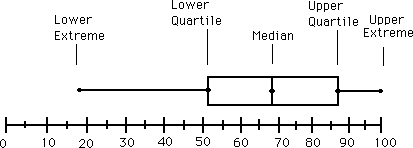
calculation: action, process, or result of a
mathematical computation
causation: an action that produces an effect
Celsius: metric measurement of temperature (i.e., 32
degrees Celsius, 32°c)
census: data collected from every member of the
identified population
centimeter: a metric unit of length equivalent to 1/100
of a meter
chord of a circle: a segment joining any two points on the
circle
circle: a set of points in a plane equidistant from
a given point called the center
circle graph: a graph in which a circle is divided into
sectors in order to compare different parts of a data set to the entire set
(i.e., pie graph)
circumference: the perimeter of a circle
closure property: a set is closed under an operation if the
application of the operation on any members in the set always results in a
member of that set
coefficient: the numerical factor in an algebraic term
(i.e., in 7x, 7 is the co-efficient)
collinear: a set of points is said to be collinear if they lie on a single straight line
combinations: a group of unordered items or events taken
from a larger group (i.e., the number of three-person committees that can be
chosen from a group of 21)
common denominator: any nonzero number that is a multiple of
the denominators of two or more fractions
common factor: any number that is a factor of two or more
numbers (i.e., 4 is a common factor of 8 and 12)
common multiple: a term that contains two or more terms as
factors
commutative property: the property in addition and multiplication
that states the order in which two terms are added or multiplied does not
change the results. For real numbers a and b, a + b = b + a
and ab = ba
complementary angles: two angles, the sum of whose measures is
90°
complex fraction: a fraction that contains one or more
fractions in the numerator or denominator
complex number: a number that can be written in the form a
+ bi, where a and b are real numbers and i is the imaginary
number, 
composite number: a number that has more than two numerical
factors
concave polygon: a polygon with one or more diagonals that
have points outside the polygon
conclusion: the then clause of a conditional
statement
conditional statement: a statement in “if-then” form where the
“if” clause is called the hypothesis and the “then” clause is called the
conclusion
cone: a three-dimensional figure generated by rotating a right triangle about
one of its legs
concrete objects: physical objects used to represent
mathematical situations
congruent: coinciding exactly when superimposed
conjecture: an unproven statement based on observations
consecutive: in order, with nothing missing
consecutive exterior angles: angles formed by a transversal intersecting
two lines; angles on the same side of the transversal, having two different
vertices, and outside the two lines; if the two lines are parallel, the same
side exterior angles are supplementary
consecutive interior angles: angles formed by a transversal intersecting
two lines: angles on the same side of the transversal, having two different
vertices, and inside the two lines; if the two lines are parallel, the same
side interior angles are supplementary
constant: a quantity that always stays the same
construct: a conclusion or result built or put
together systematically
contextual situation: relating a mathematical problem to a real
modeled or illustrated circumstance
continuous data: data in which there are no gaps, jumps or
holes; data that can be measured and broken down into smaller parts and still
have meaning; temperature and time are continuous
contrapositive of a statement: a new statement obtained by exchanging the
negation of the conclusion with the negation of the hypothesis of a conditional
statement
converse of a statement: a new statement obtained by exchanging the
hypothesis and the conclusion of a conditional statement
convex polygon: a polygon with each interior angle
measuring less than 180º; all diagonals
of a convex polygon lie inside the polygon
coordinate system (Cartesian): a two dimensional system in which the
coordinates of a point are its distances from the origin, the intersection of
the x and y axes
coordinates of a point: an ordered pair of real numbers that
locates a point in a plane
coplanar: in the same plane
correlation: an association between two variables
corresponding angles: angles formed by a transversal intersecting
two lines; angles on the same side of the transversal, having two different
vertices, and in the same relative position; if the two lines are parallel, the
corresponding angles are congruent
cosine: in a right triangle, the ratio of the
length of the leg adjacent to an acute angle to the length of the hypotenuse
counterexample: an example that shows that a conjecture is
not always true
counting numbers: the set of numbers consisting of 1, 2, 3,
4, 5, 6, ... (natural numbers)
cube: the third power of a number; a regular 3-dimensional figure having six
congruent square faces
customary system of measurement: the measuring system used most often in the
cylinder: a 3-dimensional figure composed of two
congruent and parallel circular regions joined by a curved surface
data: information gathered by observation, questioning or measurement,
usually expressed with numbers
data sets: a defined group of information, especially
numerical
decimal number system: a place value number system based on
groupings by powers of ten
decimal point: the point used to write values less than
one in the base ten number system
deductive reasoning: a series of logical steps in which a
conclusion is drawn directly from a set of statements (premises) that are
assumed to be true
degree: a unit of measure for angles based on
dividing a circle into 360 equal parts; or a unit of measure for temperature
denominator: the number of equal parts into which a
whole is divided (i.e., in the fraction ¾, 4 is the denominator)
density property: between any pair of rational numbers there
is another number
dependent events: two events in which the outcome of the
second event is affected by the outcome of the first event
dependent variable: in a function, the variable that is
determined by the value of the related independent variable
descending: an order in which numbers or terms are
organized in decreasing value
diagonal: a line segment joining two non-adjacent
vertices of a polygon
diameter: a chord that contains the center of the
circle
difference: the result of a subtraction
digit: in the base ten numeration system, one of the symbols 0, 1, 2, 3, 4, 5,
6, 7, 8, 9
digital clock: a device for telling time, makes jumps from
number to number ( digital clocks usually use numbers with a colon separating
the hour from the minutes,
dilation: a transformation that either enlarges or
reduces a geometric figure proportionately
dimension: a measure in one direction (i.e., length or
width)
discrete data: involves a count of data items that can’t
be broken down into smaller units, such as number of defects, people, or items
discrete mathematics: the study of mathematics dealing with
objects that can assume only certain “discrete” values; discrete objects can be characterized by
integers whereas continuous objects require real numbers
dissection: to separate into parts, usually equal
distance: the length of the shortest line segment
joining two points
distance formula: a formula used to find the distance between
two points identified by their ordered pairs:

distortions of sets of data: the use of incorrect proportion, design
variation in comparing to sets of data, lack of context or insignificant data
used in direct comparison with meaningful data
distributive property: the distributive property of multiplication
over addition or subtraction is a multiplication of a group of terms such that
the multiplier is multiplied by each and every term in the group a, b, and c, a(b + c) = ab + ac and a(b - c)
= ab –ac
dividend: in a division problem, the quantity to be
divided
divisibility: one whole number is divisible by another
whole number if the result of the division is a whole number without a
remainder
division: a mathematical operation based on
separating into equal parts
divisor: in a division problem, the quantity by
which another quantity is divided
domain: the set of values for the independent
variable of a function (i.e., usually, the x values of a function)
edge of a polyhedron: a line segment where two faces of a
polyhedron meet
edge (vertex-edge graph): the path that joins two vertices
elapsed time: time between two events
ellipsis: the mark
“…” to indicate the continuance of a pattern
empty set: a set that contains no elements
endpoint: the point at either end of a line segment;
also, the initial point of a ray
equation: a mathematical sentence in which equivalent
values are separated by an equal sign
equivalent: equal in value, but in a different form
equilateral triangle: a triangle with three congruent sides
estimate: a close rather than exact answer
evaluate: to find the numerical value of a
mathematical expression
even number: an integer that is divisible by two without
a remainder
event: one of the many occurrences that can take place during a probability
activity
expanded notation: a way to write numbers that shows the place
value of each digit. (i.e., 343 = 300+40+3)
experimental (empirical)
probability: relating to the
outcomes of an actual performance of a probability activity
exponent: a number placed to the right of and above a
non-zero base that indicates how many times the base is used as a factor; a
base with a zero exponent is equal to 1 (i.e.,  ,
,  and
and  )
)
exponential function: a function commonly used to study growth
and decay; it has a form y = ax
expression: a mathematical phrase containing one or
more terms linked by operation symbols
face of a polyhedron: a flat surface on a 3-dimensional object
fact family: a collection of related addition and
subtraction facts, or multiplication and division facts, made from the same
numbers
factor (noun): a number or expression that evenly divides
another quantity (i.e., 4 is a factor of 12; and (x + l) is a factor of x2
+ 3x + 2)
factor (verb): to represent a number as a product of
factors
Fahrenheit: the customary scale system for temperature
measurement (32°F)
finite set: a set that contains a countable number of
elements
formula: a general mathematical rule using variables
fractal: an algebraically generated complex
geometric shape having the property of being endlessly self-similar under
magnification
fraction: a number in the form  , where b is not zero
fractional part: part of a whole or part of a group that is
less than a whole
frequency table: a collection of data that specifies the number
of occurrences in each of several categories
function: (input – output) a dependent relationship
between two sets of numbers in which a value in the first set determines one
and only one element in the second set
geometric model: a model of mathematical concepts using
geometric representations
geometric sequence: a set of ordered terms in which the ratio
between consecutive terms is constant
geometric solid: a 3-dimensional shape bounded by surfaces
(i.e., rectangular prism, pyramid, cylinder, cone, and sphere)
graph: a pictorial device that shows a relationship between variables or sets
of data
greatest common factor: largest factor that two or more numbers
have in common (GFC) (i.e., the GFC of 8 and 12 is 4)
grouping symbols: symbols of inclusion; parentheses,
brackets, braces or bars (i.e., ( )
, [
] , {} , ̅ )
height: the perpendicular distance to a base from a
vertex or between bases
histogram: a vertical bar graph with each bar
representing a certain interval of data
horizontal: parallel to or in the plane of the horizon; in a coordinate grid, the x-axis is a
horizontal line
hypotenuse: the side opposite the right angle in a
right triangle
hypothesis: the if clause of a conditional
statement
identity element: a number when used in an operation with a
given number leaves the given number unchanged;
the identity element for addition is zero; the identity element for
multiplication is 1
image: a figure created as the result of a transformation
imaginary numbers: the square root of a negative number
expressed using i ( )
)
improper fraction: a fraction in which the numerator is
greater than the denominator
independent events: two events in which the outcome of the
second event does not related to the outcome of the first event
indirect proof: a deductive proof using contradiction or
elimination to rule out all possible conclusions except the desired one
inductive reasoning: making a generalization based on
observation of specific cases or patterns (i.e., formulating a rule after
considering several parts of a pattern)
inequality: a statement indicating that two quantities
are not equal
inference: a conclusion drawn from data
infinite set: the set in which the number of elements
cannot be counted or determined (never ending)
inscribed angles: an angle with its vertex on the circle and
with sides that are chords of the circle
integers: the set of numbers consisting of the whole
numbers and their opposites … -2, -1, 0, 1, 2 …
interval: the set of numbers between two numbers a
and b; the interval may include a or b
inverse operation: a related but opposite process (i.e.,
multiplication is the inverse of division)
inverse of a statement: a new statement obtained by negating both
the hypothesis and the conclusion of a conditional statement
irrational numbers: a set of numbers that cannot be expressed
as a ratio of two integers (i.e.,  )
)
isosceles triangle: a triangle that has at least two congruent
sides
iterative pattern: a pattern generated by using an initial value and repeatedly applying an operation (i.e., 4,7,10,13, is adding 3 each time)
kite: a quadrilateral with two distinct pairs of adjacent, congruent sides
lateral surface: in a prism or a pyramid, it is the face
that is not a base
least common multiple: the smallest number for which two or more
numbers are factors (i.e., the LCM of 3, 4, and 6 is 12)
line: an undefined geometric term; a straight path that extends infinitely in
opposite directions; a line that has no thickness
line graph: a graph in which points are connected by
line segments to represent data
line of best fit: a line drawn on a scatter plot to estimate
the relationship between two sets variables in a set of data
line of symmetry: a line that divides a figure into two
congruent parts that are mirror images of each other
line plots: a sketch of data in which check marks, x’s,
or other marks above a number line shows the frequency of each value
line segment: a part of a line that consists of two
points, called endpoints, and all the points between them
linear equation: a polynomial equation containing one or
more terms in which the variable is raised to the power of one but no
higher
linear function: a function that has a constant rate of
change and can be modeled by a straight line
liter: a metric unit of capacity, equal to the volume of a cube that measures
ten centimeters on a side
logic: a system of reasoning used to validate arguments
lowest common denominator: the least common multiple of the
denominators of every fraction in a given collection of fractions
magnitude: size or quantity
manipulatives: a wide variety of physical materials,
objects, and supplies that students use to foster the learning of abstract
ideas in mathematics
matrix: a rectangular array of numbers or letters
arranged in rows and columns (matrices)
mass: matter within an object
maximum: the greatest value
mean: a measure of central tendency where the sum of a set of numbers is
divided by the number of elements in the set; often referred to as the average
measures of central tendency: numbers that communicate the
"center" or "middle" of a set of data. The mean, median,
and mode are statistical measures of central tendency.
median: a measure of central tendency that
identifies a value such that half the data is above the value and half the data
is below the value when the data is listed in order
metric system of measurement: a measurement system based on the base-ten
numeration system (i.e., meter, liter, gram)
midpoint: a point on a geometric figure halfway
between two points
minimum: the least value
minuend: in subtraction, the minuend is the number
from which you are subtracting
ex. 90,000
minuend
-3,456 subtrahend
86,544
difference
mixed number: a number that is equal to the sum of a
whole number and a fraction
mode: a measure of central tendency that is the value or values that occurs
most frequently in a given set of numbers
model (noun): a representation of concrete materials,
objects or drawings
model (verb): use of concrete materials and the use of
the symbolic
monomial: an expression consisting of a single term
(i.e., 5y)
multiple of a number: a number into which the given number may be
divided with no remainder
multiplication: the operation of repeated addition (i.e., 4
x 3 is the same as 4+4+4)
natural numbers: the set of counting numbers consisting of
1, 2, 3, 4, 5, 6...
negative number: a number less than zero
net of a polyhedron: a two-dimensional representation of the
surface of a three-dimensional figure that has been unfolded
normal curve: in statistics, the distribution of data
along a bell-shaped curve that reaches its maximum height at the mean
normal distribution: a “bell-shaped” probability
distribution; there are as many values
that are less than the mean as there are values that are greater than the mean
number line: a diagram that represents numbers as points
on a line with a uniform scale
number sentence: an equation or inequality with numbers
numerator: the number or expression written above the
line in a fraction; it tells how many
equal parts of a total number of parts are described by a fraction
obtuse angle: an angle whose measure is greater than 90°
and less than 180°
octagon: a polygon with eight sides
odd number: an integer that is not divisible by two
open sentence: a statement that contains at least one
unknown (i.e., 6 + x = 14)
operation: an action performed on some set of
quantities (i.e., addition, raising to a power)
order of operations: the sequence in which operations are
performed when evaluating an expression
ordered pair: a pair of numbers used to locate points in
the coordinate plane
ordinal number: a whole number that names the position of
an object in a sequence
origin: the intersection of the x- and y-axes
in a coordinate plane; the origin is described by the ordered pair (0,0)
outcome: one of the possible events in a probability
situation
outcome set: set of all outcomes of a given situation
outliers/extreme values: numerical data piece that are significantly
larger or smaller than the rest of the data in a set
parallel lines: lines in the same plane that never
intersect and are always the same distance apart
parallelogram: a quadrilateral with opposite sides
parallel and congruent
pattern: a set or sequence of shapes or numbers that
are repeated in a predictable manner
pentagon: a polygon with five sides
percent: a ratio that compares a number to 100 ( % )
perfect square: a whole number whose square root is a whole
number
perimeter: the distance around a shape or figure
permutation: an ordered arrangement of a set of events
or items (if you put the items or events into a different order, you have a
different permutation)
perpendicular lines: two lines that intersect to form right
angles
pi: the ratio of the circumference of a circle to its diameter. Pi is an
irrational number and approximately equal to 3.14 or 

pictograph: a graph that uses pictures or symbols to
represent data
place value: the value of the position of a digit in a
numeral
plane: an undefined geometric term; a flat surface that extends infinitely in
all directions
point: an undefined geometric term; denotes an exact location in space; a
point has no size
polygon: a closed 2-dimensional figure made up of
segments, called sides, which intersect only at their endpoints, called
vertices
polyhedron: a closed 3-dimensional figure in which all
the surfaces are polygons
population: in statistics, an entire set of objects,
observations, or scores that have something in common
postulate: a mathematical statement that is accepted
as true without proof
power: a number with a base and an exponent
predictions: use of base information to produce an
approximation of change or result
pre-image: a picture or object before it undergoes a
transformation
premise: a statement that is given to be true
prime number: a positive integer that has exactly two
different positive factors, itself and one; one is not a prime number
prime factorization: a composite number expressed as the product
of factors that are prime numbers
prism: 3-dimensional figures that have two congruent and parallel face that
are polygons; the remaining faces are parallelograms
probability: the measure of the likelihood of an event
occurring
product: the result of multiplication
proof: a logical argument that shows why a statement must be true
proper fraction: a fraction whose numerator is an integer
smaller than its integral denominator
properties of operations: mathematical principals that are always
true (i.e., commutative, associative, distributive and inverses)
proportion: the statement of equality between two
ratios
proportionality: the concept of having equivalent ratios
pyramid: a 3-dimensional figure whose base is a
polygon and who’s other faces are triangles that share a common vertex
Pythagorean theorem: in a right triangle, the sum of the squares
of the lengths of the legs is equal to the square of the length of the
hypotenuse (a²+b²= c²)
quadrant: one of the four sections into which the
coordinate plane is divided by the x- and y-axes
quadratic equation: a polynomial equation containing one or
more terms in which the variable is raised to the second power but no higher
quadratic formula: the formula used to find the roots of
quadratic equations; 
quadratic function: a function that has an equation of the
form:  ; a function
of degree two
; a function
of degree two
quadrilateral: a polygon with four sides
quartiles: the quartiles divide an ordered set of data
into four groups of the same size
quotient: the result of division of one quantity by
another (dividend ÷ divisor = quotient)
radius of a circle: a segment whose endpoints are the center of
the circle and a point on the circle (radii)
random sample: each item or element of the population has
an equal chance of being chosen as part of a sample of the population
range: the set of output values for a function
range (of data set): the difference between the greatest and
least number in a set of numbers
rate: a ratio comparing two different units (i.e., miles per hour or cents
per pound)
ratio: a comparison of two values by division; a ratio can be expressed as a
to b, , or a:b
rational number: a number that can be expressed as a ratio
of two integers
ray: a geometric figure that extends infinitely along a straight path from a
point, called its endpoint
real numbers: the set of numbers combining rational and
irrational numbers
reasonable estimations: approximations based on mathematical
reasoning that are with in the desired degree of accuracy (i.e., 35+43= reasonable estimation would be
75 or 80 not 100 or 700)
reciprocals: two numbers whose product is equal to one
(multiplicative inverses)
rectangle: a quadrilateral with two pairs of
congruent, parallel sides and four right angles (square, parallelogram,
quadrilateral, polygon)
recursive pattern: a pattern that uses the solution from
previous steps to generate the solution to the next step. (i.e.,
2,2,4,6,10,16…)
reflection: a transformation creating a mirror image of
a figure on the opposite side of a line
reflex angle: an angle that is greater than 180° and less
than 360°
reflexive property: the property that states a quantity is
equal to itself; the property that states an object is congruent to itself
regular polygon: a convex polygon in which the angles are
equiangular and sides are equilateral
rhombus: a parallelogram with four congruent sides.
(plural: rhombi)
right angle: an angle whose measure is 90°
right triangle: a triangle that contains a right angle
root: the inverse of a power
rotation: a transformation in which a figure is
turned a given angle and direction around a point
rounding: approximating a number by analyzing a specific
place value
sample: a part of the total population; used in
statistics to make predictions about the characteristics of the entire group
sample space: a list of all possible outcomes of an
activity
scale: (1) an instrument used for weighing; (2) a system of marks at fixed
intervals used in measurement or graphing
scale factor: the ratio between the lengths of
corresponding sides of two similar figures
scalene triangle: a triangle with no sides the same length
and no congruent angles
scatter plot: a graph of the points representing a
collection of data
scientific notation: a form of writing a number expressed as a
power of 10 and a decimal number greater than or equal to one and less than ten
secant: a line that intersects a circle at exactly two
points; a line that contains a chord of a circle
sector: a region defined by a central angle and an
arc
signed number: a positive or negative number
similar figures: figures that are the same shape but not
necessarily the same size
sine: in a right triangle, the ratio of the length of the leg opposite the
given angle to the hypotenuse
skip counting: counting by equal intervals (i.e., 2,4,6…
or 4,8,12…)
slope of a line: the measure of steepness of a line; the ratio of rise over run; or change in y
over change in x
solid: a 3-dimensional figure
solution: a value for a variable that makes an
equation or inequality true
solution set: a set consisting of all values that make an
equation or inequality true
space: the set of all possible points
sphere: a 3-dimensional figure made up of all
points in space equidistant from a given point called the center
square: a parallelogram with four congruent sides
and four right angles
square root: one of the two equal factors of a number
standard notation: a number written with one digit for each
place value in base ten; the most
familiar way of representing whole numbers, integers, and decimals is standard
notation (i.e., three hundred fifty six is 356)
statistics: the collection, organization, description
and analysis of data; statistics are quantitative data
stem-and-leaf plot: a display of data in which digits with
larger place values (10’s) are “stems” and digits with smaller place values
(1’s) are “leaves”
straight angle: an angle whose measure is 180°; it is
formed by two opposite rays
subscript: a number written to the right of and
slightly below a term; usually used for indexing
substitution property: the property that allows equal values to
replace each other
subtraction: a mathematical operation that gives the
difference between two numbers;
subtraction also is used to compare two numbers or sets
subtrahend: in subtraction, the subtrahend is the
number being subtracted
750
minuend
- 84
subtrahend
666
difference
sum: the result of an addition
supplementary angles: two angles the sum of whose measures is
180°
surface area: the total area of the faces (including the
bases) and curved surfaces of a three-dimensional figure
symbol: a sign or token used to represent
something, such as an operation, quantity, or relation
symmetric property: the property that states for real numbers a
and b, if a = b, then b = a
symmetry: a correspondence in size, form, and
arrangement of parts, related to a plane, line, or point; for example, a figure
that has line symmetry has two halves that coincide if folded along a line of
symmetry
system of equations: a set of two or more equations with the same number of unknowns
tangent: in a right triangle, the ratio of the
length of the leg opposite an acute angle to the leg adjacent to the acute
angle
tangent to a circle: a line in the plane of a circle that
touches a circle in exactly one point (tangent line)
t-chart: a mathematical organizer to display and
record data, patterns, or functions/rules in an organized way
term: a product or quotient of numerals or variables or both; terms are
separated by plus or minus signs in an expression
terminating decimal: a decimal that contains a finite number of
digits
tessellation: a covering of a plane without overlaps or
gaps using combinations of congruent figures
theorem: a mathematical statement or proposition
derived from previously accepted results
theoretical probability: the probability of an event without doing
an experiment or analyzing data
transformation: an operation that creates an image from an
original figure or pre-image
transitive property: the property that states for real numbers a,
b, and c, if a = b and b = c, then a
= c or if a > b and b > c then, a
> c or if a < b and b < c, then a
< c
translation: a transformation that moves every point on
a figure a given distance in a given direction
transversal: a line that intersects two or more lines in
a plane at different points
trapezoid: a quadrilateral that has exactly one pair
of parallel sides
Tree diagram: a tree diagram used to find all the
possible permutations for a set of items or the prime factorization of a number
of a number
trend: the general drift, tendency, or direction of a data
trend line: a line that represents a general pattern
for a set of data
triangle: a polygon with three sides
trigonometric ratios: the ratios of the lengths of pairs of sides
in a right triangle (i.e., sine, cosine and tangent)
unit fraction: a fraction with a numerator of one
unit price: the price of something for one unit of
measure
valid argument: an argument that is correctly inferred or
deduced from a premise
variability: numbers that describe how spread out a set
of data is (i.e., range and quartile)
variable: a symbol that represents a quantity
venn diagram: a representation that uses circles to show
relationships between sets
vertical: at right angles to the horizon
volume: the measure of the capacity of a
three-dimensional figure, measured in cubic units
whole: the entire object, collection of objects, or quantity being considered
whole numbers: the set of numbers consisting of the
counting numbers and zero (i.e., 0, 1,
2, 3 . . . )
x-intercept: the coordinate at which the graph of a line
intersects the x-axis
y-intercept: the coordinate at which the graph of a line intersects the y-axis
Mathematical/Logical (Science)
abiotic: nonliving
absorb: to take up (e.g., plant roots absorb water)
adaptation: hereditary features of organisms that allow
them to live in a particular environment
affect: to have an influence on
applied science: research aimed at answering questions that
have practical applications, e.g., determining the causes of diseases so that
cures might be found
asteroid: small rocky body orbiting the Sun
atmosphere: gaseous envelope surrounding the Earth
atom: smallest particle of an element that retains the chemical nature of the
element
barometric pressure: atmospheric pressure as indicated by a
barometer, used especially in weather forecasting
basic science: research designed to describe or explain
nature to satisfy one's curiosity
bias: statistical sampling or testing error caused by systematically favoring
some outcomes over others
biodiversity:
1.
number and variety of organisms found within a specified geographic
region
2.
variability among organisms, including the variability within and between
species and within and between ecosystems
biome: broad area of the Earth's surface characterized by distinctive
vegetation and associated animal life; e.g., broad-leaf forest biome, grassland
biome, desert biome
calorimetric: relating to the measurement of heat energy
by means of temperature measurements
camouflage: concealment by disguise or protective
coloring
carrying capacity: maximum number of individuals that a given
environment can support for a sustained period of time
catalyst: substance, usually used in small amounts
relative to the reactants, that modifies and increases the rate of a reaction
without being consumed in the process
cellular respiration: metabolic processes which break down
nutrients into usable energy
circuit:
1.
closed path followed or capable of being followed by an electric current
2.
configuration of electrically or electromagnetically connected components
or devices
cirrus: high-altitude cloud composed of narrow
bands or patches of thin, generally white, fleecy parts
characteristic: distinguishing trait, feature, quality, or
property
cladistics: system of classification that constructs
evolutionary trees, showing how shared derived characters can be used to reveal
degrees of evolutionary relationships between existing and extinct species
classification system: method of organization of objects or
organisms using distinct characteristics or features
classify: to arrange or organize according to class
or category
climate: average course or condition of the weather
at a place usually over a period of years as exhibited by temperature, wind
velocity and precipitation
comet: body of dust, ice, and gas, which orbits the Sun; the orbit is usually
highly elliptical or even parabolic
community: group of plants and animals living and
interacting with one another in a specific region under relatively similar
environmental conditions
compound: substance formed from two or more elements
chemically united in fixed proportions
conduction: process by which heat or electrical energy
is transmitted through a material or body without gross motion of the medium
itself
conifer: any of various mostly needle-leaved or
scale-leaved, chiefly evergreen, cone-bearing gymnosperm trees or shrubs such
as pines, spruces, and firs
conservation:
Life science: the
protection, preservation, management, or restoration of wildlife and of natural
resources such as forests, soil, and water, to prevent exploitation,
destruction or neglect
Physical science: a
unifying principle of constancy of a quantity under specified conditions
constellation: formation of stars perceived as a figure or
design, especially one of 88 recognized groups named after characters from
classical mythology and various common animals and objects
consumer: organisms requiring complex organic
compounds for food, which is obtained by preying on other organisms or by
eating particles of organic matter
contrail: artificial cloud created by an aircraft,
caused either by condensation due to the reduction in air pressure above the
wing surface, or by water vapor in the engine exhaust
controlled investigation: investigation in which all but one variable
remain constant
convection: transfer of heat energy in a gas or liquid
by the circulation of currents of matter from one region to another
cumulus: dense, white, fluffy, flat-based cloud with
a multiple rounded top and a well-defined outline, usually formed by the ascent
of thermally unstable air masses
data: factual information, from observations, organized for analysis
decomposer: organisms such as bacteria and fungi that
feed and break down dead organisms, returning constituents of organic
substances to the environment
deformation: alteration of shape, as by pressure or
stress
deposition
1.
act of depositing, especially the laying down of matter by a natural
process
2.
something deposited; a deposit
distinguish: to perceive or indicate differences;
discriminate
dominant: of, relating to, or being an allele that
produces the same phenotypic effect whether inherited with a homozygous or
heterozygous allele
DNA: (Deoxyribonucleic acid) double strand of nucleotides that is a
self-replicating molecule present in living organisms as the main constituent
of chromosomes; contains the genetic code and transmits the heredity pattern
ecology: study of the interactions and relationships
between and among organisms and their environment
ecosystem: all the organisms in a given area and the
abiotic factors with which they interact
eclipse: partial or complete obscuring, relative to
a designated observer, of one celestial body by another
electron: negatively charged fundamental particle in
an atom
element: any of more than 100 fundamental substances
that consist of atoms of only one atomic number and that singly or in
combination constitute all matter
environment: sum of all external conditions affecting
the life, development and survival of an organism, including the biotic
(living) and abiotic (non-living) elements
erosion: group of natural processes, including
weathering, dissolution, abrasion, corrosion, and transportation, by which
material is worn away from the Earth's surface
eukaryotic: referring to a cell with a nucleus and
other internal structure
experimentation: act of conducting a controlled test or
investigation
extinct: no longer in existence
fertilization:
1.
act or process of initiating biological reproduction by insemination or
pollination
2.
union of male and female gametes to form a zygote
food chain: arrangement of the organisms of an
ecological community according to the order of predation in which each uses the
next as a food source
food web: totality of interacting food chains in an
ecological community
force:
K-6: push
or pull that changes the motion or shape of an object
7- HS: vector quantity that
tends to produce an acceleration of a body in the direction of its
application
formulate: to devise or invent
frequency: ratio of the number of times an event
occurs in a series of trials of a chance experiment to the number of trials of
the experiment performed; the number of cycles an oscillating system executes
in one second
friction: force that resists relative motion between
two bodies in contact
front (weather): interface between air masses of different
temperatures or densities
gas: state of matter that does not have a definite shape or volume and is
much less dense than a liquid because its molecules are far apart compared to
their diameters
genotype: particular combination of genes in an
organism
gravitation: universal force by which every body in the
universe attracts every other body
gravity: attraction of the mass of the Earth, the
Moon or a planet for bodies at or near its surface
greenhouse gas: atmospheric gas such as carbon dioxide,
water vapor, and methane that allows incoming sunlight to pass through but
absorbs infrared radiation radiated back from the Earth's surface, leading to
the phenomenon whereby the Earth's atmosphere traps solar radiation
guided investigation: teacher-directed investigation
habitat: place or environment where a plant or
animal naturally or normally lives and grows
hazardous waste: substance, such as nuclear waste or an
industrial byproduct, that is potentially damaging to the environment and
harmful to humans and other organisms
heredity: genetic transmission of characteristics
from parent to offspring
heterogeneous: consisting of dissimilar elements or parts
homogeneous: uniform in structure or composition
throughout
hydrosphere: aqueous envelope of the Earth, including
the oceans, all lakes, streams, and underground waters, ice, and the aqueous
vapor in the atmosphere
hypothesis:
K-5:
statement of an anticipated result of an investigation
6-HS: proposed relationship among observable
phenomena or an inferred explanation for those
phenomena
igneous: relating to, resulting from, or suggestive
of the intrusion or extrusion of magma or volcanic activity; rock formed from
molten magma
inorganic: involving neither organic life nor the
products of organic life
Chemistry: of or relating to compounds not containing
carbon
interdependence: state of organisms depending on each other
and the environment for survival
interpretation: explanation
interrelationships: interactions between two or more objects or
organisms
invertebrate: animal, such as an insect or mollusk, that
lacks a backbone or spinal column
investigation: inquiry, research, or systematic
examination
involuntary: not under the influence or control of the
will; not voluntary; as, the involuntary movements of the body (involuntary
muscle fibers)
isotope: any of two or more species of atoms of a chemical
element with the same atomic number and nearly identical chemical behavior, but
with differing atomic mass and mass number and different physical properties
law: statement that summarizes, identifies, or describes a relationship
among observable phenomena
lever: simple machine consisting of a rigid bar pivoted on a fixed point and
used to transmit force, as in raising or moving a weight at one end by pushing
down on the other
limiting factor: conditions or resources that control the
size of a population
liquid: state of matter that does not hold a
definite shape but occupies a definite volume because its molecules are in
close contact
lithosphere: outer part of the Earth, consisting of the
crust and upper mantle, approximately 100 km (62 mi.) thick
living: state of being alive
lunar: of, involving, caused by, or affecting the Moon
macroscopic: large enough to be perceived or examined by
the unaided eye; large compared to a microscopic object
mass: property of a body that is a measure of its inertia and causes it to
have weight in a gravitational field, that is commonly taken as a measure of
the amount of material it contains
matter: anything that possesses mass and occupies
volume
mean: average value of a set of numbers
meiosis: type of cell division that occurs during
the reproduction of diploid organisms to produce the gametes. The double set of
genes and chromosomes of the normal diploid cells is reduced during meiosis to
a single haploid set in the gametes. Crossing-over and, therefore,
recombination occur during a phase of meiosis
metamorphic: change in the constitution of rock;
specifically, a pronounced change affected by pressure, heat and water that
results in a more compact and more highly crystalline condition; a rock
produced by these processes
meteor: bright trail or streak that appears in the
sky when a meteoroid is heated to incandescence by friction with the Earth's
atmosphere; also called falling star, meteor burst, shooting star
microscopic: too small to be seen by the unaided eye but
large enough to be studied under a microscope; small compared to a macroscopic
object
mimicry: resemblance of one organism to another or
to an object in its surroundings for concealment and protection from predators
mitosis: cell division; cell division in
multicellular organisms occurs by mitosis except for the special division
called meiosis that generates the gametes
mixture: portion of matter consisting of two or more
components in varying proportions that retain their own properties
model: schematic description or representation of a system, theory, or
phenomenon that accounts for at least some of its known or inferred properties
and may be used for further study of its characteristics
molecule: smallest particle of a chemical substance
that retains all the properties of the substance and is composed of one or more
atoms
mutation: change of the DNA sequence within a gene or
chromosome of an organism
mutualism: close, prolonged association between organisms of two different species in which each member benefits; type of symbiotic relationship
natural selection: process by which, in a given environment,
individuals having characteristics that aid survival will produce more
offspring, so the proportion of individuals having such characteristics will
increase with each succeeding generation. Two mechanisms of natural selection
include:
gradualism -
slow genetic modification (evolution) of a population over long periods of
time· punctuated equilibrium -
relatively rapid evolution at a speciation event
neutron: uncharged elementary particle that has a
mass a little greater than that of the proton and is present in most atomic
nuclei
nonliving: objects that don’t reproduce, grow, react,
or use food
nonstandard units of measure: units of measurement based on everyday items
(e.g., hands, feet, pace, candy, potato, paper clip) used as a precursor to
learning and using standard units of measurement
mutualism: close, prolonged association between
organisms of two different species in which each member benefits
nucleus:
Physical
science: central region of an atom, which contains
more than 99% of the atom's mass
Life science:
cellular organelle in eukaryotes that contains most of the genetic
material
observation: event that is experienced personally or
enhanced through measurement or instruments
openness: mind set that allows a person to consider
explanations of a phenomena
organic: of, relating to, or derived from living
organisms
Chemistry:
having to do with carbon compounds
organism: living individual, such as a plant, animal, bacterium, protist, or
fungus; a body made up of organs, organelles, or other parts that work together
to carry on the various processes of life
periodic table: arrangement of the chemical elements by
atomic number, starting with hydrogen in the upper left-hand corner and
continuing in ascending order from left to right, arranged in columns according
to similar chemical properties
pH: numerical measure of the acidity or alkalinity of a chemical solution;
the negative of the logarithm of the hydrogen ion concentration
phenotype: physical or visible characteristics of an
organism that are determined by its genotype
photosynthesis: chemical process by which
chlorophyll-containing plants use light to convert carbon dioxide and water
into carbohydrates, releasing oxygen as a byproduct
pitch: aurally perceived property of a sound, especially a musical tone, that
is determined by the frequency of the waves producing it; highness or lowness
of sound
plane: flat or level surface
plate tectonics: theory that explains the global
distribution of geological phenomena such as seismicity, volcanism, continental
drift, and mountain building in terms of the formation, destruction, movement,
and interaction of the Earth's lithospheric plates; the theory that the earth’s crust is broken
into fragments (plates) which move in relation to one another, shifting
continents, forming new crust, and causing volcanic eruptions
population: group of organisms of the same species
living and reproducing in a particular habitat or geographic region
population density: number of organisms per unit area
precipitation: any form of water, such as rain, snow,
sleet, or hail, which falls to the Earth's surface
predict: to forecast a future occurrence based on
past observations or the extension of an idea
prediction: statement of an expected (future) outcome
of a planned test assuming that the hypothesis being tested is correct; to be
compared with observed result to test the hypothesis
preservation: to keep in perfect or unaltered condition;
maintain unchanged
probability: measure of the likelihood of an event
occurring
procedures: series of steps taken to accomplish an end
producer: organisms (e.g., green plants) that produce
their own organic compounds from simple precursors (such as carbon dioxide and
inorganic nitrogen), many of which are food sources for other organisms
prokaryotic: referring to a cell with no nucleus (e.g.,
a bacterium)
property: characteristic attribute possessed by all
members of a class
propose: to put forward for consideration,
discussion, or adoption
proton: stable subatomic particle occurring in all
atomic nuclei, with a positive electric charge equal in magnitude to that of an
electron
pulley: simple machine consisting of a wheel with a
grooved rim in which a pulled rope or chain can run to change the direction of
the pull and thereby lift a load
pure science: science for the pursuit of scientific
knowledge
qualitative: involving quality or kind
quantitative: involving the measurement of quantity or
amount
radiation:
Physical science: transfer
of energy by electromagnetic radiation; process of emitting energy in the form
of waves or particles (e.g., visible light, X-rays, alpha and beta radiation).
Life science: the
geographic spreading of a species
recessive: of, relating to, or designating an allele
that does not produce a characteristic effect when present with a dominant
allele
reflect: to throw or bend back (light, for example)
from a surface
refract: to deflect from a straight path undergone
by light or other wave in passing obliquely from one medium (e.g., air) into
another (e.g., glass) in which its speed is different
reliability: to yield the same or compatible results in
different clinical experiments or statistical trials
respiration: physical and chemical processes by which an
organism supplies its cells and tissues with the oxygen needed for metabolism
and relieves them of the carbon dioxide formed in energy-producing reactions
revolution: orbital motion about a point, especially as
distinguished from axial rotation
RNA: (Ribonucleic acid) nucleic acids that contains ribose and uracil as
structural components and is associated with the control of cellular chemical
activities
rotation: act or process of turning around a center
or an axis; the turning of a body part about its long axis as if on a pivot
sedimentary: of or relating to rocks formed by the
deposition of sediment
sexual: relating to, produced by, or involving
reproduction characterized by the union of male and female gametes
simple investigation: investigation involving a single variable
solid: body of definite shape and volume; not liquid or gaseous
species: class of individuals or objects grouped by
virtue of their common attributes and their ability to mate and produce fertile
offspring, and assigned a common name; a division subordinate to a genus
spectrophotometer: instrument used to determine the intensity
of various wavelengths in a spectrum of light
stimulus: object or event that causes a response
stratus: low-altitude cloud formation consisting of
a horizontal layer of clouds
structures: way in which parts are arranged or put
together to form a whole; makeup
Life science: arrangement or formation of the tissues,
organs, or other parts of an organism; an organ or other part of an organism
subsystem: component of a system (e.g., a solar system
is a subsystem of a galaxy)
symbiotic relationship: close, prolonged association between
organisms of two different species that may, but does not necessarily, benefit
each member; includes mutualism, commensalisms, and parasitism
system:
1.
group of body organs that together perform one or more vital functions
2. organized group of devices, parts or factors that together perform a function or drive a process (e.g., weather system, mechanical system)
technology: application of science, especially to
industrial or commercial objectives; tools and techniques
temperature: degree of hotness or coldness of a body or
environment
theory: collection of statements (conditions,
components, claims, postulates, propositions) that when taken together attempt
to explain a broad class of related phenomena; inferred explanations for
observable phenomena
transient: not regular or permanent
valid: correctly inferred or deduced from a premise
variable: characteristic with values (e.g., numbers,
colors, sizes) that differ from one object, event, or situation in a group to the
others; e.g., in a group of students, their heights differ, thus
"height" is a variable
Ø independent: manipulated variable in an experiment or
study whose presence or quantity determines the change in the dependent
variable
Ø dependent: observed variable in an experiment or study
whose changes are determined by the presence or quantity of one or more
independent variables
vector: representation of a quantity having both
magnitude and direction, such as velocity or force
velocity: rate of change of position and direction
with respect to time
Venn Diagram: representation that uses circles to show
relationships between sets
vertebrate: having a backbone or spinal column
viable: capable of living, developing, or
germinating under favorable conditions
volume: measure of the capacity of a
three-dimensional figure or object, measured in cubic units
voluntary: normally controlled by or subject to
individual volition, such as voluntary muscle contractions
weathering: effect of exposure to the action of the elements
wedge: piece of material, such as metal or wood, thick at one edge and tapered
to a thin edge at the other for insertion in a narrow crevice, used for
splitting, tightening, securing, or levering
wheel and axle: simple machine made up of two coaxial cylindrical objects of different size in which the axle (a small wheel) is attached to the center of a larger wheel; the wheel and axle must move together to be a simple machine; a wheel and axle lifts or moves loads
Processes
analyze: to examine methodically by separating into parts and studying their interrelations
classify: to arrange or organize according to category
compare: to examine in order to note the similarities or differences of
communicate: to convey information about; make known; express oneself in such a way that one is readily and clearly understood
conclusion: statement, or statements, that summarize the extent to which hypotheses have been supported or not supported
evaluate: to examine and judge carefully; appraise
infer: to conclude from evidence or premises
interpret: to explain the meaning of
justify: to demonstrate or prove to be just, right, or valid
measure: to ascertain the dimensions, quantity, or capacity of
observe: to be or become aware of, through one’s senses, and may include qualitative or quantitative data
predict: to forecast a future occurrence based on past observation or the extension of an idea
question: to ask
result: quantity or expression obtained by calculation
Musical
A-B/A-B-A Musical Forms: The
organization of sections of a musical work, represented by letters that depict
similar and contrasting sections. A-B refers to a work with two distinct parts:
A-B-A refers to a work with two distinct parts, the first of which is repeated
after performing the second.
A Cappella: “In the Chapel”;
term for choral music sung without instrumental accompaniment.
Accent: Giving prominence to
a specific musical note.
Accompaniment: A subordinate
vocal and/or instrumental part or parts added to a principal part or parts.
Acoustics: The science of
sound.
Aleatoric: Term applied to
music in which certain choices in composition or realization are, to a greater
or lesser extent, left to chance or whim.
Arpeggio: The notes of a
chord played one after another instead of simultaneously.
Articulation: The separation
of successive notes from one another, singly or in groups, by a performer, and
the manner in which this is done; the manner in which notes are performed.
Articulators: Lips, teeth,
tongue and throat when used to shape consonants, vowels, embouchure in vocal
music production.
Aural: Having to do with the
ear or the sense of hearing.
Beat: Unit of measure of
rhythmic time.
Blues (12-bar blues): A
secular black American folk music of the 20th century, related to,
but separate from, jazz. The term describes both the characteristic melancholy
state of mind and the eight-, 12-, and 32- bar harmonic progressions that form
the basis for blues improvisation; the most common is 12 bars long. The other
characteristic is the ‘blue note’, a microtonal flattening of the 3rd,
7th and (to a lesser extent) 5th scale degrees.
Call and Response: A structure that is most often associated with African musical forms, although it is also used elsewhere. One soloist/group performs with the second soloist/group entering “in response” to the first.
Canon: A musical form in which a melody is imitated exactly in one or more parts. Similar to a round.
Chord: Three or more tones sounded simultaneously.
Chord Progression: Succession of harmonic content in time (e.g., tonic-dominant, 12 bar blues).
Chromatic: Movement by half steps (e.g., c to c#).
Chromatic Scale: A scale of half steps with 12 tones to an octave.
Clef: A symbol written at the beginning of a musical staff indicating which notes are represented by which lines and spaces.
Composer: A person who writes compositions.
Composition: Creation of original music by organizing sound. Usually written for others to perform.
Conductor: A person who directs a group in the performance of music.
Coordinated Onset: Balance between the muscular activity of the vocal chords and the air pressure beneath them is exactly right for easy, efficient production of high-quality period.
Crescendo: Usual term for gradually increasing in volume.
Cues: Motions made by a conductor to assist a performing ensemble (e.g., give cut offs, entrances, dynamics, breaths).
Decrescendo: Usual term for gradually decreasing in volume.
Descant: An obbligato part that soars above the tune.
Detache: A board, vigorous stroke in which the notes of equal time value are bowed singly with a slight articulation owing to the rapid change of bow.
Diatonic Scale: The notes found with a major or minor scale.
Diction: Enunciation of words in singing.
Disjunct: A term applied to a melodic line that moves by leap rather than in conjunct motion (by step).
Dominant Chord: In tonal music, the chord built on the 5th degree of the scale.
Double Stops: On a string instrument, playing two notes simultaneously.
Dynamics: Varying degrees of volume in the performance of music.
Elements of Music: Melody, rhythm, harmony, pitch, dynamics, timbre, tempo, texture, form, text and/or lyrics.
Embouchure: The proper position of the lips in the playing of wind instruments.
Ensemble: A group of musicians.
Fermata: Pause.
Flautando: A flutelike effect produced by bowing very slightly over the fingerboard.
Form: The structure, shape or organizing principal of music.
Genre: A type or kind of musical work (e.g., opera, oratorio, art song, gospel, suite, jazz, madrigal, march, work song, lullaby, barbershop, Dixieland).
Glottal Onset or Stop: The glottal (stop) is the sound made when the vocal chords are pressed together to stop the flow of air then released, and is the sound in the middle of the interjection un-oh (e.g., for a glottal onset practice saying “egg”).
Harmonic: Pertaining to harmony.
Harmony: The combining of notes simultaneously.
Homophonic: Texture where voices or instruments sound together or in which all the parts move in the same rhythm.
Improvisation: Spontaneous creation of music.
Interval: The distance between two pitches.
Intonation: Singing or playing in tune.
Legato: To be played without any perceptible interruption between the notes.
Levels of difficulty: A classification system used by performing ensembles:
Level 1: very easy; easy keys, meters, and rhythms; limited ranges.
Level 2: easy; may include changes of tempo, key, and meter; modest ranges.
Level 3: moderately easy; contains moderate technical demands, expanded ranges, and varied interpretive requirements.
Level 4: moderately difficult; requires well-developed technical skills, attention to phrasing and interpretation, and ability to perform various meters and rhythms in a variety of keys.
Level 5: difficult; requires advanced technical and interpretive skills; contains key signatures with numerous sharps or flats, usual meters, complex rhythms, subtle dynamic requirements.
Level 6: very difficult; suitable for musically mature students of exceptional competence.
(adapted with permission from the New York State School Music Association (NYSSMA) Manual, 1991)
Major Key: Tonally, a key based on a major scale; a scale that contains the following step pattern: whole, whole. Half, whole, whole, whole, half.
Major Scale: A scale that contains the following step patterns: whole, whole, half, whole, whole, whole, half.
Martele: In string performance, a hammered stroke, an effect obtained by releasing each stroke forcefully and suddenly.
Melodic Minor: A minor scale that has the sixth and seventh scale degrees raised one half step while ascending, and in natural form while descending.
Melody: An organized sequence of single notes.
Meter: The grouping of rhythmic pulses or beats by which a piece of music is measured.
Meter Signature: An indicator of the meter of a musical work, usually presented in the form of a fraction; the denominator indicates the unit of measurement (note) and the numerator indicates the number of units (notes) that make up a measure.
Meters: The pattern of beats by which the timespan of a piece of music is measured.
Minor Key: Tonally, a key based on a minor scale; a scale that contains the following step pattern: whole, half, whole, whole, half, whole, whole.
Minor Scale: A scale that contains the following step patterns: whole, half, whole, whole, half, whole, whole.
Mode: The selection of tones arranged in a scale that form the basic tonal substance of a composition.
Modulation: Tonally, the change from one key or tonal center to another.
Motives: A short figure of characteristic design that recurs throughout a composition or section as a unifying element.
Natural Harmonic: String term describing high tones of a flute-like timbre that are produced by lightly touching the string at one of its nodes instead of pressing it down.
Notation: Method or methods used for writing down music.
Octave: A musical interval of 8 degrees or steps. Musical notes 8 steps apart carry the same letter name and sound similar due to their acoustical properties.
Onsets (see also glottal or coordinated): Referring to vocal sound production, the moment where phonation begins in the vocal folds, creating sound (e.g., for a glottal onset practice saying “egg”; or an aspirate onset, put an “h” in front of your tone; for a coordinated onset sing “meow” like a cat.
Ostinato: A rhythmic or melodic accompaniment figure repeated continuously.
Partner Songs: Two or more totally independent songs that have the same harmonic structure and can be sung together at the same time.
Pentatonic Scale: Tonally, a scale having five tones and containing no half steps. Most commonly: whole, whole, minor third, whole.
Phrase: A musical idea comparable to a sentence or a clause in language.
Phrasing: The clear and meaningful rendition of musical phrases.
Pitch: The location of a note related to its highness or lowness.
Pizzicato: Indication that the string is to be plucked with the finger.
Polyphonic: Music arranged for several voices or instruments in which parts enter individually at different times.
Ponticello: The bridge of a string instrument.
Position: String term describing the places on the fingerboard to which the left hand shifts in order to obtain higher or lower notes.
Range: The compass of an instrument or voice, or of a piece of music, from the lowest note to the highest; the interval between those notes.
Registration: Referring to vocal sound production, the term used to denote various theories of how the human voice changes, both subjectively and objectively, as it moves through its pitch range. This includes falsetto, head and chest voices.
Repertoire: A body or selection of musical works/pieces.
Resonance: The creation by a vibrating body of vibrations in another body. May refer to human singing and/or instrumental playing.
Rhythm: The combinations of long and short, even and uneven sounds that convey a sense of movement in time.
Ricochet: Throwing the bow on the string in the upper third of the bow so it will produce a rapid series of notes.
Ritardando: A gradual slowing of tempo.
Rondo Form: A musical form in which a section is repeated, with contrasting sections in between, such as ABACA. Musical example: Spring from Vivalidi’s The Four Seasons.
Rote: Performing a written piece of music by memory.
Round: Common name for a circle canon in which each musician returns from the conclusion of the melody to its beginning repeating it ad libitum.
Scale: The arrangement of notes in a specific order of intervals, normally whole or half steps.
Score: The organized notation of all of the instrumental and/or vocal parts of a composition. A score is normally vertically aligned so as to represent visually the musical coordination desired in performance.
Slur: A curved line placed above or below a group of notes to indicate that they are to be played legato.
Solfège: A system of designating verbal syllables for the degrees (steps or intervals) of a scale.
Staccato: A manner of performance indicated by a dot placed over a note calling for a reduction of its written duration.
Staff (Staves): A set of lines, on, between, above and below which notes are written. In Western music, a five-line staff has been the most widely used type since early 13th century.
Style: The style of a composition is its manner of treating form, melody, rhythm, counterpoint, harmony and tone color.
Sub-dominant Chord: In tonal music, the chord build on the 4th degree of the scale.
Syncopation: The placement of rhythmic accents on weak beats or weak portions of beats.
Tempo (Tempi): The pace at which music moves according to the speed of the underlying beat.
Tenuto: Held; sustained.
Texture: The musical element representing the different layers of horizontal and vertical sounds, usually with regard to the way individual parts or voices are put together (e.g., polyphonic, homophonic).
Timbre: Term describing the tonal quality of a sound; a clarinet and an oboe sounding the same note are said to produce different timbres.
Time Signature: The meter indicated at the beginning of a piece by two numbers.
Tonality (key): The tonal center of a composition.
Tonic/Tonic Chord: In tonal music, the chord built on the 1st note of the scale (the tonal center).
Transcribe: The writing down of music.
Transpose: To write or perform music in a different key.
Triad: A chord of three notes consisting of a root, a third and fifth above it.
Vibrato: A slight fluctuation of pitch.
Whole Tone Scale: A scale that
divides the scale into six equal, tempered whole tones.
“If you are worthy and fortunate,
somebody might endow you with that noblest of distinctions by calling you
‘teacher.’”
Guy R. McPherson, Letters to a Young Academic: Seeking
Teachable Moments